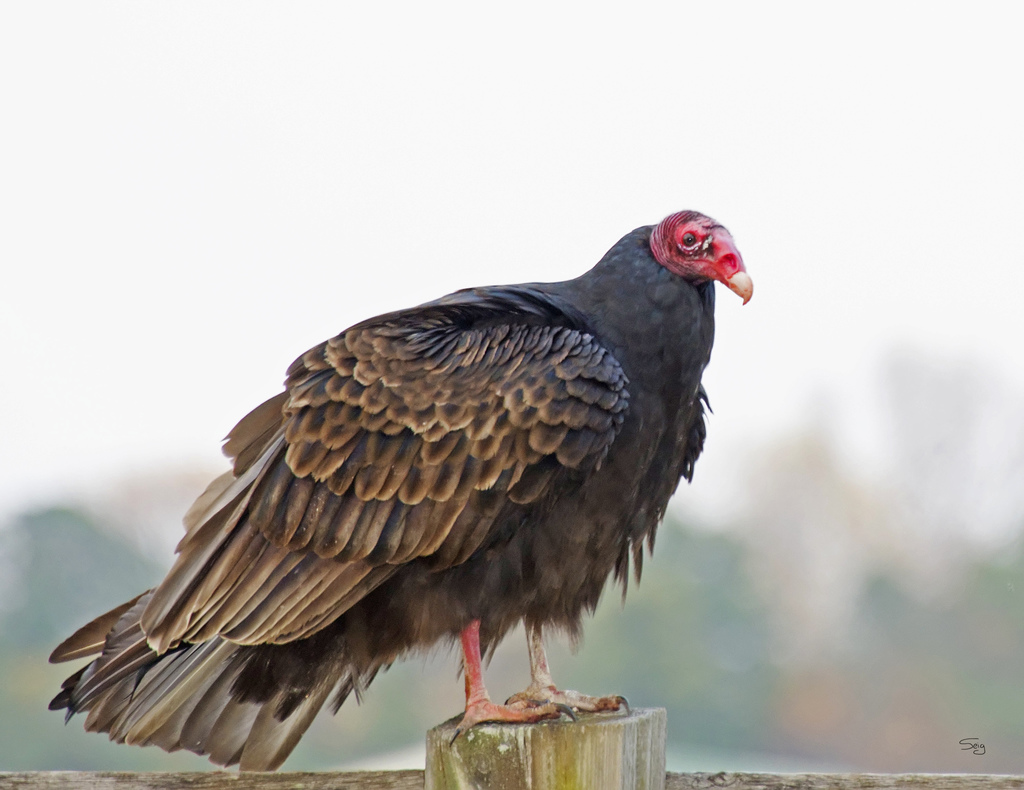
Turkey Vulture
Photo © Seig
Photo © Seig — CC BY 4.0 — Source: iNaturalist photo #52277010Identification
The turkey vulture is a large bird with a wingspan of 1.5–2 metres and a length of 62–81 centimetres. Its common name derives from the resemblance of the adult's bald red head and dark plumage to that of the male wild turkey. Birds in the northern limit of the species' range tend to be larger than those from the neotropics. Note that in North America this species is sometimes called a "buzzard" or "turkey buzzard"—terms that refer to different birds (genus Buteo) in the Old World. In some Caribbean regions it is known as the "John crow" or "carrion crow."
Range & Habitat
The turkey vulture is the most widely distributed vulture in the Americas, ranging from southern Canada to the southernmost tip of South America. It inhabits open and semi-open areas including subtropical forests, shrublands, pastures, and deserts. The species shows particular preferences for relatively open areas that adjoin woodland, which provide essential nesting and roosting sites. In North America, turkey vultures generally avoid enclosed forested areas that might hamper flight and tend to favour hill or low mountainous terrain where they can catch thermals with minimal effort.
Agricultural land—particularly pastureland and low-input farmland—provides key habitat for foraging and roosting. The species can be seen over grasslands and open country but is often absent from completely treeless areas such as parts of the prairies or Great Plains. Turkey vultures are regularly seen over urban areas throughout their range, though they use these more when not breeding, as they require appropriate nesting sites. Northern birds may migrate as far south as South America, while southern populations are permanent residents.
Behaviour & Diet
The turkey vulture is a scavenger that feeds almost exclusively on carrion. It locates food using keen eyesight and an exceptional sense of smell, flying low enough to detect the gases produced by decomposition in dead animals. In flight, the bird uses thermals to move through the air, flapping its wings only infrequently—a highly efficient hunting strategy.
Turkey vultures roost in large community groups and nest in caves, hollow trees, or thickets. Each year a pair typically raises two chicks, which they feed by regurgitation. Lacking a syrinx (the vocal organ found in most birds), their only vocalizations are grunts or low hisses. The species has very few natural predators, and in the United States it receives legal protection under the Migratory Bird Treaty Act of 1918.
Best Time & Places to See It
The turkey vulture is the most widespread of the New World vultures and rivals the black vulture as the most abundant raptorial bird worldwide, with a global population estimated at 18 million individuals. Its enormous range and preference for open and semi-open habitats make it visible across diverse landscapes throughout the Americas. Look for them soaring overhead in hill and mountainous areas, over agricultural lands, grasslands, and open country. In northern regions, spring and autumn migrations offer excellent viewing opportunities, while in the south the species is present year-round.
Photography Tips
The turkey vulture's large wingspan and thermalling behaviour make it an excellent subject for flight photography. Position yourself on hills or elevated terrain where thermals are strongest—the bird's preferred hunting grounds—to capture it soaring with minimal wing flaps. The distinctive red head and dark plumage are most visible when the bird passes overhead. Early morning and midday thermals provide the best opportunities to photograph birds in active flight. Agricultural and open grassland habitats offer the clearest skies and longest sightlines for capturing these graceful soarers.
Acadia National Park
Alerce Costero National Park
Algonquin Provincial Park
Alligator River National Wildlife Refuge
Amacayacu National Park
Amazônia National Park
Anavilhanas National Park
Antisana National Park
Araucárias National Park
Nothing matches these filters.
No community photos yet. Log in to add the first one.
No community observations of this species yet.