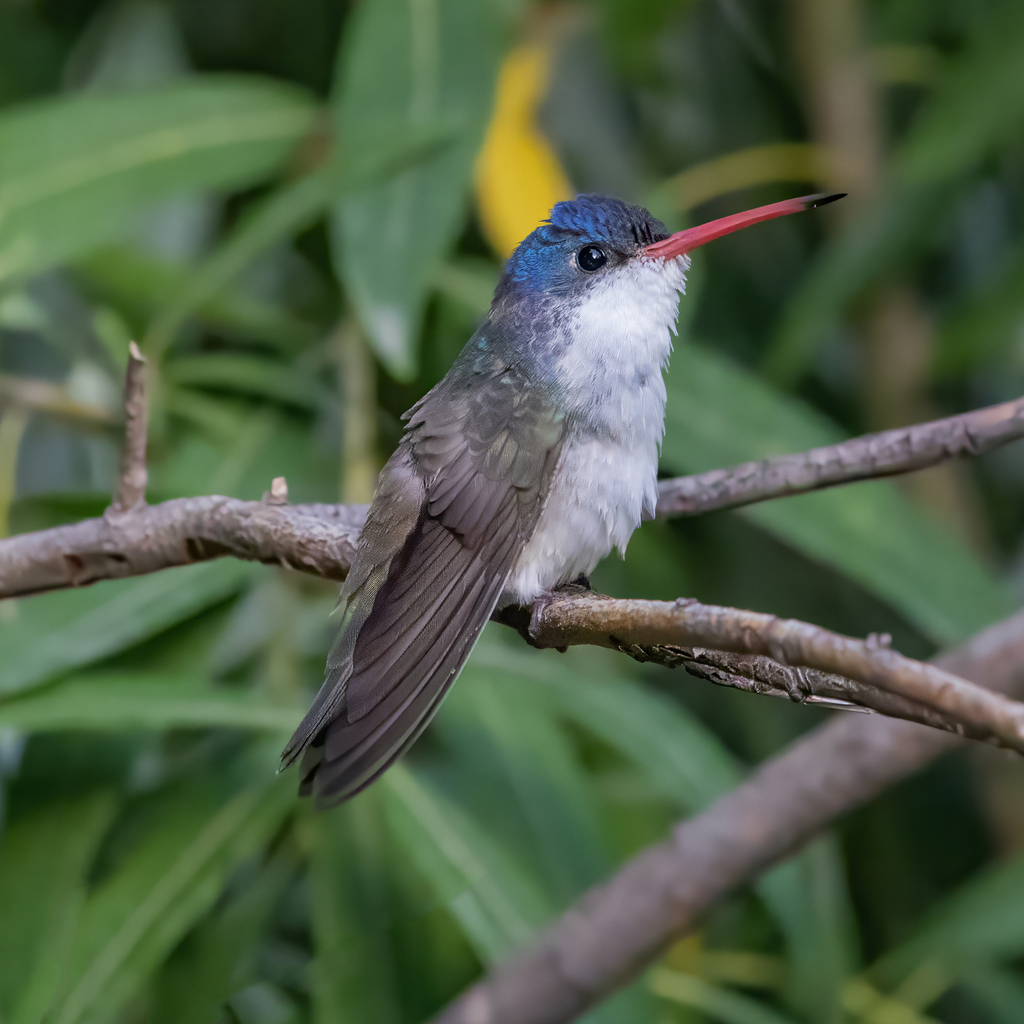
Violet-crowned Hummingbird
Photo © Dan Vickers
Photo © Dan Vickers — CC BY 4.0 — Source: iNaturalist #304386925Identification
The violet-crowned hummingbird is a small hummingbird measuring 10 to 11.5 cm long and weighing just 5.1 to 5.8 grams. Both sexes are remarkably similar, featuring a distinctive bright red bill (sometimes with a black tip) and pure white underparts from throat to undertail coverts. Males display an intense violet-blue crown and bluish-violet hindneck, with a dull grayish-brown to greenish-brown back and coppery-bronze tail. The subspecies R. v. ellioti, found in the northern part of the range, has a more turquoise-blue crown and greenish-bronze tail. Females are virtually identical to males but generally duller in coloration. Light olive-green flanks provide subtle contrast to the white underside.
Range & Habitat
This species occurs in Mexico and the southwestern United States, with two subspecies dividing the range. The northern subspecies, R. v. ellioti, ranges from southeastern Arizona and southwestern New Mexico south through Sonora, Chihuahua, and into central Mexico as far as Michoacán and Hidalgo. The nominate subspecies, R. v. violiceps, inhabits the southern portion from eastern Michoacán into northwestern Oaxaca. In the U.S., the species occurs between 1,200 and 1,700 meters elevation, though in Mexico it ranges from sea level to 2,400 meters. Violet-crowned hummingbirds favor diverse habitats including riparian corridors in thorn scrub, deciduous and pine-oak forests, fields, orchards, and urban and suburban gardens.
Behaviour & Diet
Populations in the United States and northern Mexico are mostly migratory, though some individuals overwinter in Arizona, and the species appears to be expanding its range northward. Southern populations are largely sedentary but make local movements to follow food resources. This species forages for nectar while hovering from a wide variety of flowering plants and shrubs. Where flowers are abundant, violet-crowned hummingbirds feed with minimal aggression; however, when flowers are scarce, they attempt to defend patches from smaller hummingbird species. In addition to nectar, they supplement their diet by hawking small insects from a perch and by hover-gleaning from vegetation.
Best Time & Places to See It
In Arizona and New Mexico, the breeding season runs from April to September, making these months ideal for observation in the United States. In Mexico, breeding occurs mostly between March and August, though individuals may be found nesting year-round. The species favors riparian areas and gardens where flowering plants provide abundant nectar. Look for them in sycamore-lined canyons in Arizona and New Mexico, and in oak-pine forests and rural gardens throughout their Mexican range. Early morning is typically the best time to observe hummingbirds as they actively forage after the cool night.
Photography Tips
Capture the violet-crowned hummingbird's striking crown and pure white underparts with fast shutter speeds (at least 1/2000th second) to freeze rapid wing movement. The bright red bill is a key identifying feature worth emphasizing in your compositions. Males singing from exposed perches provide excellent photographic opportunities and clear views of plumage details. Their small size and rapid flight demand patience and good tracking skills. Backlighting can beautifully highlight the iridescent violet crown, though side-lighting often reveals the most color saturation. Early morning light is particularly advantageous for capturing the vibrant blue tones of the crown and the white underparts without excessive glare.
Arizona in Winter
Nothing matches these filters.
Big Bend National Park
Cave Creek Canyon
Chiricahua Mountains
Madera Canyon
Parque Nacional Cerro de la Estrella
Parque Nacional Grutas de Cacahuamilpa
Saguaro National Park
San Pedro Valley
Santa Rita Mountains
Nothing matches these filters.
No community photos yet. Log in to add the first one.
No community observations of this species yet.