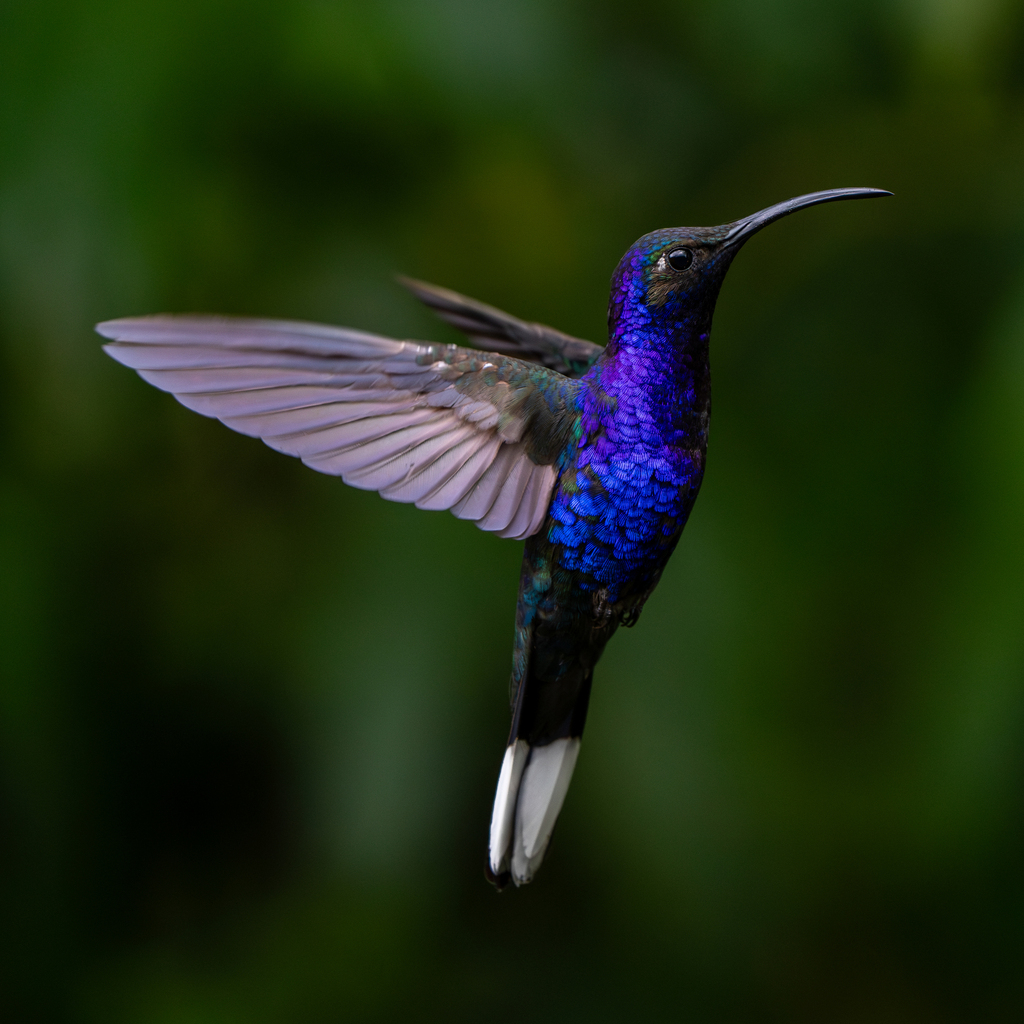
Violet Sabrewing
Photo © Anthony Batista
Photo © Anthony Batista — CC BY 4.0 — Source: iNaturalist #190931761Identification
The violet sabrewing is the largest hummingbird found in Mexico and Central America, measuring 13 to 15 cm in length and weighing 9 to 12 grams. Males of the nominate subspecies are strikingly coloured, with a dusky crown showing a bluish-green gloss and brilliant metallic violet-blue plumage on the nape, upper back, face, and underparts—the belly tinged slightly more blue. Their lower back and uppertail coverts are metallic green, while the central tail feathers are bluish-green to bluish-black; the remaining tail feathers are blackish with distinctive wide white tips. Females are more subdued, sporting a dusky crown and metallic green to bronze-green upperparts with a bluish-green rump and a violet-blue throat. Their underparts are mostly gray with a whiter belly and metallic green spots along the sides. Both sexes have a black bill, though birds of the subspecies C. h. mellitus have notably longer bills. Males of the mellitus subspecies show more green on their upper parts and almost entirely violet underparts, while females of this race have coppery-tinged upperparts.
Range & Habitat
The violet sabrewing is found from Mexico to Panama, with two subspecies occupying different ranges. The nominate subspecies inhabits the Mexican states of Guerrero and Veracruz, ranging intermittently southward through Guatemala, southern Belize, Honduras, and El Salvador into northern Nicaragua. The mellitus subspecies occurs across most of Costa Rica and into western Panama. The species prefers humid evergreen montane forests, inhabiting both forest edges and interior locations, as well as mature secondary forest, banana plantations, and gardens. Elevational preferences vary by region: in Mexico, violet sabrewings generally occur between 500 and 2,000 metres, occasionally reaching 2,500 metres, while in Costa Rica they range between 1,500 and 2,400 metres.
Behaviour & Diet
Violet sabrewings are largely sedentary, though individuals frequently descend to lower elevations after breeding season. They feed primarily by trap-lining, visiting a circuit of flowering plants in search of nectar. Males are notably aggressive, often defending patches of flowers and dominating other hummingbird species at feeding sites. The birds forage mostly in the understory, favouring Heliconia, banana, Cephalism, and Palic urea flowers, and readily visit nectar feeders. Beyond nectar, they supplement their diet with small arthropods gleaned from foliage and spiderwebs. During breeding season—June to September in Mexico and May to November in Costa Rica—males court females through singing in leks situated in the understory or at forest edges. Females construct tiny cup nests of moss cemented with spider silk and lined with fine fibres, typically placing them 1 to 6 metres above ground on horizontal branches over ravines or streams. A clutch of two eggs is incubated for 19 to 22 days, with fledging occurring 22 to 24 days after hatching. In Costa Rica, pairs may raise two broods per season. The species produces loud, high-pitched vocalizations described as piercing and ventriloquial, with varied sharp chipping, warbles, and explosive notes.
Best Time & Places to See It
Birdwatchers and nature travellers can encounter violet sabrewings throughout their range in montane forest habitats, with the best opportunities during breeding season when birds are most active and vocal. In Mexico, visit between June and September; in Costa Rica, the May to November breeding season offers extended viewing opportunities. Look for them in humid evergreen montane forests at appropriate elevations, particularly at forest edges and in the understory. Gardens and banana plantations also attract the species. The birds are relatively common within their range and readily visit nectar feeders, making them accessible to visitors staying in mountain lodges and reserves.
Photography Tips
Photograph violet sabrewings at nectar feeders for reliable close encounters, positioning yourself downwind to avoid disturbing the birds. The males' brilliant violet-blue plumage requires careful exposure management to capture detail without blown highlights; shoot in open shade when possible to reduce contrast. Capture their aggressive territorial behaviour by photographing multiple birds at feeders, or position yourself near flowering plants in the understory where they naturally forage. Early morning and late afternoon light brings out the iridescent qualities of their plumage. The species' large size relative to other hummingbirds makes them excellent subjects for detailed head and tail studies.
Corcovado National Park
Puerto Jiménez, Costa Rica
+444 birds+48 mammals
Where the Osa Peninsula juts into the Pacific, rainforest descends almost to the tide line, and Corcovado National Park protects one of Central America's most intact…
VIEW NATIONAL PARKManuel Antonio National Park
Quepos, Costa Rica
+426 birds+22 mammals
Where tropical rainforest descends steeply to a rocky Pacific coastline, Manuel Antonio National Park distills Central American biodiversity into one of Costa Rica's most compressed and…
VIEW NATIONAL PARKArenal Volcano National Park
Peñas Blancas, Costa Rica
+551 birds+21 mammals
Straddling the border between Alajuela and Guanacaste in northwestern Costa Rica, this national park rises dramatically around one of Central America's most active volcanic systems. The…
VIEW NATIONAL PARKChirripó National Park
Rivas, Costa Rica
+274 birds+6 mammals
Where the volcanic spine of Costa Rica's Central Cordillera reaches its apex, Chirripó National Park encompasses a landscape that shifts dramatically with elevation, from montane cloud…
VIEW NATIONAL PARKBraulio Carrillo National Park
Las Horquetas, Costa Rica
+547 birds+18 mammals
Where the Caribbean slope descends from the central volcanic cordillera toward the humid lowlands of Heredia, Braulio Carrillo National Park preserves one of Costa Rica's most…
VIEW NATIONAL PARKSanta Rosa National Park
Santa Elena, Costa Rica
+359 birds+30 mammals
Where Pacific-facing slopes descend from volcanic uplands toward the Guanacaste lowlands, Santa Rosa National Park unfolds across a mosaic of tropical dry forest, gallery woodland, and…
VIEW NATIONAL PARKGuanacaste National Park
Santa Elena, Costa Rica
+461 birds+17 mammals
Where the Pacific slopes of northwestern Costa Rica rise toward the Continental Divide, dry tropical forest gives way to cloud-laden peaks and misty ridges—a landscape that…
VIEW NATIONAL PARKVolcán Poás National Park
Toro Amarillo, Costa Rica
+237 birds+4 mammals
Where volcanic slopes rise sharply from the Central Valley floor, Volcán Poás National Park protects one of Costa Rica's most active and accessible volcanic systems. The…
VIEW NATIONAL PARKBaru Volcano National Park
Cerro Punta, Panama
+402 birds+6 mammals
Where the land rises sharply toward the Caribbean's western spine, Baru Volcano National Park sprawls across roughly 220 square kilometres of southwestern Panama, anchored by the…
VIEW NATIONAL PARKGeneral de División Omar Torrijos Herrera National Park
La Pintada, Panama
+401 birds+2 mammals
Across the highlands of central Panama, where the continental divide funnels moisture-laden trade winds into steep river valleys, the terrain rises and falls in a landscape…
VIEW NATIONAL PARKParque Internacional la Amistad
Teribe, Panama
+325 birds+11 mammals
Where the continental divide rises between the Caribbean and Pacific watersheds, a wilderness of extraordinary biological richness unfolds across the Talamanca Range and into lowland rainforest—a…
VIEW NATIONAL PARKLagunas de Montebello National Park
Laguna de Montebello, Mexico
+360 birds+2 mammals
Where turquoise lagoons pierce the limestone plateau of southeastern Chiapas, the Lagunas de Montebello National Park unfolds across roughly 174 square kilometers of spectral water and…
VIEW NATIONAL PARKMontes Azules
Candelaria, Mexico
+395 birds+47 mammals
Where jungle-clad limestone plateaus plunge into canyon systems carved by the Usumacinta River, Mexico's most pristine rainforest reserve unfolds across the Lacandón region of Chiapas. Montes…
VIEW BIOSPHERE RESERVECarara National Park
Tárcoles, Costa Rica
+397 birds+19 mammals
Where the Pacific coastal plain meets transitional forest, Carara National Park straddles one of Central America's most dynamic ecological boundaries. The park's landscape encompasses lowland deciduous…
VIEW NATIONAL PARKPalo Verde National Park
Bagaces, Costa Rica
+318 birds+24 mammals
Dry forest spreads across Palo Verde's low-lying terrain in northwestern Guanacaste, where seasonal rivers and lagoons etch through deciduous woodland that sheds its canopy each winter.…
VIEW NATIONAL PARKLos Quetzales National Park
Copey, Costa Rica
+232 birds+3 mammals
Cloud forest sweeps across the upper slopes of the Central Valley watershed, where elevation and persistent moisture forge an ecosystem unlike any other in Costa Rica.…
VIEW NATIONAL PARKRincón de la Vieja National Park
Liberia, Costa Rica
+451 birds+30 mammals
Where volcanic slopes rise abruptly from the Guanacaste lowlands, Rincón de la Vieja National Park sprawls across a landscape shaped by geothermal drama and seasonal extremes.…
VIEW NATIONAL PARKTapantí Macizo de la Muerte National Park
Orosi, Costa Rica
+503 birds+18 mammals
Where montane cloud forest rises steeply from the Orosi Valley, Tapantí Macizo de la Muerte National Park enfolds a landscape of perpetual moisture and emerald complexity.…
VIEW NATIONAL PARKLa Amistad International Park
Crorina, Costa Rica
+532 birds+20 mammals
Where the Caribbean slopes of Costa Rica's Talamanca Mountains rise steeply inland from Limón, the boundary between two nations dissolves into an unbroken expanse of rainforest.…
VIEW NATIONAL PARKVolcán Tenorio National Park
Guatuso, Costa Rica
+480 birds+12 mammals
Where volcanic slopes rise through Costa Rica's northwestern borderlands, Volcán Tenorio National Park sprawls across terrain shaped by ancient lava flows and mineral-rich springs. The park's…
VIEW NATIONAL PARKNo community photos yet. Log in to add the first one.
No community observations of this species yet.