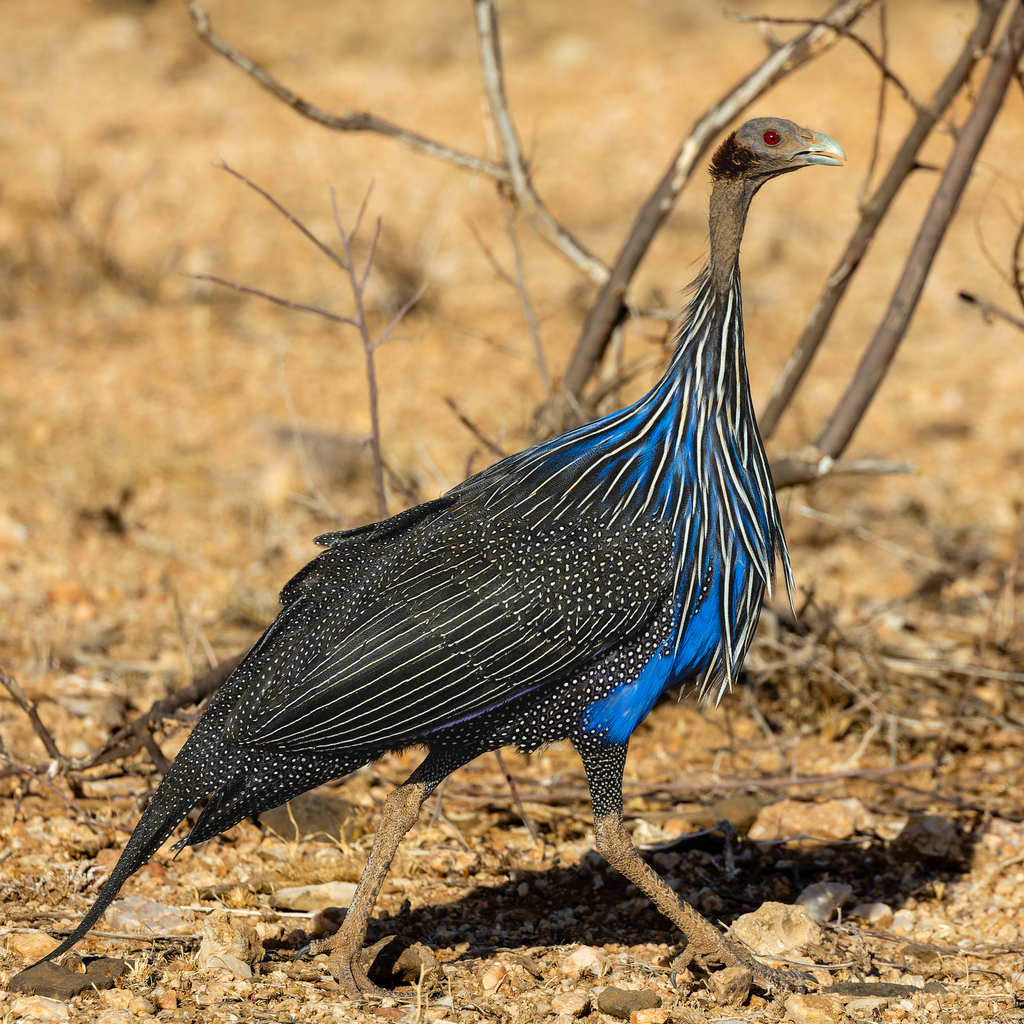
Vulturine Guineafowl
Photo © Gary T. Leavens
Photo © Gary T. Leavens — CC BY-SA 4.0 — Source: iNaturalist #209237468Identification
The vulturine guinea fowl is the largest extant species of guinea fowl, measuring 61–71 centimeters in length and weighing between 1–1.6 kilograms. Its most striking feature is its bare blue face and black neck, which give it a distinctly vulture-like appearance—hence its name. The bird has a round body but notably longer wings, neck, legs, and tail than other guinea fowl species, with a slim neck that projects from a distinctive cape of long, glossy blue and white hackles.
The breast is cobalt blue, while the rest of the plumage is black, finely spangled with white. The wings are short and rounded, and the tail is proportionally longer than in other family members. The sexes are similar in appearance, though females are usually slightly smaller than males with smaller tarsal spurs. Young birds are predominantly grey-brown with duller blue breasts and shorter hackles, making them easily distinguishable from adults.
Range & Habitat
The vulturine guinea fowl is a resident breeder in northeast Africa, with its range extending from southern Ethiopia and Somalia through Kenya and just into northern Tanzania. The species is the only member of its genus, Acryllium, and is only distantly related to other guinea fowl genera, making it taxonomically distinctive within the family Numididae.
These birds prefer dry and open habitats with scattered bushes and trees, such as savannah or grassland environments. Despite inhabiting relatively open terrain, they tend to keep to cover during the day and roost in trees at night, suggesting they favour areas where woodland and grassland intermingle.
Behaviour & Diet
The vulturine guinea fowl is highly gregarious, forming flocks of typically around 25 birds outside the breeding season. The species is predominantly terrestrial, preferring to run rather than fly when alarmed, which suits their savannah habitat. They are vocal birds, producing characteristic loud "chink-chink-chink-chink-chink" calls that often reveal their presence before they are seen.
These birds are omnivorous foragers, feeding on seeds, roots, tubers, grubs, rodents, small reptiles, and insects. They also occasionally consume vegetation and fruits. During the breeding season, pairs nest in dry, open habitats with scattered cover, typically laying 4–8 cream-coloured eggs in a well-hidden grass-lined scrape.
Best Time & Places to See It
The vulturine guinea fowl's range is concentrated in the arid and semi-arid regions of northeast Africa, making Kenya and northern Tanzania the most accessible destinations for viewing. Look for them in savannah and grassland habitats with scattered acacia trees and bushes, where they spend their days foraging on the ground. Their loud calling often provides the best clue to their presence, allowing you to locate flocks even in open terrain.
These birds are resident breeders, meaning populations remain year-round in their range, so they can potentially be encountered during any season. However, outside the breeding season when they form larger flocks of approximately 25 birds, they may be easier to locate and photograph.
Photography Tips
The vulturine guinea fowl's striking coloration and distinctive bare-necked appearance make it a rewarding subject for wildlife photography. Its preference for ground-level foraging means you should position yourself low to capture the birds' full plumage, particularly the glossy blue and white hackles and the spangled black-and-white body. The cobalt blue breast is especially vibrant in good light.
Since these birds run rather than fly when alarmed and tend to keep to cover, approach slowly and quietly through suitable habitat. Their loud calling provides excellent opportunities to locate flocks; once you've heard them, move cautiously toward the sound. Early morning and late afternoon light will best showcase the iridescent qualities of their plumage and the striking bare facial skin.
Arusha National Park
Tanzania
+555 birds+16 mammals
Where the slopes of Mount Mawenzi rise above the Arusha region, a compact yet ecologically rich national park unfolds across montane forest, moorland, and alpine zones.…
VIEW NATIONAL PARKTsavo East National Park
Athi ward, Kenya
+468 birds+50 mammals
Across the semi-arid lowlands of southeastern Kenya, where acacia woodland fragments into scrubland and the landscape rolls toward the Indian Ocean horizon, lies one of Africa's…
VIEW NATIONAL PARKTsavo West National Park
Mwatate, Kenya
+513 birds+49 mammals
Where volcanic ridges and weathered lava flows meet the semi-arid lowlands of south-central Kenya, Tsavo West National Park unfolds across a landscape sculpted by fire and…
VIEW NATIONAL PARKTarangire National Park
Tanzania
+527 birds+50 mammals
Acacia woodland and grassland sweep across the Manyara Region where the Tarangire River carves through low hills and volcanic soils, creating one of East Africa's most…
VIEW NATIONAL PARKNgorongoro Conservation Area
Tanzania
+626 birds+55 mammals
Volcanic calderas and open grassland dominate this high plateau in northern Tanzania, where the landscape rises above 2,000 metres and ancient geological forces have shaped both…
VIEW WILDLIFE MANAGEMENT AREAYabelo Wildlife Sanctuary
Bedewera, Ethiopia
+359 birds+5 mammals
Where acacia woodlands meet volcanic plateaus in southern Ethiopia, a landscape of austere beauty unfolds across nearly 2,500 square kilometers. Yabelo Wildlife Sanctuary sprawls across semi-arid…
VIEW WILDLIFE SANCTUARYMeru National Park
Igembe Central, Kenya
+408 birds+38 mammals
Granite outcrops and acacia woodland rise across the northern reaches of Meru, where semi-arid savanna transitions into drier scrubland under the fierce equatorial sun. The park's…
VIEW NATIONAL PARKSamburu National Reserve
Samburu, Kenya
+430 birds+42 mammals
Across the arid plains of northern Kenya, where scattered acacia woodland gives way to rocky outcrops and dry riverbeds, Samburu National Park unfolds as one of…
VIEW NATURE RESERVESibiloi National Park
Kenya
+118 birds
Where the northern deserts of Kenya meet the volcanic Chalbi Plain, Sibiloi National Park sprawls across a landscape shaped by millennia of tectonic upheaval and semi-arid…
VIEW NATIONAL PARKNo community photos yet. Log in to add the first one.
No community observations of this species yet.