Water Rail
Photo © bristolian
Photo © bristolian — CC BY 4.0 — Source: iNaturalist photo #327347235Identification
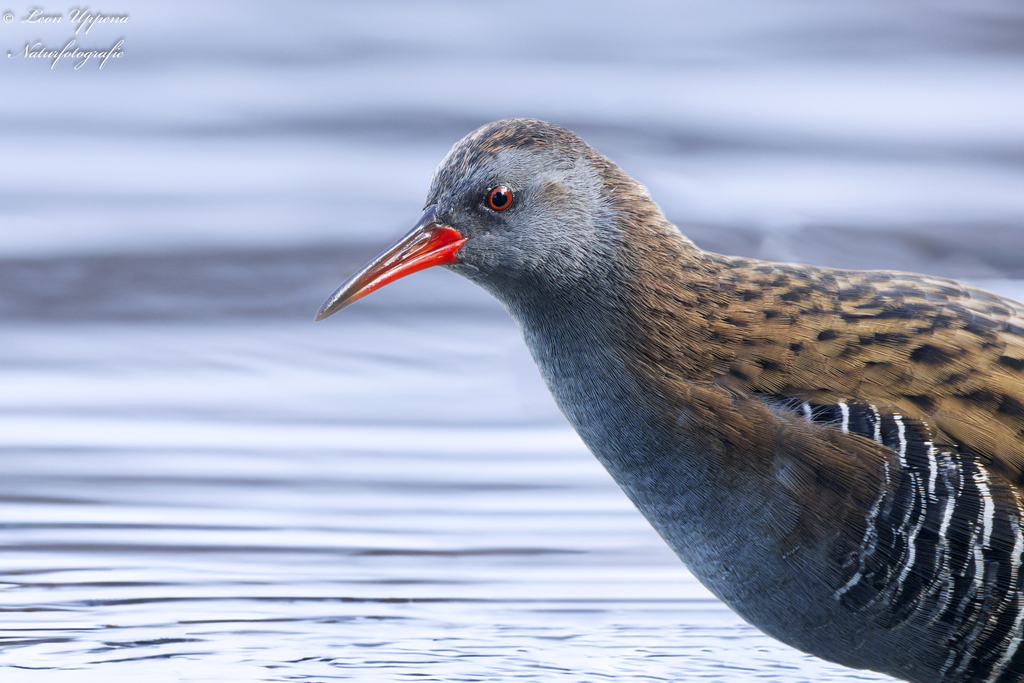
The Water Rail is a medium-sized rail measuring 23–28 cm long with a distinctive appearance shaped by its life among dense reeds. Its body is notably flattened from side to side, an adaptation that allows it to slip easily through reed beds. Adults display mainly brown upperparts with a striking contrast of blue-grey underparts, black barring on the flanks, a short tail, long toes, and a long reddish bill that is particularly striking in good light. The eye and iris are also red, while legs are flesh-brown.
Immature birds are generally similar to adults but lack the bright blue-grey colouring, which is replaced by buff tones instead. The downy chicks are entirely black, a characteristic shared with all rails. Sexes are similar in appearance, though females average slightly smaller with more slender bills, making visual sexing unreliable. Interestingly, adult birds can be individually identified by the unique markings on their undertail coverts, with males showing the strongest black streaking.
Range & Habitat
The Water Rail breeds across well-vegetated wetlands spanning Europe, Asia, and North Africa. Northern and eastern populations are migratory, retreating southward in winter, while populations in the warmer parts of the breeding range remain as permanent residents year-round. The species favours reed beds and other marshy sites with tall, dense vegetation where it can build its nest slightly above water level using whatever plant materials are available.
Behaviour & Diet
Water Rails are omnivorous foragers, feeding predominantly on invertebrates during summer months and switching to berries and plant stems as winter approaches. These rails are notably territorial even after the breeding season ends, aggressively defending feeding areas throughout winter. They breed in their reed-bed homes, building nests just above the waterline and typically raising two clutches per season. The off-white, blotched eggs are incubated mainly by the female, with precocial chicks hatching after 19–22 days. Females fiercely defend their eggs and broods against intruders or will relocate them if discovered. The species can breed after its first year of life.
Best Time & Places to See It
Water Rails inhabit reed beds and marshy wetlands across their broad European, Asian, and North African range. In northern regions, spring and summer are the best times to encounter breeding birds, while permanent populations in warmer regions can be found year-round. However, these birds are vulnerable to flooding, freezing conditions, habitat loss, and predation by mammals and large birds, including introduced American mink which has eliminated populations on some islands. Despite these threats, the species' enormous range and large overall population numbers mean it is not currently considered threatened.
Photography Tips
Photographing Water Rails presents challenges and rewards for patient wildlife photographers. The birds' preference for dense reed beds means they often remain hidden, requiring careful stalking and positioning along wetland edges. Early morning light is ideal for capturing the striking contrast between their blue-grey underparts and brown upperparts, as well as the vivid red of the bill and eye. During the breeding season, females defending nests or tending broods may be more active and visible than at other times. The bird's flattened body shape and long toes are diagnostic features worth capturing, as is the distinctive black barring on the white flanks.
Private Full-Day Birdwatching Tour from Lisbon to the Tagus Estuary
Nothing matches these filters.
Nothing matches these filters.
Alpilles Regional Nature Park
Alta Murgia National Park
Appennino Lucano Val d’Agri Lagonegrese National Park
Åsnens National Park
Avesnois Regional Nature Park
Bannau Brycheiniog National Park
Bardenas Reales
Bavarian Forest National Park
Białowieża National Park
Nothing matches these filters.
No community photos yet. Log in to add the first one.
No community observations of this species yet.