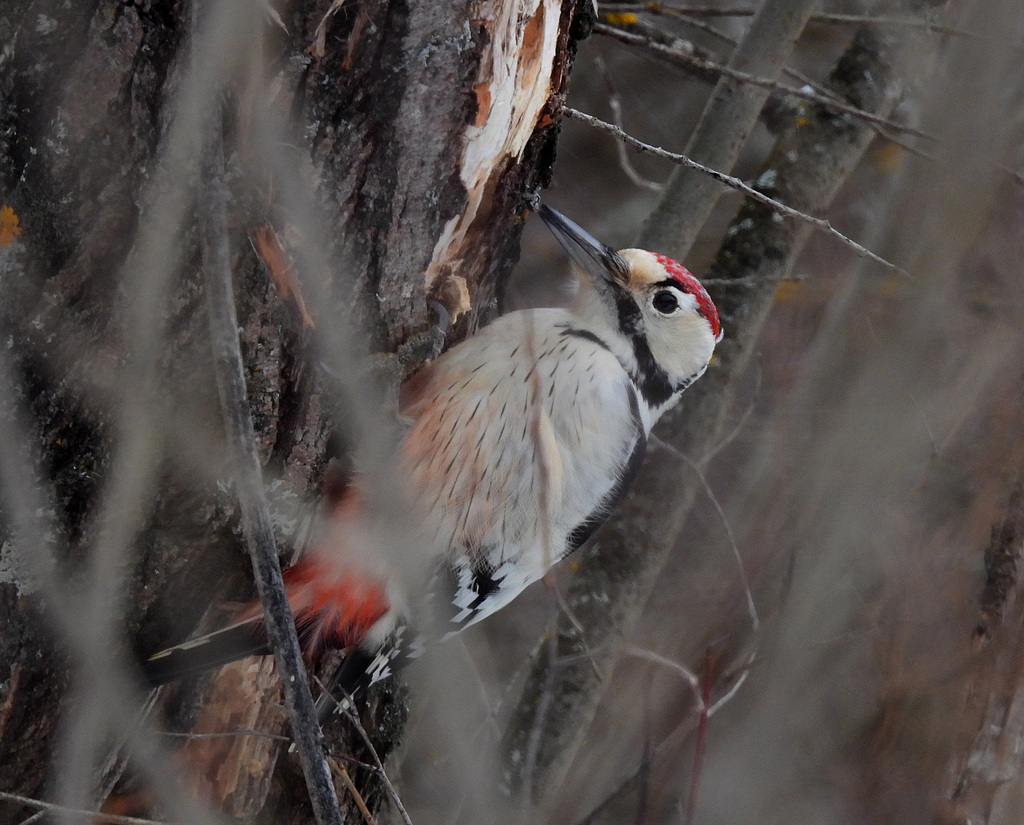
White-backed Woodpecker
Photo © Олег Юмашев
Photo © Олег Юмашев — CC BY 4.0 — Source: iNaturalist #258940873Identification
The white-backed woodpecker is the largest of the spotted woodpeckers in the western Palearctic, measuring 24–26 cm in length with a wingspan of 38–40 cm. Its plumage resembles that of the great spotted woodpecker, but with distinctive white bars crossing the wings rather than spots, and a notably white lower back. The most reliable way to distinguish males from females is by crown colour: males display a striking red crown, while females have a black one. Both sexes produce distinctive vocalizations—males deliver very loud drumming sounds, while their calls include a soft kiuk and a longer kweek.
Range & Habitat
This Eurasian species is distributed across a vast range from central and northern Europe eastwards to northeast Asia, Korea, and Japan. The nominate race occurs in central and northern Europe, while the subspecies D. l. lilfordi is found in the Balkans and Turkey. Ten additional races inhabit regions progressively eastward. The white-backed woodpecker is a scarce bird that demands extensive tracts of mature deciduous forests with substantial quantities of standing and lying dead wood. Unfortunately, populations have declined in Nordic countries, prompting the Swedish government to include the species in its national Biodiversity Action Plan.
Behaviour & Diet
During the breeding season, this woodpecker excavates nest holes approximately 7 cm wide and 30 cm deep in decaying tree trunks. Females typically lay three to five white eggs, with an incubation period of 10–11 days. The white-backed woodpecker's diet consists predominantly of wood-boring beetles and their larvae, supplemented by other insects, nuts, seeds, and berries. In the wild, individuals can survive between three and four years, though in captivity they may live approximately eleven years.
Best Time & Places to See It
Observing this scarce species requires patience and access to suitable habitat—mature deciduous forests with abundant dead wood. Birdwatchers hoping to encounter white-backed woodpeckers should focus on regions where populations remain viable, particularly in central and northern Europe. Their preference for extensive forest tracts means sightings are relatively uncommon, making any encounter a rewarding experience for dedicated birders.
Photography Tips
Photographing white-backed woodpeckers presents unique challenges due to their scarcity and preference for mature forests. The striking contrast between the white lower back and darker upper plumage provides excellent photographic potential, particularly in side profiles. Listen for their characteristic loud drumming and distinctive calls—kiuk and kweek sounds—to locate individuals. Early morning visits to suitable forest habitats offer the best chances of encountering these elusive woodpeckers when they are most active.
Abruzzo, Lazio and Molise National Park
Aggtelek National Park
Baikal National Park
Białowieża National Park
Biebrza National Park
Bükk National Park
Central Balkan National Park
Dovrefjell-Sunndalsfjella National Park
Duna-Ipoly National Park
Nothing matches these filters.
No community photos yet. Log in to add the first one.
No community observations of this species yet.