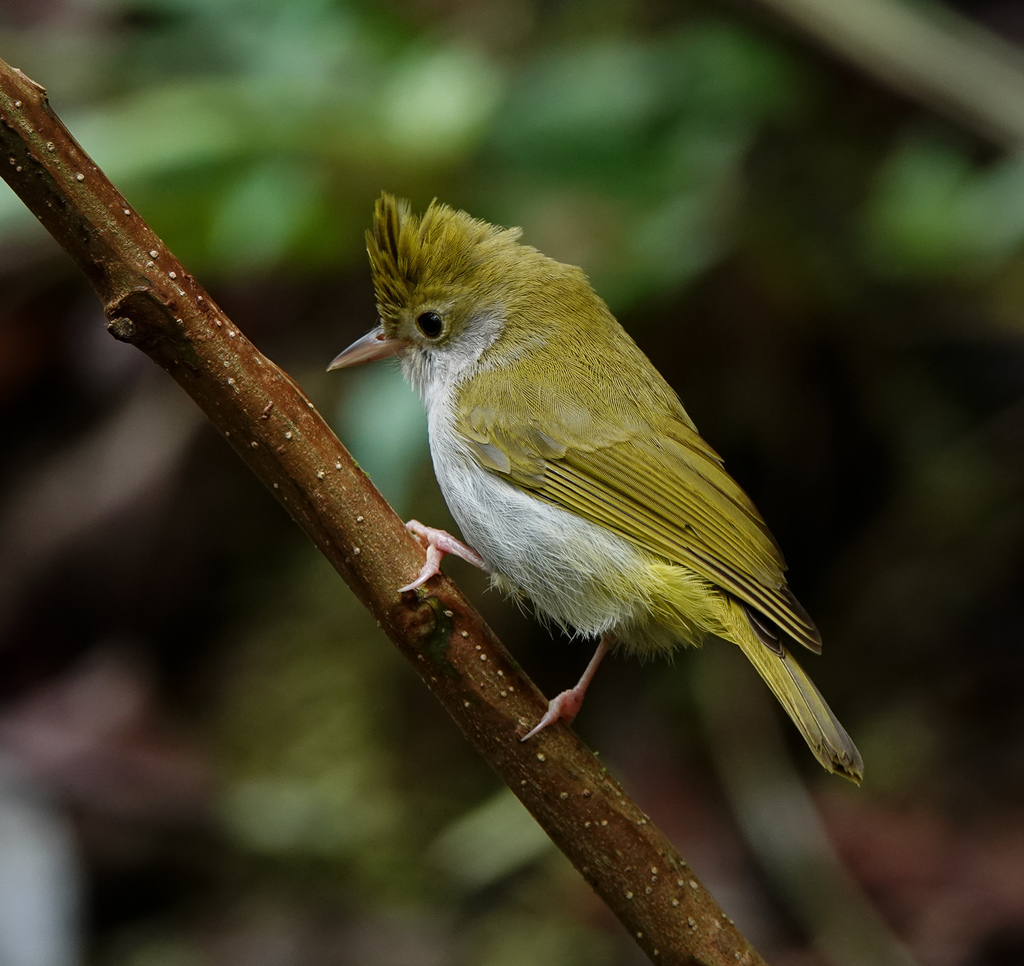
White-bellied Erpornis
Photo © Rejoice Gassah
Photo © Rejoice Gassah — CC BY 4.0 — Source: iNaturalist #105145510Identification
The white-bellied erpornis is a small, distinctively crested songbird with a striking appearance that blends characteristics of several bird families. Its most prominent feature is the prominent crest on its head, which gives it an immediately recognizable silhouette. The bird's upperparts—including the crested head, back, wings, and tail—are olivaceous or golden brown, while the underparts are clean white, providing excellent contrast. In its coloration, morphology, and acrobatic habits, this bird bears a notable resemblance to vireos, though the prominent crest sets it apart and has historically caused confusion about its true taxonomic relationships.
One of the erpornis's most interesting anatomical features is its well-developed musculature for gaping—the forceful opening of the bill. This adaptation allows the bird to pry bark from trees in search of insects, a specialized feeding technique that reflects its ecological niche within forest canopies. The bird's compact size and agile build make it well-suited to its arboreal lifestyle.
Range & Habitat
The white-bellied erpornis has an extensive range across southern and southeastern Asia, with populations found in Bangladesh, Bhutan, Brunei, Cambodia, China, India, Indonesia, Laos, Malaysia, Myanmar, Nepal, Singapore, Taiwan, Thailand, and Vietnam. This wide distribution reflects its successful adaptation to suitable habitats throughout the region, with particularly significant populations recorded in China and Taiwan.
This species is strictly a bird of subtropical and tropical moist montane forests. It favors the forest canopy and mid-story levels, where it forages among foliage and branches. The requirement for moist montane forests means that altitude and moisture levels are key factors determining where travelers will encounter this species within its broad geographic range.
Behaviour & Diet
The white-bellied erpornis is an acrobatic forager, actively gleaning insects from bark, branches, and foliage as it moves through the forest canopy. Its well-developed gaping muscles enable it to pry bark from trees, allowing it to access insects hidden beneath the surface. This specialized feeding technique makes it a valuable member of mixed-species feeding flocks that commonly move through Asian montane forests.
The bird's behavior reflects its close relationship to vireos, demonstrating the same active, purposeful foraging style characteristic of that family. It typically remains in the upper levels of the forest, making observation and photography challenging but rewarding for dedicated birdwatchers.
Best Time & Places to See It
The white-bellied erpornis is common within much of its wide range, though specific seasonal patterns are not detailed in available sources. Travelers should focus on subtropical and tropical moist montane forests across its distribution, with particularly accessible populations likely in established birdwatching destinations in Taiwan, Thailand, and southern China, where the species is estimated to occur in substantial numbers.
The IUCN lists this species as of "Least Concern," reflecting its very wide range and common status throughout much of its habitat. This favorable conservation status means that travelers seeking this species can do so with confidence that populations remain healthy and stable.
Photography Tips
Photographing the white-bellied erpornis requires patience and attention to the canopy level, as the bird typically forages in the upper portions of the forest. The bird's prominent crest and contrasting coloration—olivaceous-brown upperparts against white underparts—provide excellent photographic subjects when adequate light penetrates the forest. Early morning hours often provide the best lighting conditions in montane forest environments.
The bird's acrobatic feeding behavior offers dynamic photography opportunities. Position yourself where you can observe feeding flocks, and be prepared for rapid movements as the bird gleams insects from bark and foliage. A telephoto lens is essential given the bird's preference for the canopy, and tracking the bird's movements through dense foliage will test both your equipment and technique.
Langtang National Park
Helambu, Nepal
+364 birds+14 mammals
Where the southern slopes of the Himalayan highlands descend toward the subtropical valleys of central Nepal, Langtang National Park sprawls across one of the subcontinent's most…
VIEW NATIONAL PARKValmiki National Park
Ramnagar, India
+66 birds+6 mammals
Along Bihar's western frontier, where the Gandak River winds through subtropical forest and grassland, Valmiki National Park sprawls across terrain shaped by monsoon rains and seasonal…
VIEW NATIONAL PARKPhou Khao Khouay National Protected Area
Thaphabath District, Thailand
+113 birds
Where the Annamite Mountains descend into central Thailand's monsoon forests, Phou Khao Khouay National Protected Area sprawls across rugged limestone terrain interlaced with river valleys and…
VIEW NATIONAL PARKKhao Yai National Park
Prachantakham District, Thailand
+377 birds+46 mammals
Evergreen dipterocarp forest blankets the rolling terrain of this national park in eastern Thailand, where limestone hills rise abruptly from the forest floor and seasonal streams…
VIEW NATIONAL PARKKhao Laem National Park
Sangkhla Buri District, Thailand
+197 birds
Where the Vajiralongkorn Reservoir sprawls across the forested valleys of Kanchanaburi's northern borderlands, Khao Laem National Park protects a landscape where limestone ridges rise dramatically from…
VIEW NATIONAL PARKMount Nanling Forest Park
Ruyang Forest Farm, China
+179 birds+3 mammals
Granite ridges and weathered peaks rise through a canopy of subtropical montane forest where Ruyang Forest Farm anchors one of southern China's most biodiverse landscapes. Across…
VIEW FOREST & JUNGLEKaziranga National Park
Kohora, India
+422 birds+26 mammals
Dawn breaks over the floodplains of the Brahmaputra, where tall grasslands stretch endlessly beneath monsoon-heavy skies. This sprawling wilderness of northeastern Assam is a mosaic of…
VIEW NATIONAL PARKBako National Park
Kuching, Malaysia
+210 birds+17 mammals
Weathered sandstone cliffs rise dramatically from the South China Sea, their ochre faces sculpted by millennia of wind and tide into a landscape of extraordinary geological…
VIEW NATIONAL PARKTaman Negara National Park
Kampong Samas, Malaysia
+393 birds+48 mammals
Where ancient rainforest meets limestone peaks, one of Southeast Asia's oldest protected wilderness preserves sprawls across 4,343 square kilometers of primordial landscape. Dipterocarp giants tower overhead,…
VIEW NATIONAL PARKTaman Negara Bukit Lambir National Park
Miri, Malaysia
+153 birds+7 mammals
Rainforest cascades down sandstone ridges where crystal streams carve through ancient geology, creating a landscape of profound biological richness in Sarawak's interior. This 68-square-kilometre sanctuary protects…
VIEW NATIONAL PARKGunung Mulu National Park
Long Seridan, Malaysia
+280 birds+39 mammals
Where granite monoliths pierce the rainforest canopy of Sarawak, an ancient limestone karst landscape reveals one of Southeast Asia's most biodiverse strongholds. Soaring peaks cloaked in…
VIEW NATIONAL PARKHainan Tropical Rainforest National Park
Haikou, China
+69 birds+1 mammals
Tropical forests blanket the volcanic slopes of central Hainan, where moisture-laden winds from the South China Sea collide with mountainous terrain to create some of China's…
VIEW NATIONAL PARKWuyishan National Park
Yanshan County, China
+141 birds+2 mammals
Where subtropical monsoon rains sustain a perpetually humid landscape, Wuyishan National Park rises from Fujian's eastern plateau as a realm of forested ridges, cascading streams, and…
VIEW NATIONAL PARKXishuangbanna National Nature Reserve
Xishuangbanna Dai Autonomous Prefecture, China
+173 birds+2 mammals
Where subtropical monsoon forests meet the margins of the Yunnan plateau, Xishuangbanna National Nature Reserve sprawls across a landscape of dramatic relief—deep river valleys carved by…
VIEW NATURE RESERVEGaoligong Mountain National Nature Reserve
Nujiang Lisu Autonomous Prefecture, China
+443 birds+13 mammals
VIEW NATURE RESERVENo community photos yet. Log in to add the first one.
No community observations of this species yet.