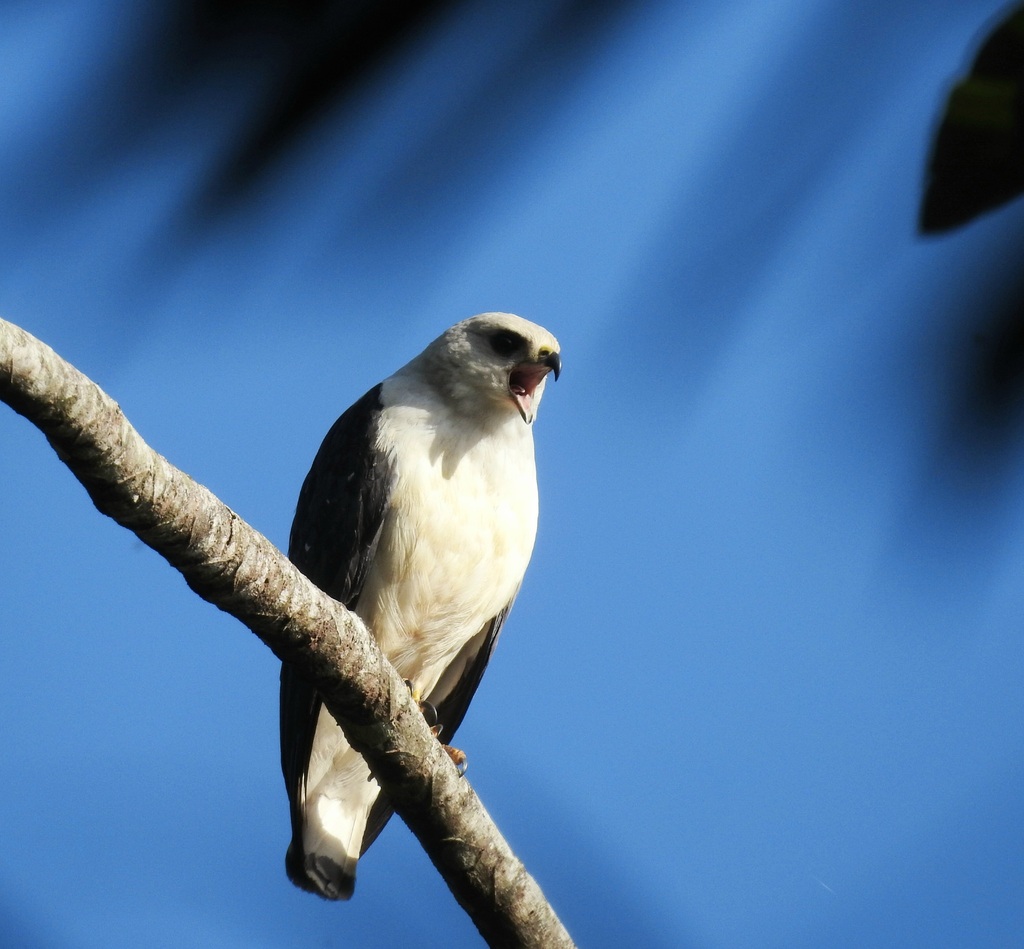
White-necked Hawk
Photo © Marcelo Schmidt Roberti
Photo © Marcelo Schmidt Roberti — CC BY 4.0 — Source: iNaturalist #253100845Identification
The white-necked hawk is a striking and distinctive raptor, measuring 43 to 48 cm in length with a wingspan of 91 to 101 cm. Adults are unmistakable, featuring a white head and underparts contrasting sharply with black upperparts. The tail is black with a prominent wide white band across the middle—a key field mark. The eye is brown or pale yellow, while the legs and feet are bright yellow. Males and females share identical plumage, though females are approximately 4% larger.
Immature birds are similar to adults but show dark streaks on the crown and neck, brownish tips on some upperpart feathers, and white barring on the black base of the tail. These features help distinguish juveniles from other forest raptors in their range.
Range & Habitat
The white-necked hawk is endemic to Brazil, found discontinuously in the southeastern region from Paraíba state south to Paraná, with possible historical occurrence in Santa Catarina. The species is strongly associated with dense primary Atlantic Forest, though it has been recorded in secondary forest habitats. Elevation ranges from sea level to at least 900 m, with local populations reaching 1,300 m in Minas Gerais.
The bird's fragmented range reflects the severe loss and conversion of its Atlantic Forest home. Although it occurs within at least 10 protected areas, these reserves are separated by extensive deforested regions, limiting movement and gene flow between populations.
Behaviour & Diet
The white-necked hawk is generally sedentary, though some wandering and dispersal from usual habitats has been documented. This raptor hunts by dropping to the ground from low perches, sometimes as low as 1.5 m high. It has evolved a remarkable foraging strategy: it follows army ant swarms and troops of monkeys to capture prey that these animals flush from vegetation and leaf litter.
Its diet remains incompletely understood. Some researchers believe arthropods form its primary food, while others argue it is a generalist predator taking arthropods, reptiles, amphibians, mammals, birds, and snails. Very little is known about its breeding biology, and its vocalizations remain largely undescribed, with only a handful of recordings documented in scientific archives.
Best Time & Places to See It
Finding a white-necked hawk requires patience and access to well-preserved Atlantic Forest habitat within its range of southeastern Brazil. The species occurs in at least 10 protected areas, which offer the best opportunities for encounters. However, the fragmented nature of its distribution and small population—estimated between 2,500 and 10,000 mature individuals—means sightings are never guaranteed.
The species is generally sedentary, so timing is less critical than location. Visiting protected Atlantic Forest reserves in the states of Paraíba, Pernambuco, Bahia, Espírito Santo, Rio de Janeiro, São Paulo, Minas Gerais, and Paraná would offer the best chances. Guided birding tours familiar with the species and its preferred forest sections will significantly improve your odds.
Photography Tips
The white-necked hawk's striking black-and-white plumage makes it visually distinctive, but its behavior presents challenges. The bird often hunts from low perches within dense forest, where light is limited. Use a fast shutter speed to freeze motion when it drops to the ground to capture prey. The bright yellow legs and eye provide excellent focusing points.
Since the species follows army ants and monkey troops, patient observation of these animals may lead you to hunting white-necked hawks. The wide white tail band is one of the most diagnostic features and should be a priority to capture clearly. Expect that encounters will be brief and in challenging forest conditions, so be prepared with appropriate telephoto lenses and high ISO settings for the dim forest interior.
Tijuca National Park
Brazil
+317 birds+13 mammals
Where the Atlantic forest rises steeply from Rio de Janeiro's urban edge, Tijuca National Park encompasses a landscape of dramatic granite peaks, cascading waterfalls, and closed-canopy…
VIEW NATIONAL PARKItatiaia National Park
Brazil
+519 birds+12 mammals
Where granite peaks pierce the Atlantic rainforest canopy in southeastern Brazil, Itatiaia National Park rises as one of the country's oldest and most ecologically vital protected…
VIEW NATIONAL PARKSaint-Hilaire/Lange National Park
Brazil
+225 birds
Subtropical Atlantic forests rise and fall across the plateaus of inland Paraná, where Saint-Hilaire/Lange National Park protects nearly 578 square kilometres of Brazil's most biodiverse woodland…
VIEW NATIONAL PARKSerra do Itajaí National Park
Brazil
+227 birds+2 mammals
Where the Atlantic rainforest rises steeply from the coastal plains of Santa Catarina, Serra do Itajaí National Park spreads across 1,136 square kilometres of montane wilderness…
VIEW NATIONAL PARKSerra da Bocaina National Park
Brazil
+441 birds+5 mammals
Where the escarpment of the Serra da Bocaina rises sharply from the Atlantic coastal plain, tropical rainforest cloaks steep mountainsides that climb toward peaks exceeding 2,000…
VIEW NATIONAL PARKSerra dos Órgãos National Park
Brazil
+446 birds+13 mammals
Granite peaks thrust skyward through the Atlantic Forest canopy in the mountains immediately north of Rio de Janeiro, their bare rock faces rising above a landscape…
VIEW NATIONAL PARKNo community photos yet. Log in to add the first one.
No community observations of this species yet.