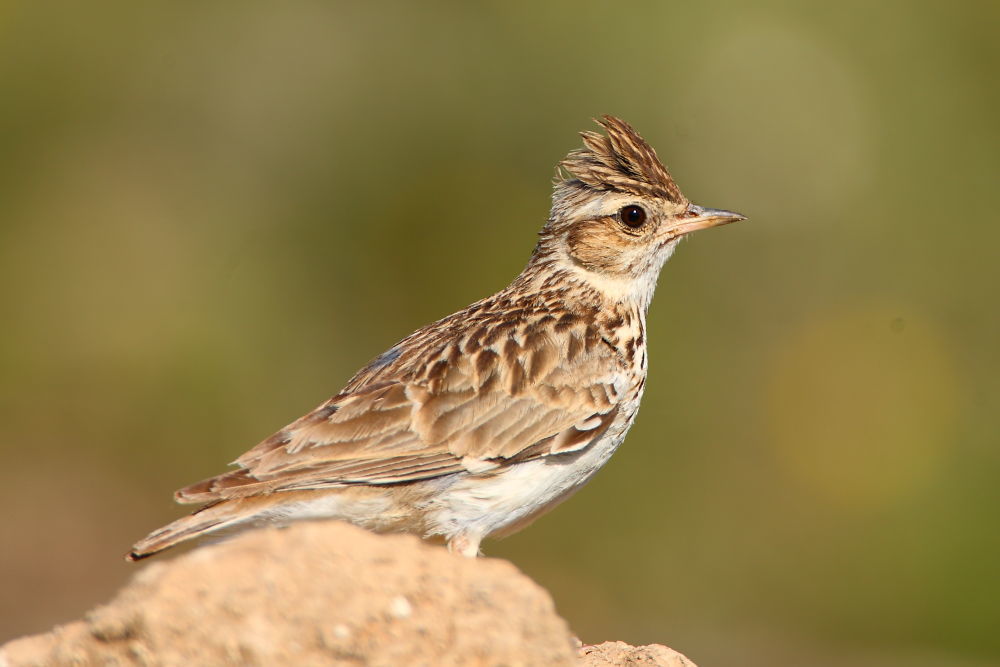
Woodlark
Photo © Carles Pastor
Photo © Carles Pastor — CC BY-SA 4.0 — Source: iNaturalist photo #5741186Identification
The woodlark is a small, unobtrusive lark measuring 13.5 to 15 centimetres in length—roughly 20% shorter than the more familiar skylark. Its plumage is predominantly brown above with a pale underside, and it bears a distinctive white superciliary stripe that meets on the nape. The bird sports a small crest that is often inconspicuous. In flight, its short tail and short broad wings are apparent, with the tail distinctively tipped white, though unlike the skylark, the tail sides and rear wing edges lack white edging.
As a songbird, the woodlark produces a melodious, warbling song often described onomatopoeically as a "lu-lu-lu" or more precisely as a serial "lū-lū-lū-lū-lū" pattern, with clear "toolooeet" phrases. Both males and females sing, performing either in characteristic song flight or from ground and perches.
Range & Habitat
The woodlark is found across most of Europe, the Middle East, western Asia, and the mountains of north Africa, with its range extending from England in the west to Iran and Turkmenistan in the east, and from the Scandinavian Peninsula north to parts of northern Egypt in the south. Two subspecies exist: the northern woodlark (L. a. arborea) occupies northern, western and central Europe through to western Russia and Ukraine, while the southern woodlark (L. a. pallida) inhabits southern Europe, north-western Africa, the Middle East and the Caucasus region.
The species favours heathland and open spaces sparsely populated with trees, particularly clearings in pine forests and newly planted areas with pine saplings. It thrives in lowland grass-heaths, especially where annual ground disturbance occurs, and occasionally appears in urban areas. The bird is mainly resident in western portions of its range, while eastern populations migrate southward during winter. Unfortunately, ranges have contracted in recent years; in Britain, for example, the woodlark once bred in Wales and central England but is now confined to southern England.
Behaviour & Diet
Male woodlarks perform characteristic song flights similar to skylarks but with more pronounced fluttering as they rise and spiral upwards, circling at a fairly constant height while singing. Both sexes sing from ground or perches, typically beginning their vocal activity early in the season, usually around February in Britain.
The woodlark's diet consists primarily of seeds, supplemented with insects during the breeding season. Beetles, flies and moths feature prominently among their insect prey. Breeding begins early, with first eggs sometimes laid before the end of March. Nests are constructed from grass, bracken, roots and moss in ground depressions. Clutches typically contain three to five whitish, brown-speckled eggs, which the female incubates for 13 to 15 days. Both parents feed the nestlings, which fledge after 11 to 13 days. Woodlarks typically raise two broods annually, sometimes three, with families remaining together through summer and into autumn.
Best Time & Places to See It
The best period for observing woodlarks is early in the breeding season, around February onwards in Britain, when males are most vocal and active in their distinctive song flights. Sandy heaths in Belgium have historically supported particularly high densities, making this region an excellent destination. Southern England remains the most reliable location in Britain, though populations have declined significantly across Europe. Other strongholds include suitable heathland habitat across central and northern Europe.
Habitat loss, agricultural intensification, development, and recent wildfires have severely impacted populations, so current abundance varies considerably across the range. Contacting local ornithological societies or conservation organizations before visiting will provide the most up-to-date information on reliable viewing locations.
Photography Tips
Capturing the woodlark's characteristic song flight is key to compelling photography. Position yourself in open heathland during early morning sessions in spring and monitor the sky for the typical fluttering ascent and circular flight pattern as males vocalize. The bird's small size and brown coloration demand careful exposure metering to retain detail in both plumage and background. A telephoto lens of at least 400–600mm will be necessary to frame the bird adequately during flight.
Ground-feeding birds can be photographed during insect-hunting periods on heathland, though their wariness requires patient stalking and well-concealed positioning. The distinctive white-tipped tail and superciliary stripe should be identifiable features in your shots. Early morning light will enhance the subtle brown tones of the plumage, while clear sky provides an uncluttered background for flight photography.
Private Full-Day Birdwatching Tour from Lisbon to the Tagus Estuary
Nothing matches these filters.
Abruzzo, Lazio and Molise National Park
Aggtelek National Park
Alpilles Regional Nature Park
Alta Murgia National Park
Appennino Lucano Val d’Agri Lagonegrese National Park
Asinara National Park
Aspromonte National Park
Avesnois Regional Nature Park
Bardenas Reales
Nothing matches these filters.
No community photos yet. Log in to add the first one.
No community observations of this species yet.