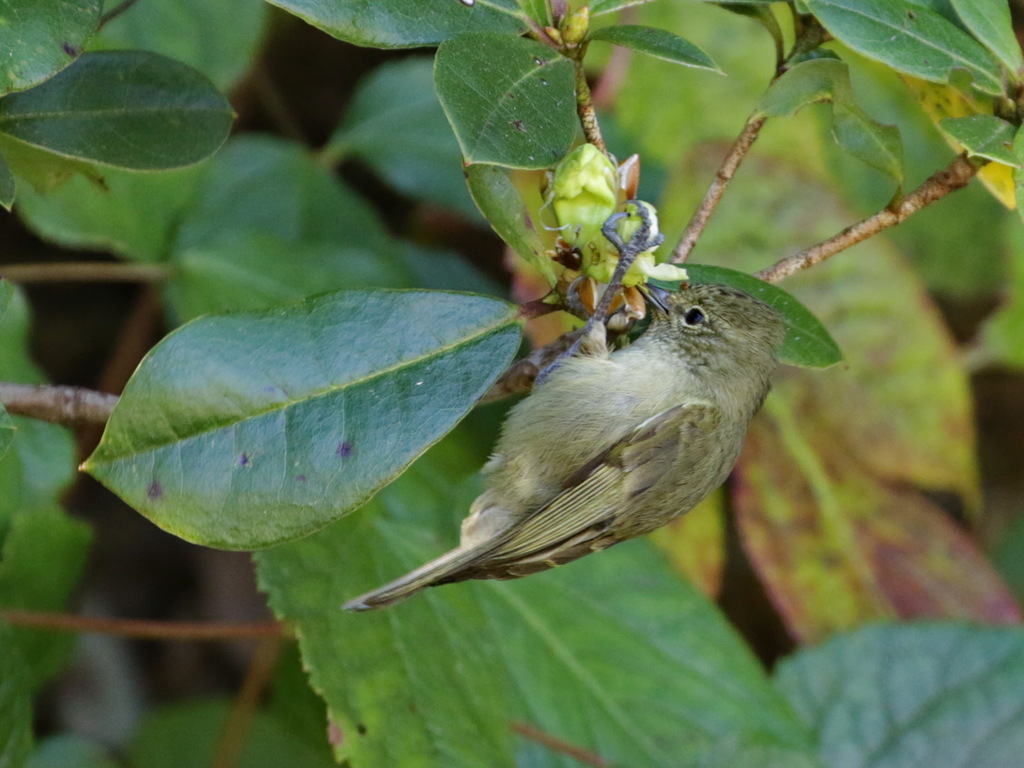
Yellow-browed Tit
Photo © Ian Dugdale
Photo © Ian Dugdale — CC BY 4.0 — Source: iNaturalist #303365125Identification
The Yellow-browed Tit is the smallest member of the Paridae family, measuring just 9–10 cm in length and weighing a mere 5–9 grams. Despite its diminutive size, it is a striking bird with distinctive plumage. Its upperparts from crown to back are olive-green with a slightly greyer forehead, while the wings and tail are greyish-brown with green edges and faint yellow at the tail's base. The face is olive-green with subtle yellow flecks, and the bird's most characteristic feature is a short, faint yellow line above the eye paired with a thin yellow ring encircling it—the "yellow brow" that gives the species its name. The throat and underparts are dull olive-yellow, paler on the belly. Males and females are indistinguishable in appearance, and juveniles closely resemble adults, though their tail feathers are more pointed. When feathers become worn, the bird appears duller with a less prominent eyebrow line and browner wings.
Range & Habitat
The Yellow-browed Tit is found across southern Asia, primarily throughout the southern Himalayas, Northeast India, and southern China, with smaller populations in Southeast Asia. Three subspecies are recognised, with distribution spanning from Kashmir eastward through the Himalayas to Southeast Tibet, Yunnan, and extending through Myanmar, Thailand, Laos, and Vietnam. This species inhabits subtropical and tropical moist lowland and montane forests, showing a preference for areas dominated by oak and mixed tree species. At higher elevations, it occupies mossy forests with epiphytic vegetation and scrub near the tree line, while also frequenting willow thickets and apricot orchards. Outside the breeding season, it adapts to deciduous and evergreen forests with gardens and hillside bushes at lower elevations.
Behaviour & Diet
The Yellow-browed Tit is an active and restless forager, feeding primarily in the middle and higher parts of trees and tall bushes on small invertebrates, larvae, and seeds, though its diet is not extensively documented. It exhibits characteristic tit-like behaviour, often hanging acrobatically from twigs and leaves while searching for food. Outside the breeding season, it frequently joins mixed flocks with other tit species, green-backed tits, black-throated tits, various babblers, Eurasian treecreepers, goldcrests, and Blyth's leaf-warblers, moving through the forest in energetic, mixed-species associations.
The species is generally solitary, in pairs, or found in small groups during breeding season, which extends from at least April through May. Clutches typically consist of four to six eggs, with both parents participating in feeding chicks. Adults become notably defensive when protecting their young. The bird produces a distinctive short, high-pitched song transcribed as "tsit," "psit," or "pit," along with harsher "chip" or "tchup" notes. When agitated or producing longer calls, it utters a ringing "tszizizizizi tszizizizizi" or repeated high-pitched "tee" or "tzee-tzee" sounds.
Best Time & Places to See It
The Yellow-browed Tit is best observed during the breeding season from April through May when birds are more vocal and active in establishing territories. The species favours montane and submontane forests throughout its range, and birders should focus on oak-dominated and mixed forests in the Himalayan regions, particularly in Nepal, Northeast India, and southern China. Outside breeding season, look for mixed feeding flocks in deciduous and evergreen forests at lower elevations, typically between 900 and 2,800 meters depending on location.
Photography Tips
The Yellow-browed Tit's tiny size and rapid, restless movements present a significant challenge for photographers. Fast shutter speeds (at least 1/1000th second) are essential to freeze its quick, acrobatic movements as it hangs from foliage. The bird's preference for feeding in the middle to upper canopy means positioning yourself at eye level or slightly above will improve your chances of clear shots without excessive backlighting. Its greenish plumage blends easily with forest foliage, so watching for movement and listening for its high-pitched calls will help locate individuals. Early morning light in montane forests provides the best illumination for capturing the subtle yellow facial markings and overall plumage detail that characterise this elegant little tit.
Langtang National Park
Helambu, Nepal
+364 birds+14 mammals
Where the southern slopes of the Himalayan highlands descend toward the subtropical valleys of central Nepal, Langtang National Park sprawls across one of the subcontinent's most…
VIEW NATIONAL PARKSagarmatha National Park
Khumjung, Nepal
+219 birds+7 mammals
Soaring peaks and deep glacial valleys define this alpine wilderness in northeastern Nepal, where the terrain rises from forested foothills into a realm of high-altitude tundra…
VIEW NATIONAL PARKKhangchendzonga National Park
Sakkyong, India
+290 birds+1 mammals
Where the eastern Himalayas surge toward their crowning peaks, Khangchendzonga National Park embraces a landscape of almost overwhelming vertical drama. Rising from subtropical river valleys into…
VIEW NATIONAL PARKNanda Devi National Park
Garpak, India
+218 birds+5 mammals
Where the Himalayas surge into their most dramatic alpine amphitheater, a wilderness of raw geological power unfolds across 624 square kilometers of pristine terrain. Nanda Devi,…
VIEW NATIONAL PARKWuyishan National Park
Yanshan County, China
+141 birds+2 mammals
Where subtropical monsoon rains sustain a perpetually humid landscape, Wuyishan National Park rises from Fujian's eastern plateau as a realm of forested ridges, cascading streams, and…
VIEW NATIONAL PARKWolong National Nature Reserve
Wenchuan County, China
+333 birds+17 mammals
Where the Qingyi River cuts through the eastern flanks of the Minshan Range, a temperate montane forest cloaks steep valleys in dense canopy that thins dramatically…
VIEW NATURE RESERVEGaoligong Mountain National Nature Reserve
Nujiang Lisu Autonomous Prefecture, China
+443 birds+13 mammals
VIEW NATURE RESERVENo community photos yet. Log in to add the first one.
No community observations of this species yet.