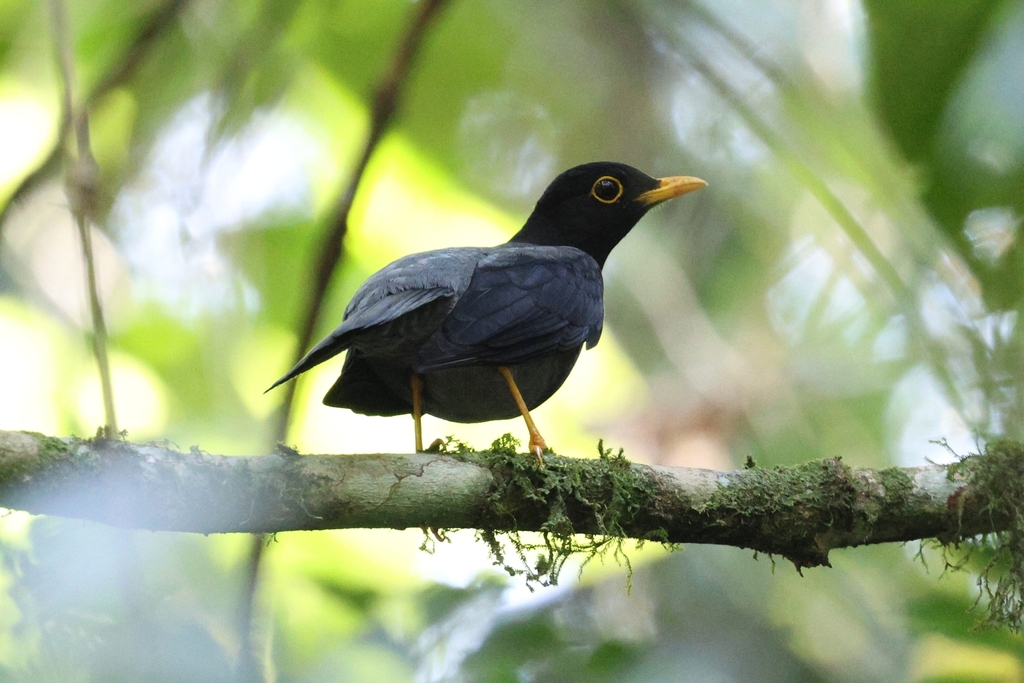
Yellow-legged Thrush
Photo © Miguel
Photo © Miguel — CC BY-SA 4.0 — Source: iNaturalist photo #423593702Identification
The yellow-legged thrush is a medium-sized thrush, 20–22 cm long and weighing 55–72 g, with striking sexual dimorphism. Males of the nominate subspecies are predominantly black on the head, wings, tail, and breast, contrasting with slate-gray back, rump, flanks, belly, and vent. Both sexes display the species' most distinctive feature: bright yellow eye-ring, bill, legs, and feet. Females are notably different, with warm darkish brown upperparts and head, paler orangey-brown throat and underparts, and a dull bill. Juveniles show buffy-orange spots on crown, nape, and back. Five subspecies occur across the range, with plumage variations; some males are paler gray or entirely black depending on subspecies.
Range & Habitat
This highly disjunct species is found across northern South America and southeastern Brazil, occurring in Venezuela, Colombia, Guyana, Brazil, Trinidad, and Tobago, with historical records from Argentina and Paraguay. Elevations vary by region: Venezuelan birds range from 480–2,500 m north of the Orinoco, 1,000–1,800 m south of it, and 100–900 m on Isla Margarita. Brazilian populations inhabit sea level to 2,000 m in the south, but only above 1,000 m in the north. The species favors the interior, edges, and clearings of humid primary and secondary forest and woodlands, also frequenting shade coffee plantations.
Behaviour & Diet
The yellow-legged thrush is a partial migrant; the southernmost Brazilian population moves north during the austral winter, while other populations show poorly documented movements. It feeds predominantly on fruit, supplemented with insects, foraging at all forest levels but rarely on the ground. It sometimes feeds in small groups at fruiting trees and occasionally joins mixed-species flocks. Breeding seasons vary geographically: June, September, and December in Colombia; March to July on Trinidad; November to January in southeastern Brazil. The species constructs shallow cup nests from roots, mud, and moss in niches on earthen banks or rock faces, occasionally in bromeliads. Clutches consist of two pale blue to greenish-blue eggs marked with reddish-brown spots.
Best Time & Places to See It
The yellow-legged thrush is fairly common in Venezuelan mountains and rare to uncommon in southeastern Brazil, where it is considered frequent in some areas. To locate this species, visit humid forest interiors and edges at appropriate elevations: 1,000–2,000 m in southeastern Brazil, 480–2,500 m in Venezuela depending on location. Listen for its distinctive loud, energetic song from high perches, especially during the breeding season, which spans most of the year depending on region. In Venezuela, breed during the first half of the year, while Brazilian birds breed November to January. Early morning visits to primary forest and shade plantations offer the best chance of encounters.
Photography Tips
The bright yellow facial features, legs, and feet of both males and females provide excellent color contrast for photography. Males are particularly striking with their black and gray plumage, while females offer warmer brown tones. Photograph singing birds perched at the forest canopy top, where they typically vocalize. Use a fast shutter speed to capture their active foraging movements through all forest levels. The species' preference for fruiting trees offers opportunities for feeding behavior shots. Early morning light enhances the visibility of yellow facial markings and plumage details. In montane regions, changing elevation within humid forests may help locate different subspecies.
Tijuca National Park
Brazil
+317 birds+13 mammals
Where the Atlantic forest rises steeply from Rio de Janeiro's urban edge, Tijuca National Park encompasses a landscape of dramatic granite peaks, cascading waterfalls, and closed-canopy…
VIEW NATIONAL PARKSerra do Cipó National Park
Brazil
+379 birds+5 mammals
Where granite escarpments rise above the Atlantic Forest transition zone in southeastern Brazil, Serra do Cipó National Park unfolds across a landscape of dramatic ridges, cascading…
VIEW NATIONAL PARKNatural Serranía de los Yariguíes National Park
El Carmen de Chucurí, Colombia
+320 birds+3 mammals
Where the northern cordilleras of Colombia rise toward cloud forest, the Serranía de los Yariguíes unfolds across nearly 1,820 square kilometers of some of the most…
VIEW NATIONAL PARKEl Tamá National Park
Toledo, Colombia
+435 birds
Where the Andes descend toward the Caribbean coastal lowlands of northern Colombia, El Tamá National Park sprawls across nearly 3,800 square kilometres of montane forest, cloud…
VIEW NATIONAL PARKItatiaia National Park
Brazil
+519 birds+12 mammals
Where granite peaks pierce the Atlantic rainforest canopy in southeastern Brazil, Itatiaia National Park rises as one of the country's oldest and most ecologically vital protected…
VIEW NATIONAL PARKSuperagui National Park
Brazil
+246 birds+2 mammals
Where the Atlantic rainforest meets the subtropical coast of Paraná, Superagui National Park sprawls across more than 1,000 square kilometres of one of Brazil's most biodiverse…
VIEW NATIONAL PARKSaint-Hilaire/Lange National Park
Brazil
+225 birds
Subtropical Atlantic forests rise and fall across the plateaus of inland Paraná, where Saint-Hilaire/Lange National Park protects nearly 578 square kilometres of Brazil's most biodiverse woodland…
VIEW NATIONAL PARKSerra do Itajaí National Park
Brazil
+227 birds+2 mammals
Where the Atlantic rainforest rises steeply from the coastal plains of Santa Catarina, Serra do Itajaí National Park spreads across 1,136 square kilometres of montane wilderness…
VIEW NATIONAL PARKSerra da Bocaina National Park
Brazil
+441 birds+5 mammals
Where the escarpment of the Serra da Bocaina rises sharply from the Atlantic coastal plain, tropical rainforest cloaks steep mountainsides that climb toward peaks exceeding 2,000…
VIEW NATIONAL PARKSão Joaquim National Park
Brazil
+222 birds+9 mammals
Where the southern Brazilian highlands rise above the Atlantic Forest, São Joaquim National Park protects nearly 1,000 square kilometers of montane terrain that shifts between temperate…
VIEW NATIONAL PARKMonte Roraima National Park
Brazil
+226 birds+1 mammals
Where the tepuis rise from the Amazon basin like islands in a sea of forest, Monte Roraima National Park sprawls across 3,714 square kilometres of one…
VIEW NATIONAL PARKSerra dos Órgãos National Park
Brazil
+446 birds+13 mammals
Granite peaks thrust skyward through the Atlantic Forest canopy in the mountains immediately north of Rio de Janeiro, their bare rock faces rising above a landscape…
VIEW NATIONAL PARKSerra do Gandarela National Park
Brazil
+333 birds+3 mammals
Where granite massifs rise through Atlantic Forest in southeastern Brazil's highlands, Serra do Gandarela National Park protects nearly 1,000 square kilometres of montane terrain that few…
VIEW NATIONAL PARKSerra Geral National Park
Brazil
+211 birds+2 mammals
Where basalt cliffs and sandstone escarpments rise above the subtropical forests of southern Brazil, Serra Geral National Park preserves one of the Atlantic region's most dramatic…
VIEW NATIONAL PARKNo community photos yet. Log in to add the first one.
No community observations of this species yet.