Identification
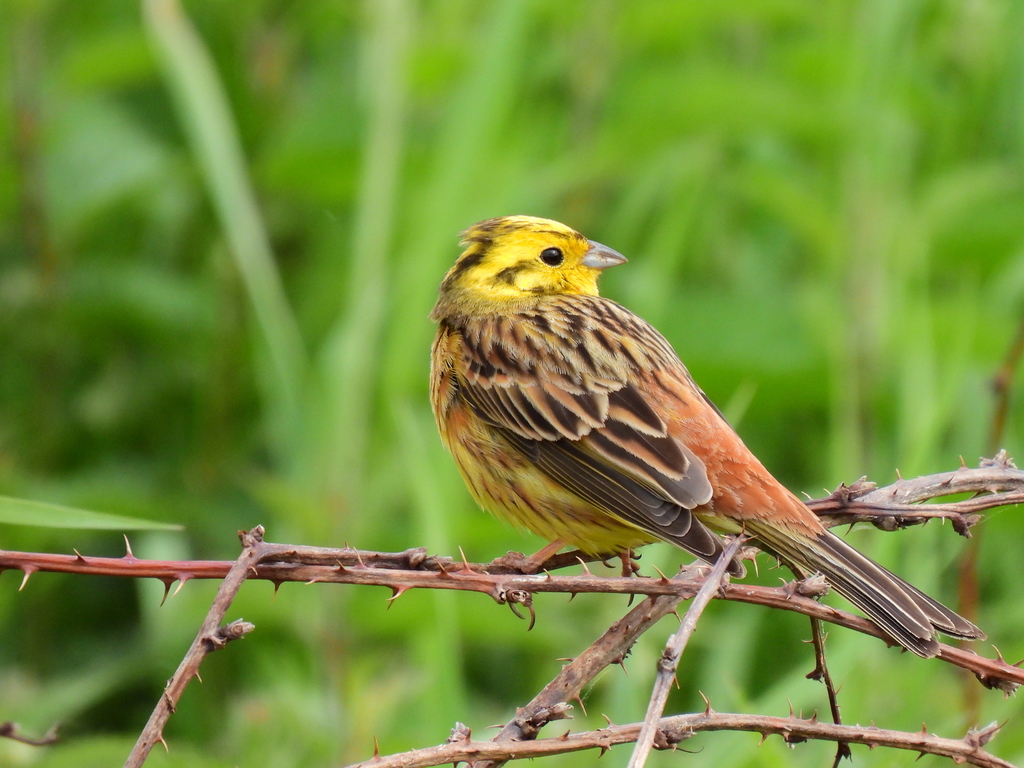
The yellowhammer is a large bunting, measuring 16–16.5 cm in length with a wingspan of 23–29.5 cm. The male of the nominate subspecies is unmistakable: a bright yellow head and underparts contrast sharply with a heavily streaked brown back and distinctive chestnut rump, along with white outer tail feathers. Females are considerably duller and more heavily streaked on the crown, breast, and flanks, while juveniles are much duller overall with less yellow plumage and a paler rump. Outside the breeding season, dark fringes on new feathers obscure the bright yellow plumage in both sexes. Subspecific variation is subtle and gradual; the western form E. c. caliginosa is slightly smaller and darker with more back streaking, while the eastern E. c. erythrogenys is paler and less streaked, with brighter yellow on the crown and throat.
Females and juveniles may be confused with pine buntings, but yellowhammers always retain a yellow tint to their plumage, a paler rufous rump, and more uniform upperparts. They can be distinguished from cirl buntings by their rufous rather than grey-brown rump. Male hybrids with pine buntings typically have white faces with some yellow on the head or underparts, while females are usually indistinguishable from yellowhammers.
Range & Habitat
The yellowhammer is native to Eurasia and has been introduced to New Zealand and Australia. Three subspecies are recognized: E. c. citrinella occurs in southeast England and most of Europe east to northwestern Russia and western Ukraine; E. c. caliginosa is found in Ireland, the Isle of Man, and Great Britain (except southeast England); and E. c. erythrogenys breeds from Russia and central Ukraine eastwards to Siberia and northwest Mongolia, with isolated populations east of the Black Sea and in the Caucasus. Most European birds remain in their breeding range year-round, but the eastern subspecies is partially migratory, with much of the population wintering further south.
The species is common in open areas with some shrubs or trees, where it forms small flocks in winter. Population declines have occurred in western Europe due to changes in agricultural practices, though its large numbers and huge range mean it is classified as least concern by the International Union for Conservation of Nature.
Behaviour & Diet
Yellowhammers are highly vocal birds; the male's song is a series of short notes that gradually increase in volume, followed by one or two more protracted notes, classically represented as "A little bit of bread and no cheese." This song is very similar to that of the closely related pine bunting, with which yellowhammers interbreed where their ranges meet. The male acquires progressively more yellow in his plumage with each moult after breeding.
Breeding commences mainly in April and May, with females building a lined cup nest in a concealed location on or near the ground. Clutches of three to five eggs are distinctively patterned with a fine mesh of dark lines—a characteristic that gave rise to the old names "scribble lark" or "writing lark." The female incubates for 12–14 days and broods the altricial chicks until fledging at 11–13 days; both adults feed the chicks and typically raise two or three broods annually. Outside the breeding season, yellowhammers feed on the ground in flocks, primarily on seeds supplemented by invertebrates during breeding season. Nests may be raided by rodents or corvids, and adults are hunted by birds of prey.
Best Time & Places to See It
Yellowhammers are conspicuous birds most easily observed in open countryside with scattered shrubs or trees. Winter is an excellent season for observation, as birds form small, accessible flocks during this period. The breeding season from April through summer offers opportunities to locate birds through their distinctive and characteristic song, which should guide you to suitable habitat across much of Europe.
Photography Tips
The bright yellow plumage of breeding males makes yellowhammers relatively straightforward to photograph, but their preference for open habitats with scattered vegetation requires patience and careful approach. Winter flocks offer good opportunities for photography as birds are more concentrated and predictable. Photograph breeding males during April to June when plumage is brightest and least obscured by dark feather fringes. The distinctive chestnut rump is an excellent identifying feature to capture in flight shots, and the white outer tail feathers provide useful compositional elements. Females and juveniles present greater photographic challenges due to their duller plumage and heavier streaking, but capturing both sexes will create a comprehensive record of the species' plumage variation.
Abel Tasman National Park
Abruzzo, Lazio and Molise National Park
Aggtelek National Park
Alpilles Regional Nature Park
Aoraki / Mount Cook National Park
Appennino Lucano Val d’Agri Lagonegrese National Park
Arthur’s Pass National Park
Åsnens National Park
Avesnois Regional Nature Park
Nothing matches these filters.
No community photos yet. Log in to add the first one.
No community observations of this species yet.