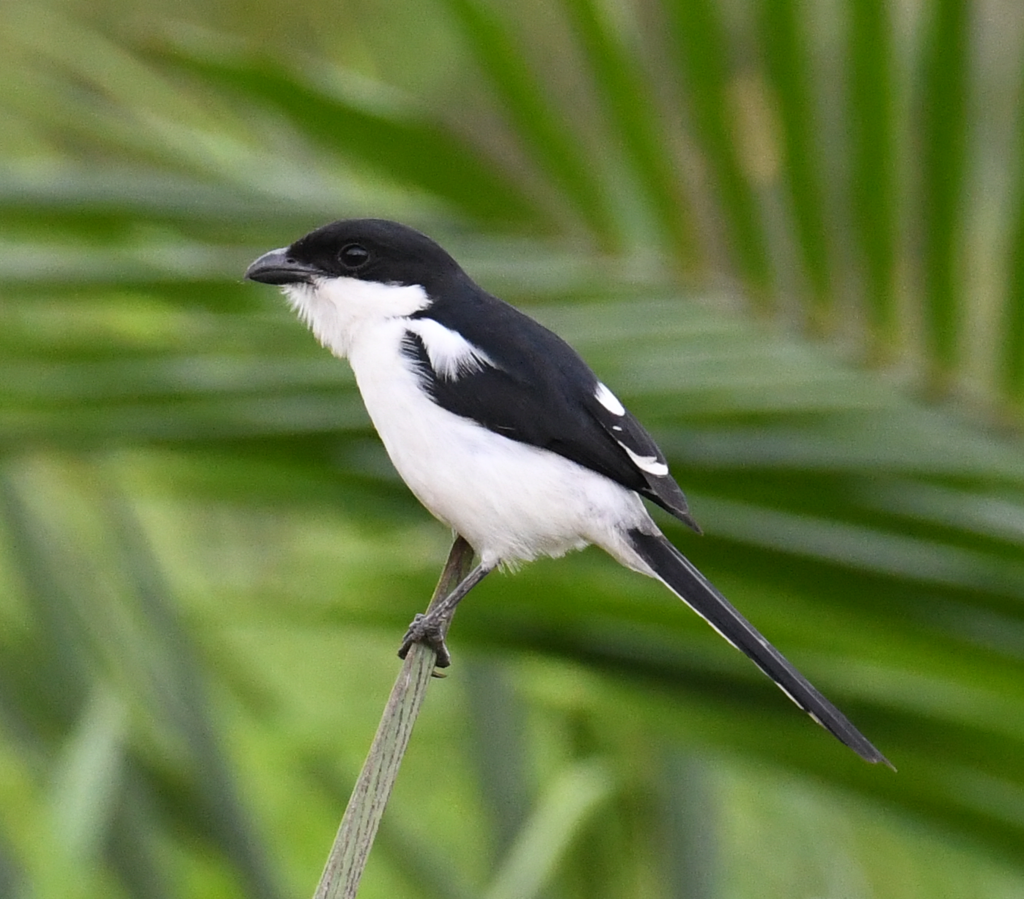
Alcaudón fiscal norteño
Photo © Ben Keen
Photo © Ben Keen — CC0 1.0 — Source: iNaturalist photo #353550264Identificación
El alcaudón norteño es un pájaro llamativo y bastante inconfundible, que mide entre 21 y 23 cm de largo. Su rasgo más reconocible es su plumaje audaz en blanco y negro, que recuerda a un formal 'traje y corbata'—una similitud que inspiró su nombre común, derivado de la palabra 'fiscal' que significa recaudador de impuestos. Las partes superiores del pájaro, incluidas la cabeza y el lomo, son de un negro azabache, mientras que las partes inferiores son blancas. Una característica 'V' blanca marca el lomo, y la cola relativamente larga es negra con plumas exteriores blancas y puntas blancas en las plumas restantes. El pico, los ojos y las patas son todos negros. Los machos y las hembras son muy similares en apariencia, aunque las hembras pueden distinguirse por la coloración rufa en sus flancos inferiores.
Distribución y Hábitat
El alcaudón norteño se encuentra en gran parte del África subsahariana, con tres subespecies reconocidas distribuidas en diferentes regiones: desde el África occidental (raro en Mauritania y Mali) pasando por el África central y la cuenca del Congo, hasta el África oriental incluyendo Etiopía, Kenia, Tanzania, y regiones meridionales que se extienden hasta Angola y Mozambique. La especie fue anteriormente agrupada con el alcaudón sureño bajo el nombre colectivo 'alcaudón común', pero ahora se reconocen como especies distintas.
Este pájaro adaptable ocupa una amplia variedad de hábitats, desde pastizales abiertos salpicados de cercas y otras oportunidades de perchas, hasta matorral espinoso de acacia y bosque disperso. El requisito clave es la disponibilidad de perchas expuestas para la caza; la especie evita hábitats muy densos donde la vegetación densa obstaculizaría su estrategia de caza.
Comportamiento y Dieta
El alcaudón norteño es típicamente solitario y emplea un estilo de caza característico, observando la presa desde una percha expuesta o desde los extremos de arbustos antes de atacar. Su dieta consiste principalmente en insectos y pequeños roedores. Interesantemente, el tamaño del territorio de un pájaro individual está directamente relacionado con la densidad de perchas de caza disponibles en su rango—los pájaros en áreas con más perchas pueden defender territorios más pequeños, permitiendo densidades de población más altas. Esta relación ha sido demostrada mediante estudios donde la instalación de perchas artificiales causó que los alcaudones redujeron el tamaño de su territorio y toleraran más pájaros en el área afectada.
Mejores Épocas y Lugares para Observarlo
La preferencia del alcaudón norteño por hábitats abiertos con perchas dispersas lo convierte en un alcaudón relativamente visible en toda su distribución. Búscalo en pastizales con cercas, bosques de acacia y hábitats de matorral espinoso en toda el África subsahariana. La naturaleza solitaria de la especie y su uso de perchas expuestas hacen que a menudo sea avistado encaramado prominentemente, lo que lo convierte en una recompensa para observadores pacientes en hábitats adecuados.
Consejos de Fotografía
La coloración audaz en blanco y negro del alcaudón norteño y su hábito de encaramarse abiertamente en puntos de vista prominentes lo convierten en un excelente sujeto fotográfico. Posiciónate para fotografiar el pájaro en sus perchas favoritas, donde el fuerte contraste de su plumaje será llamativo, particularmente bajo la luz africana brillante. La característica 'V' blanca en el lomo y la cola con punta blanca son características distintivas que vale la pena capturar. La luz de primeras horas de la mañana o de última hora de la tarde realzará la apariencia llamativa del pájaro y creará sombras más dramáticas que enfaticen su patrón contrastante.
Serengeti National Park
Arusha National Park
Virunga National Park
Volcanoes National Park
Kidepo Valley National Park
Murchison Falls National Park
Mgahinga Gorilla National Park
Lake Mburo National Park
Tsavo East National Park
Tsavo West National Park
Mount Elgon National Park
Amboseli National Park
Kilimanjaro National Park
Mount-Kenya National Park
Tarangire National Park
Ngorongoro Conservation Area
Toro-Semliki Proposed National Park
Queen Elizabeth National Park
Mabamba Swamp
Ziwa Rhino and Wildlife Ranch
Abijata-Shalla Lakes National Park
Bale Mountains National Park
Mago National Park
Awash National Park
Simien Mountains National Park
Nech Sar National Park
Yabelo Wildlife Sanctuary
Nairobi National Park
Lake Nakuru National Park
Aberdare National Park
Meru National Park
Samburu National Reserve
Ruma National Park
Saiwa Swamp National Park
Chyulu Hills National Park
Ol Donyo Sabuk National Park
Aún no hay fotos de la comunidad. Inicia sesión para añadir la primera.
Aún no hay observaciones de la comunidad de esta especie.