Golondrina angoleña
Photo © Lukas Zangl
Photo © Lukas Zangl — CC BY 4.0 — Source: iNaturalist #304438536Identification
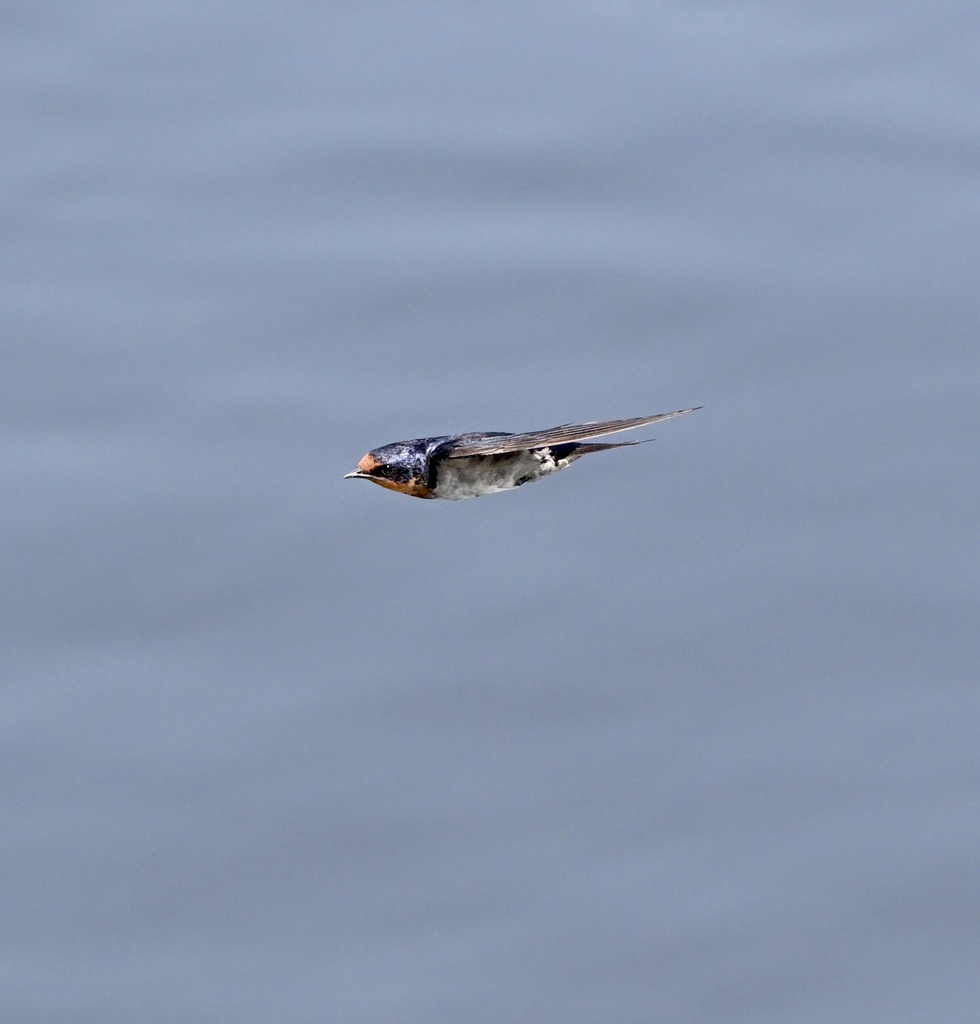
The Angola swallow is a small and striking passerine measuring 15 cm in length, with a lean weight of 16 to 19 grams. The species displays distinctive plumage that makes it recognizable in the field. Its most eye-catching feature is the deep rufous-chestnut colouring of the forehead, throat and upper breast, which contrasts beautifully with the shiny steel-blue crown and upperparts. The flight feathers and tail are black, with notably large white windows on the tail that are particularly visible in flight, providing an excellent field mark for identification.
Range & Habitat
This species is endemic to the Afrotropics and has a wide distribution across sub-Saharan Africa. The Angola swallow is found in Angola, Burundi, Democratic Republic of the Congo, Gabon, Kenya, Malawi, Namibia, Rwanda, Tanzania, Uganda, and Zambia. The species shows a preference for a variety of open habitats, ranging from natural grasslands and savannas to areas modified by human activity. They also frequent the fringes of forest margins, demonstrating considerable adaptability to different environmental conditions across their range.
Behaviour & Diet
Angola swallows are aerial insectivores with a diet consisting of a variety of flying insects captured in flight. They are flexible foragers that may hunt alone or congregate in flocks, depending on local conditions and food availability. These birds are vocally subtle, emitting weak twittering calls rather than loud vocalizations. Their breeding season and local abundance vary considerably across different regions of their range, reflecting the diversity of habitats and climatic conditions they inhabit. Notably, some populations undertake migrations, though the extent and timing of these movements depend on their specific location of residence.
Best Time & Places to See It
The best time and location to observe Angola swallows will depend on which part of their wide African range you are visiting, as breeding season and abundance vary regionally. The species occurs across multiple countries, with populations in East Africa represented by the subspecies H. a. arcticincta, while the nominate subspecies H. a. angolensis is found in western and central regions. Visitors to open habitats and savanna margins throughout their distribution in countries such as Tanzania, Kenya, Uganda, and Zambia stand a good chance of encountering this species. Since some populations are migratory, local timing and seasonal abundance should be confirmed with regional guides or birding resources before planning a visit.
Photography Tips
Photographing Angola swallows presents the typical challenges of capturing small, fast-moving aerial birds. Their frequent foraging flights make action photography the most rewarding approach; fast shutter speeds of at least 1/2000th of a second are essential to freeze their rapid movements. The distinctive white tail windows are a key identifying feature worth capturing, so aim for clear shots of the tail in flight when possible. The contrast between the deep rufous-chestnut breast and steel-blue upperparts renders beautifully in good light, so photography in morning or late afternoon sunshine will show the plumage colours at their best. When birds perch briefly on wires or dead branches—a behaviour they occasionally adopt—use these opportunities to capture detailed portraits showing the striking head and breast markings.
Rubondo Island National Park
Tanzania
+84 aves+14 mamíferos
Dawn breaks over Lake Victoria’s southwestern waters, revealing a primordial landscape where dense tropical forest cascades toward pristine shorelines. This […]
VER PARQUE NACIONALVirunga National Park
Uganda
+132 aves+30 mamíferos
Where the Rwenzori Mountains pierce the equatorial sky and volcanic slopes descend toward the Congo Basin, one of Africa’s most […]
VER PARQUE NACIONALBwindi Impenetrable National Park
Kanyashogi, Uganda
+132 aves+29 mamíferos
Steep valleys plunge through a tapestry of montane forest where mist clings to ancient trees and the undergrowth thrums with […]
VER PARQUE NACIONALVolcanoes National Park
Musanze District, Uganda
+111 aves+14 mamíferos
Where misty volcanic slopes rise through dense montane forest, the Virunga Mountains create one of Africa’s most dramatic ecosystems. These […]
VER PARQUE NACIONALMurchison Falls National Park
Uganda
+129 aves+30 mamíferos
Where the Victoria Nile surges through a narrow rocky chasm and plummets 43 metres in a thunderous cascade, Uganda’s oldest […]
VER PARQUE NACIONALMgahinga Gorilla National Park
Cyanika, Uganda
+132 aves+30 mamíferos
Where the Virunga volcanic chain rises in southwestern Uganda, montane forest cloaks three dormant peaks in an emerald embrace. The […]
VER PARQUE NACIONALMabamba Swamp
Memere, Uganda
150+ aves
Where papyrus stands shoulder-high and water mirrors an infinite sky, one of Africa’s most biodiverse wetland systems unfolds across 283 […]
VER RESERVA NATURALAún no hay fotos de la comunidad. Inicia sesión para añadir la primera.
Aún no hay observaciones de la comunidad de esta especie.