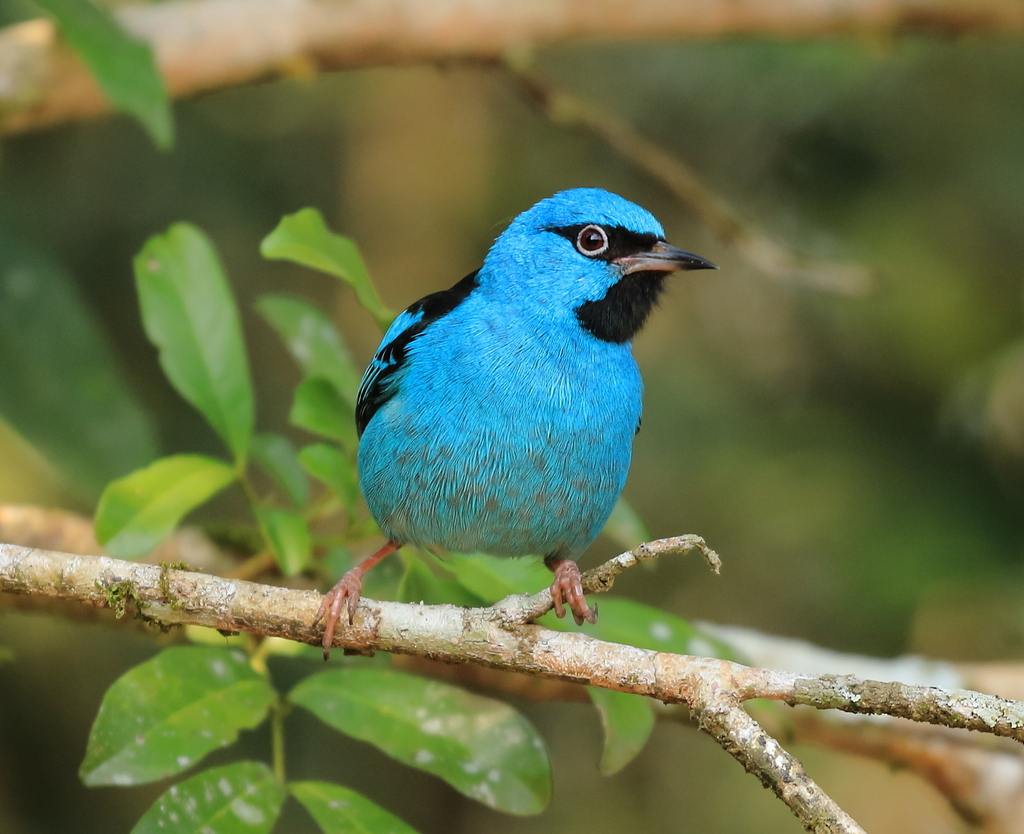
Dacnis Azul
Photo © Darren Obbard
Photo © Darren Obbard — CC BY 4.0 — Source: iNaturalist photo #425659477The blue dacnis or turquoise honeycreeper (Dacnis cayana) is a small passerine bird. This member of the tanager family is found from Nicaragua to Panama, on Trinidad, and in South America south to Bolivia and northern Argentina. It is widespread and often common, especially in parts of its South American range. == Taxonomy == In 1760, the French zoologist Mathurin Jacques Brisson included a description of the blue dacnis in his Ornithologie based on a specimen collected in Cayenne in French Guiana. He used the French name Le Pepit bleu de Cayenne and the Latin name Sylvia cayanensis caerulea. Although Brisson coined Latin names, these do not conform to the binomial system and are not recognised by the International Commission on Zoological Nomenclature. When in 1766 the Swedish naturalist Carl Linnaeus updated his Systema Naturae for the twelfth edition he added 240 species that had been previously described by Brisson. One of these was the blue dacnis. Linnaeus included a terse description, coined the binomial name Motacilla cayana and cited Brisson's work. The specific name cayana is from Cayenne. This species is now placed in the genus Dacnis that was introduced in 1816 by the French naturalist Georges Cuvier with…
Tijuca National Park
Brasil
+127 aves+30 mamíferos
Where Atlantic rainforest clings to steep granite slopes mere kilometres from Rio de Janeiro’s urban sprawl, one of Brazil’s most […]
VER PARQUE NACIONALEmas National Park
Brasil
+128 aves+29 mamíferos
Vast grasslands ripple across the central Brazilian plateau, where fire has sculpted the landscape for millennia. Parque Nacional das Emas […]
VER PARQUE NACIONALSerra do Cipó National Park
Brasil
+137 aves+24 mamíferos
Where granite peaks claw through the Brazilian cerrado and Atlantic Forest transition zones, crystalline streams cascade down escarpments carved over […]
VER PARQUE NACIONALManuel Antonio National Park
Quepos, Costa Rica
+125 aves+30 mamíferos
White sand beaches curve between steep jungle walls where the Pacific laps against Costa Rica’s most biodiverse coastal sanctuary. Rainforest […]
VER PARQUE NACIONALYasuní National Park
Aguarico, Ecuador
+132 aves+30 mamíferos
Where the Napo and Curaray rivers carve through Ecuador’s vast Amazonian lowlands, one of Earth’s most biodiverse terrestrial ecosystems sprawls […]
VER PARQUE NACIONALNatural Sierra de Chiribiquete National Park
Solano, Colombia
+130 aves+23 mamíferos
Where tabletop mountains rise abruptly from the Colombian Amazon, a landscape of almost alien majesty unfolds across nearly 87,000 square […]
VER PARQUE NACIONALNatural Utría National Park
Alto Baudó (Pie de Pató), Colombia
+144 aves+15 mamíferos
Where the Chocó rainforest plunges headlong into the Pacific, a pristine coastal wilderness unfolds across 1,287 square kilometers of Colombia’s […]
VER PARQUE NACIONALNatural Serranía de los Churumbelos National Park
Santa Rosa, Colombia
+145 aves+15 mamíferos
Where the Andes’ western cordillera surrenders to the Pacific watershed, a fortress of granite peaks and cloud-draped valleys rises across […]
VER PARQUE NACIONALNatural el Cocuy National Park
Güicán, Colombia
+139 aves+13 mamíferos
Where snow-capped peaks pierce the Colombian highlands at over 5,000 metres, a landscape of stark geological drama unfolds across nearly […]
VER PARQUE NACIONALItatiaia National Park
Brasil
+141 aves+19 mamíferos
Where granite peaks thrust through Atlantic Forest mist, Brazil’s oldest national park commands the border between Rio de Janeiro and […]
VER PARQUE NACIONALUbajara National Park
Brasil
+31 aves+1 mamíferos
Where limestone escarpments rise dramatically from northeastern Brazil’s Atlantic Forest plateau, a pocket of pristine wilderness guards some of the […]
VER PARQUE NACIONALSerra da Bocaina National Park
Brasil
+132 aves+30 mamíferos
Where Atlantic rainforest meets coastal escarpment, a landscape of dramatic elevation transforms within mere kilometers from sea level to peaks […]
VER PARQUE NACIONALViruá National Park
Brasil
+103 aves+14 mamíferos
Where granite inselbergs rise dramatically from the Amazon’s northern fringe, a 3,651-square-kilometre wilderness unfolds across Roraima State. This Category II […]
VER PARQUE NACIONALGuaricana National Park
Brasil
+34 aves+5 mamíferos
Where crystalline streams cascade through Atlantic Forest canopy and sandstone plateaus rise dramatically above the lowlands, Brazil’s Guaricana unfolds across […]
VER PARQUE NACIONALIguaçu National Park
Brasil
+133 aves+29 mamíferos
Where the Paraná Plateau drops away in a thunderous cascade, one of Earth’s most spectacular waterfall systems tears through subtropical […]
VER PARQUE NACIONALPau Brasil National Park
Brasil
+27 aves+5 mamíferos
Where Atlantic forest remnants cling to Brazil’s northeastern plateau, a landscape of dramatic escarpments and seasonal waterfalls reveals one of […]
VER PARQUE NACIONALSerra dos Órgãos National Park
Brasil
+130 aves+30 mamíferos
Dramatic peaks of Precambrian granite thrust skyward from the Atlantic Forest floor, their weathered faces etched by millennia of wind […]
VER PARQUE NACIONALChapada dos Guimarães National Park
Brasil
+146 aves+15 mamíferos
Where granite plateaus rise abruptly from central Brazilian cerrado, ancient escarpments reveal a landscape of extraordinary drama and ecological complexity. […]
VER PARQUE NACIONALChapada dos Veadeiros National Park
Brasil
+143 aves+19 mamíferos
Where granite plateaus rise abruptly from central Brazil’s cerrado savanna, ancient quartzite formations create a landscape of breathtaking geological drama. […]
VER PARQUE NACIONALChapada Diamantina National Park
Brasil
+100 aves+5 mamíferos
Where granite plateaus rise dramatically from the Atlantic Forest’s green embrace, a landscape of profound geological drama unfolds across the […]
VER PARQUE NACIONALSerra do Gandarela National Park
Brasil
150+ aves+9 mamíferos
Where granite peaks thrust upward through Atlantic Forest mist, the landscape reveals itself in dramatic relief—a montane wilderness sprawling across […]
VER PARQUE NACIONALBrasília National Park
Plano Piloto, Brasil
+122 aves+30 mamíferos
Where granite escarpments rise above the cerrado grasslands of central Brazil, a vast sanctuary unfolds across 1,077 square kilometres of […]
VER PARQUE NACIONALAmazônia National Park
Brasil
+74 aves+8 mamíferos
Dawn breaks over a realm where the Rio Tapajós cuts through the heart of the Brazilian Amazon, its dark waters […]
VER PARQUE NACIONALMapinguari National Park
Brasil
+120 aves+30 mamíferos
Where the Amazon’s southwestern frontier meets the Xingu Basin, vast tracts of pristine tropical forest rise and fall across nearly […]
VER PARQUE NACIONALSerra Geral National Park
Brasil
+124 aves+14 mamíferos
Where granite escarpments rise abruptly from the Atlantic Forest canopy, a landscape of dramatic canyons and windswept plateaus defines one […]
VER PARQUE NACIONALSerra do Divisor National Park
Brasil
+132 aves+30 mamíferos
Where the Ucayali River carves its ancient path through northwestern Brazil, rainforest canopy rises in unbroken waves across nearly 27,000 […]
VER PARQUE NACIONALBahuaja Sonene National Park
San Pedro de Putina Punco, Perú
+132 aves+30 mamíferos
Where granite ridges rise above the confluence of Peru’s Río Heath and Río Tambopata, one of the Amazon’s most pristine […]
VER PARQUE NACIONALSoberanía National Park
Cristóbal, Panamá
+132 aves+30 mamíferos
Where the Chagres River cuts through lowland tropical forest mere kilometres from Panama City’s skyline, one of Central America’s most […]
VER PARQUE NACIONALChagres National Park
Caimitillo, Panamá
+131 aves+30 mamíferos
Where rainforest canopy meets mountain spine, the Chagres River carves through some of Central America’s most pristine tropical wilderness. Spanning […]
VER PARQUE NACIONALDarién National Park
Tucutí, Panamá
+132 aves+30 mamíferos
Where rainforest swallows the horizon and rivers carve through primordial wilderness, one of Central America’s last great untamed frontiers unfolds […]
VER PARQUE NACIONALAún no hay fotos de la comunidad. Inicia sesión para añadir la primera.
Aún no hay observaciones de la comunidad de esta especie.