Cosifa Cafre
Photo © agujaceratops
Photo © agujaceratops — CC BY 4.0 — Source: iNaturalist #134950899Identification
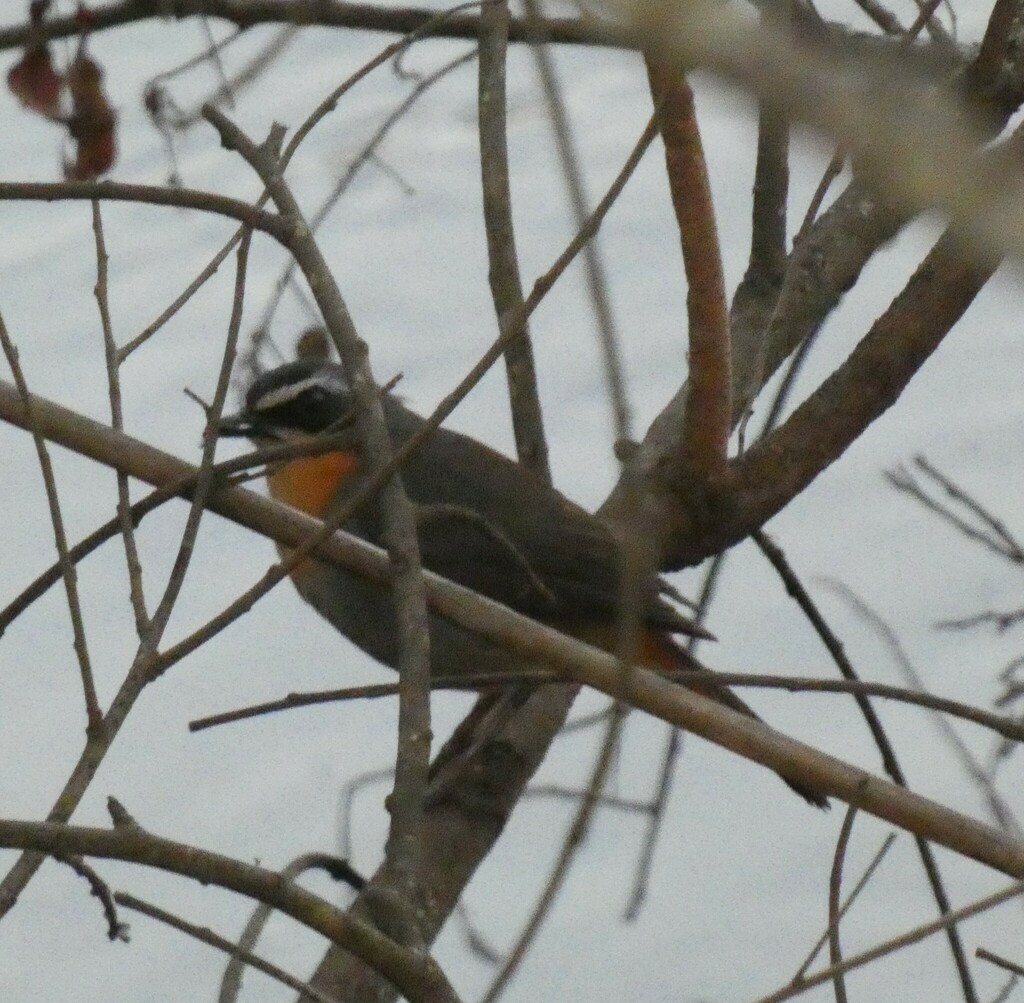
The Cape robin-chat is a small passerine measuring 16–17 cm long and weighing 28 g. Adults of both sexes are similar in appearance, featuring grey upper parts with a brownish-olive tinge on the mantle and secondary feathers. The most distinctive feature is a prominent white supercilium (eyebrow stripe) that separates the blackish lores and ear coverts from the crown. The chin, throat, central breast, rump, and outer tail feathers are bright orange, which deepens to a richer hue during the non-breeding season. The belly is pale grey to white with buffy undertail coverts. The bird sports a fairly straight, short black bill with a slightly downward curve, black legs and feet, and brown eyes. Juveniles lack the white supercilium and are dark brown above and buff below, with distinctive yellow soles on their feet—unique among robin-chats. Immatures resemble adults but retain some buff-tipped greater wing coverts.
Range & Habitat
This species has a disjunct range spanning from South Sudan southwards through Uganda, the Democratic Republic of Congo, Kenya, Tanzania, Zambia, Malawi, Zimbabwe, Namibia, South Africa, Eswatini, and Lesotho. The Cape robin-chat is a mainly resident breeder in eastern and southern Africa, though some populations migrate more than 100 km to lower, warmer regions during winter, while others remain year-round residents even at high altitudes. It has successfully colonized man-altered habitats including city suburbs and farmstead woodlots. The bird frequents bracken-briar fringes of Afromontane forest and prefers drier settings or higher altitudes rather than entering deep forest. Its altitudinal range varies by region: in Zimbabwe it occurs between 1,400 m and 2,200 m, while south of the Limpopo it utilizes habitats from sea level to 3,000 m.
Behaviour & Diet
The Cape robin-chat is an accomplished songster with a clear, ringing song delivered in short phrases, sometimes by competing males simultaneously. The song consists of passages of 4 to 10 whistled syllables beginning with a low, slurred whistle followed by improvised notes, rendered as "cherooo-weet-weet-weeeet" followed by a pause. Singing peaks at dawn and dusk, typically from within but near the top of trees or bushes, and may continue uninterrupted for an hour or more, sometimes extending into darkness. Males cease singing during post-breeding moult, and females sing equally well in the absence of their mates. The species has a distinctive harsh, low, trisyllabic alarm call rendered as "WA-dur-dra" or "TURR-da-da," which has given rise to local names such as "Jan frederik." The bird forages in proximity to cover in open or fairly well-lit environments. Like other robin-chats, it may mimic other bird species; one individual was recorded mimicking a total of 36 bird species. Anxious birds utter a plaintive, descending peeeeeuu note when threatened.
Best Time & Places to See It
The Cape robin-chat is a locally familiar and confiding species that benefits from its association with man-altered habitats, making it accessible to travellers in suburban and farmstead settings across its range. The bird is particularly common in montane regions; in Malawi it is common above 1,500 m, and similar elevations favour sightings elsewhere. Being a mainly resident breeder, the species is present year-round throughout much of its range, though winter visitors from higher altitudes may appear in lower, warmer regions. Early morning and dusk are the best times to encounter singing birds, as singing peaks during these periods. A five-year tenure of breeding territories by the same pair is commonplace, suggesting that productive locations can be revisited reliably across multiple seasons.
Photography Tips
The Cape robin-chat's confiding nature and preference for fairly well-lit, open environments near cover make it a rewarding subject for photographers. Position yourself near bracken-briar fringes or farmstead woodlots where the bird forages, and look for individuals perching in trees or bushes during singing periods at dawn and dusk. The white supercilium and orange underparts provide strong contrast against the grey upper parts, making the bird visually distinctive in photographs. Since the bird sings from within but near the top of trees and bushes, photography from a low angle looking upward can be effective. The species' relatively small size (16–17 cm) means that a telephoto lens will be advantageous for obtaining detailed shots while maintaining a respectful distance.
Arusha National Park
Tanzania
+132 aves+30 mamíferos
Where the volcanic slopes of Mount Meru rise dramatically from Tanzania’s northern highlands, a landscape of extraordinary ecological diversity unfolds […]
VER PARQUE NACIONALBwindi Impenetrable National Park
Kanyashogi, Uganda
+132 aves+29 mamíferos
Steep valleys plunge through a tapestry of montane forest where mist clings to ancient trees and the undergrowth thrums with […]
VER PARQUE NACIONALVolcanoes National Park
Musanze District, Uganda
+111 aves+14 mamíferos
Where misty volcanic slopes rise through dense montane forest, the Virunga Mountains create one of Africa’s most dramatic ecosystems. These […]
VER PARQUE NACIONALMgahinga Gorilla National Park
Cyanika, Uganda
+132 aves+30 mamíferos
Where the Virunga volcanic chain rises in southwestern Uganda, montane forest cloaks three dormant peaks in an emerald embrace. The […]
VER PARQUE NACIONALKilimanjaro National Park
Kenya
+132 aves+30 mamíferos
Where Africa’s tallest mountain rises in solitary majesty, moorland grasslands give way to dense montane forests draped in moss and […]
VER PARQUE NACIONALMount-Kenya National Park
Abothuguchi west ward, Kenya
+132 aves+30 mamíferos
Where volcanic peaks pierce the equatorial sky and glaciers crown Africa’s second-highest mountain, an extraordinary ecosystem unfolds across five distinct […]
VER PARQUE NACIONALKitulo National Park
Tanzania
+94 aves+15 mamíferos
Where the Southern Highlands of Tanzania rise above the clouds, rolling montane grasslands sweep across a landscape sculpted by water […]
VER PARQUE NACIONALNgorongoro Conservation Area
Tanzania
+123 aves+30 mamíferos
Where the East African plateau drops away into a vast amphitheatre of volcanic splendour, a 600-square-kilometre caldera cradles one of […]
VER ÁREA DE GESTIóN DE VIDA SILVESTREGarden Route National Park
George, Sudáfrica
+126 aves+30 mamíferos
Where fynbos-clad mountains plunge into temperate forests and pristine coastline, one of Africa’s most ecologically diverse reserves sprawls across nearly […]
VER PARQUE NACIONALCederberg Wilderness Area
Cederberg Local Municipality, Sudáfrica
+106 aves+26 mamíferos
Where granite gorges slice through weathered sandstone mountains, the Cederberg’s dramatic topography reveals a landscape shaped by ancient geological forces. […]
VER PARQUE NACIONALAgulhas National Park
Cape Agulhas Local Municipality, Sudáfrica
+106 aves+30 mamíferos
Where the Indian and Atlantic Oceans collide along Africa’s southernmost tip, a rugged coastline of limestone cliffs and windswept grasslands […]
VER PARQUE NACIONALMountain Zebra National Park
Inxuba Yethemba Local Municipality, Sudáfrica
+123 aves+30 mamíferos
Jagged sandstone peaks rise abruptly from the high interior plateau of the Eastern Cape, their weathered faces sculpted by millennia […]
VER PARQUE NACIONALBontebok National Park
Swellendam Local Municipality, Sudáfrica
+101 aves+30 mamíferos
Dawn breaks over rippling grasslands where the Breede River carves a verdant ribbon through the Western Cape lowlands. This intimate […]
VER PARQUE NACIONALAddo Elephant National Park
Sundays River Valley Local Municipality, Sudáfrica
+129 aves+30 mamíferos
Where granite outcrops pierce acacia woodland and dense thicket smothers the Eastern Cape landscape, one of Africa’s most biodiverse reserves […]
VER PARQUE NACIONALMarakele National Park
Modimolle Local Municipality, Sudáfrica
+122 aves+30 mamíferos
Where granite gorges slice through the bushveld and ancient mountains rise in weathered majesty, southern Africa’s most underrated wilderness unfolds […]
VER PARQUE NACIONALCamdeboo National Park
Camdeboo Local Municipality, Sudáfrica
+124 aves+30 mamíferos
Where granite gorges slice through semi-arid plateaus, ancient dolerite formations rise like sentinels above the Sundays River valley. Sprawling across […]
VER PARQUE NACIONALSperrgebiet National Park
Barcelona, Namibia
+119 aves+30 mamíferos
Where the Namib Desert’s red dunes collide with the Atlantic’s cold embrace, over 56,000 square kilometers of raw wilderness unfolds […]
VER PARQUE NACIONALTable Mountains National Park
Karłów, Polonia
150+ aves+30 mamíferos
Where sandstone plateaus rise like ancient fortresses above forested valleys, Poland’s 108-square-kilometre wilderness unfolds across the Table Mountains. Vertical rock […]
VER PARQUE NACIONALAún no hay fotos de la comunidad. Inicia sesión para añadir la primera.
Aún no hay observaciones de la comunidad de esta especie.