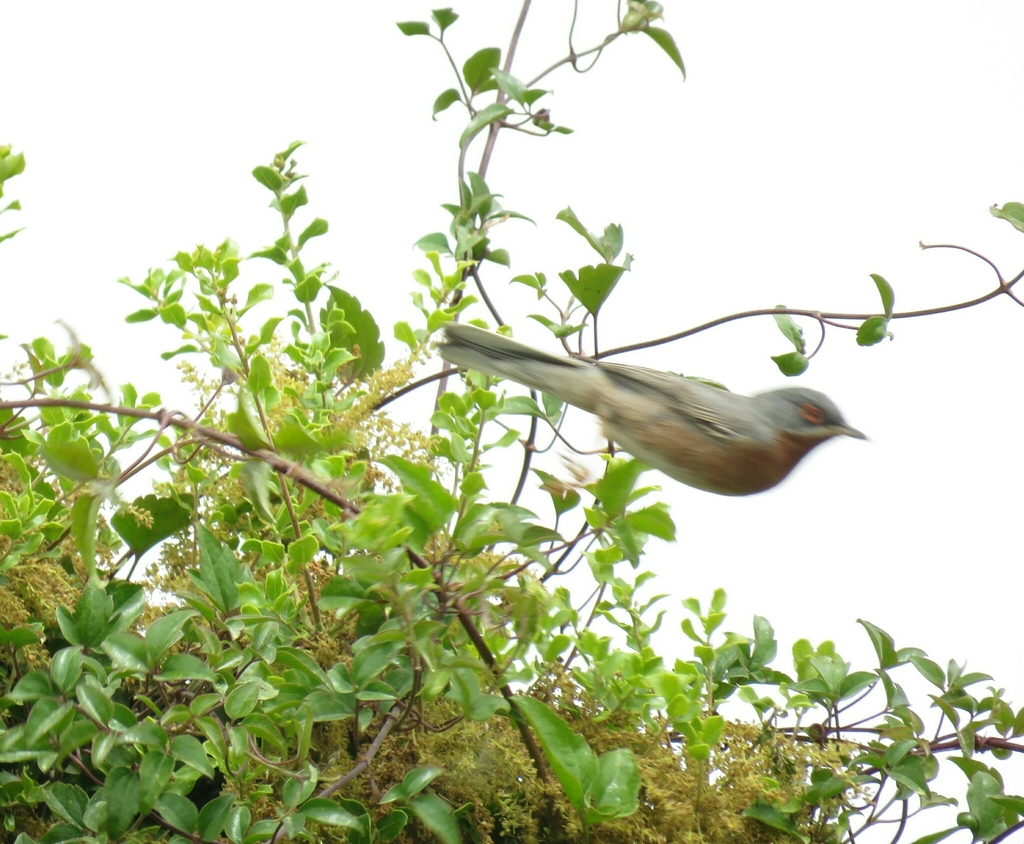
Curruca carrasqueña oriental
Photo © Juan Carlos Caicedo Hernández
Photo © Juan Carlos Caicedo Hernández — CC BY 4.0 — Source: iNaturalist #24536630Identification
The eastern subalpine warbler is a small, sexually dimorphic sylviid warbler with striking plumage differences between males and females. Adult males are particularly distinctive, featuring a deep blue-grey back and head, brick-reddish-brown coloration on the throat and breast that is sharply demarcated from a largely white belly, and characteristic white malar streaks or "moustaches" framing the face. A blackish mask on the lores and ear-coverts adds further contrast. Females are less boldly marked, with mainly brown upperparts and a greyer head, whitish underparts with a subtle pink flush, and paler flanks. The species differs from its western counterpart by its deeper blue-grey upperparts, more pronounced facial mask, and the restriction of brick-red coloration to the throat and breast with paler flanks and a wider white submoustachial stripe.
Range & Habitat
The eastern subalpine warbler breeds in the southernmost areas of Europe, inhabiting dry Mediterranean regions where it favors tall, dense heterogeneous maquis with sparse tree cover. It shows particular preference for maquis dominated by holm oak, strawberry tree, and tree-heath, as well as young cork oak forests and dense bushy areas. The bird also utilizes bushy formations dominated by brambles along sunny ravines and valley bottoms, and shows an interesting affinity for intermediate stages of post-wildfire succession, where regenerating vegetation provides ideal habitat.
Behaviour & Diet
The eastern subalpine warbler is monogamous, with the breeding season extending from late March to late June. Males construct several "cock nests" before the pair builds the actual breeding nest—a deep, robust cup of grasses, thin roots, and leaves, lined with finer materials and hair, typically placed 30–130 centimeters above the ground in low scrub or small trees. Clutches consist of three to five eggs. The species is primarily insectivorous, feeding on small insects and their larvae during the breeding season. Outside this period, it supplements its diet with berries and fruits. Its song is fast and rattling, similar to the lesser whitethroat.
Best Time & Places to See It
The breeding season from late March to late June is the best time to observe eastern subalpine warblers, when males are actively singing and pairs are engaged in nesting activities. They should be sought in dry Mediterranean hill slopes and scrubland habitats, particularly in areas with the characteristic maquis vegetation mentioned above. Look in regions where post-wildfire succession has created suitable bushy habitats interspersed with open ground.
Photography Tips
Photographing this species can be rewarding but challenging, as these warblers often remain hidden within dense scrub. Males are more visually striking than females due to their bold coloration and distinctive white malar streaks, making them preferable subjects. Early morning during the breeding season offers the best opportunities, as males are more vocal and active. Position yourself near suitable habitat and wait patiently, listening for the fast, rattling song that will help locate individuals. The white malar markings and facial mask of males are key features to capture, as they distinguish this species from related warblers. Back-lit or side-lit conditions can help emphasize the male's blue-grey upperparts and reddish-brown breast coloration.
Pirin National Park
Bansko, Bulgaria
+133 aves+21 mamíferos
Where jagged limestone peaks pierce the Macedonian sky, ancient glacial valleys cradle some of Bulgaria’s most pristine wilderness. This southwestern […]
VER PARQUE NACIONALPollino National Park
Viggianello, Italia
+102 aves+23 mamíferos
Where the southern Apennines rise toward the sky in jagged limestone peaks, forests of Bosnian pine cling to precipitous slopes […]
VER PARQUE NACIONALSila National Park
San Giovanni in Fiore, Italia
+133 aves+17 mamíferos
Where ancient beech forests rise above a high Calabrian plateau, Italy’s wilderness core reveals itself in dramatic relief. At elevations […]
VER PARQUE NACIONALSibillini Mountains National Park
Ussita, Italia
+123 aves+27 mamíferos
Where limestone ridges claw toward 2,476 metres, ancient beech forests surrender to alpine meadows and windswept crags that define the […]
VER PARQUE NACIONALGargano National Park
Cagnano Varano, Italia
+133 aves+12 mamíferos
Where limestone plateaus rise abruptly from the Adriatic coast, a spur of land juts into southern Italy bearing one of […]
VER PARQUE NACIONALAspromonte National Park
Careri, Italia
+130 aves+20 mamíferos
Where granite massifs pierce the Calabrian sky and Mediterranean maquis gives way to beech forests, one of southern Italy’s most […]
VER PARQUE NACIONALPindos National Park
Ioannina Regional Unit, Grecia
+128 aves+22 mamíferos
Where granite peaks pierce the clouds above Greece’s spine, the Pindos Mountains harbour one of southern Europe’s wildest and most […]
VER PARQUE NACIONALVikos–Aoos National Park
Ioannina Regional Unit, Grecia
+126 aves+24 mamíferos
Where granite gorges plunge nearly 1,000 metres through the Pindus Mountains, one of Europe’s most dramatic wilderness areas unfolds. The […]
VER PARQUE NACIONALMount Parnitha National Park
Municipal Unit of Acharnes, Grecia
+135 aves+15 mamíferos
Where granite ridges rise dramatically above the Athenian sprawl, a remarkable wilderness unfolds across nearly 38,000 hectares of Mediterranean terrain. […]
VER PARQUE NACIONALSounio National Park
Municipal Unit of Ayios Konstantinos, Grecia
+135 aves+15 mamíferos
Where the Athenian coast fractures into dramatic rocky promontories, ancient marble cliffs plunge toward the Aegean in a landscape that […]
VER PARQUE NACIONALSarakinikou National Park
Chania Regional Unit, Grecia
+134 aves+4 mamíferos
Where limestone cliffs plunge toward turquoise waters and endemic Mediterranean scrub clings to rocky slopes, Greece’s most dramatic coastal wilderness […]
VER PARQUE NACIONALButrint National Park
Vagalat, Albania
+133 aves+17 mamíferos
Where Ionian breezes meet the Corfu Channel, saltmarsh and freshwater lagoons create a mosaic of habitats that pulse with life […]
VER PARQUE NACIONALSamaria National Park
Chania Regional Unit, Grecia
+138 aves+12 mamíferos
Where granite gorges plunge nearly a kilometer into the Cretan landscape, a dramatic wilderness unfolds across 4,850 hectares of Crete’s […]
VER PARQUE NACIONALKerkini Lake National Park
Serres, Grecia
+132 aves+25 mamíferos
Where the Strymon River winds through northeastern Greece, a sprawling freshwater lake mirrors the dramatic Belasitsa Mountains, creating one of […]
VER PARQUE NACIONALAún no hay fotos de la comunidad. Inicia sesión para añadir la primera.
Aún no hay observaciones de la comunidad de esta especie.