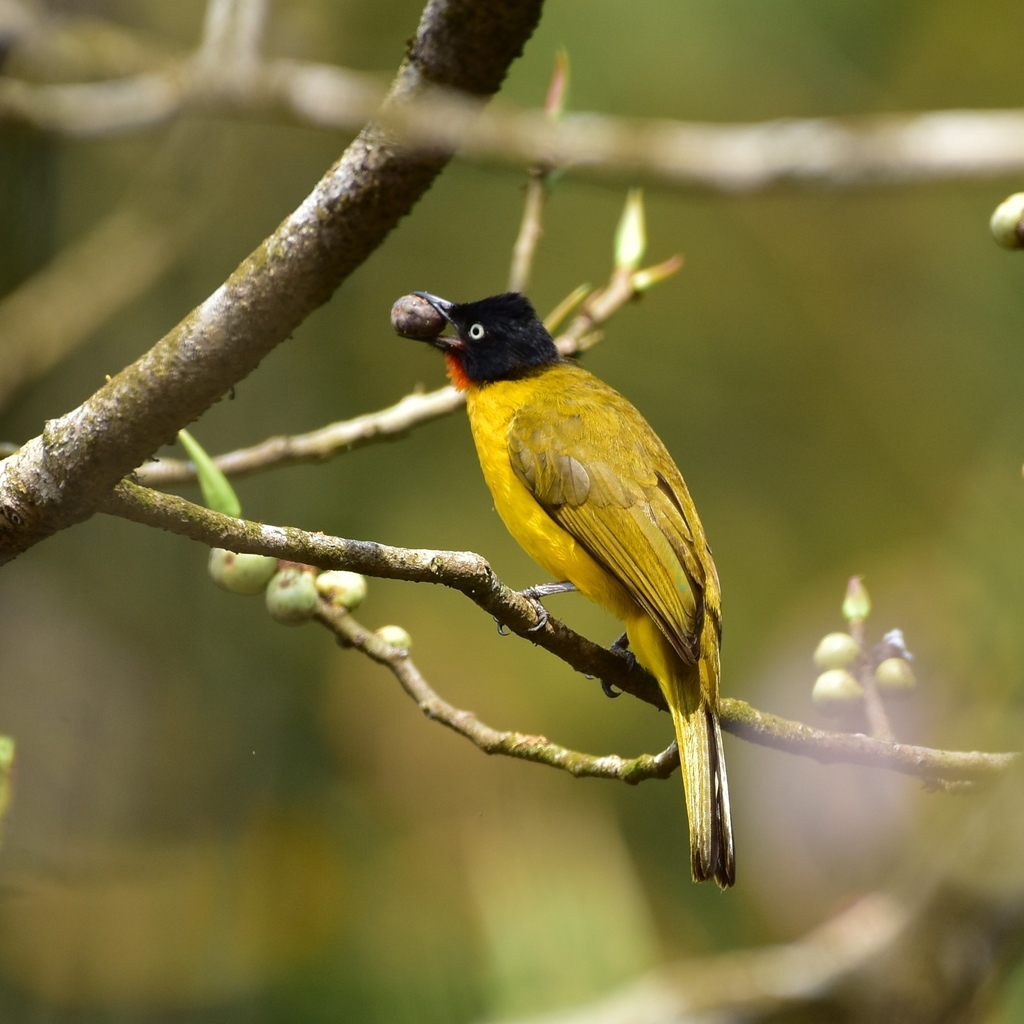
Bulbul Gorjinaranja
Photo © Renjith Jacob Mathews
Photo © Renjith Jacob Mathews — CC BY 4.0 — Source: iNaturalist #155025354The flame-throated bulbul (Rubigula gularis) is a member of the bulbul family of passerine birds and the state bird of Goa. It is found only in the forests of the Western Ghats in southern India. Formerly included as a subspecies of Pycnonotus flaviventris, it has since been elevated to the status of a full species. They are olive-backed with yellow undersides, a triangular orange-red throat and a white iris that stands out against the contrasting black head. They are usually seen foraging in groups in the forest canopy for berries and small insects. They have a call often with two or three tinkling notes that can sound similar to those produced by the red-whiskered bulbul. The species has been referred to in the past by names such as ruby-throated bulbul and black-headed bulbul, but these are ambiguous and could apply to other species such as Rubigula flaviventris and R. dispar. == Taxonomy and systematics == The species was described by John Gould in December 1835 (but published in 1836) based on a specimen in the Zoological Society of London that had been obtained from Travancore State. Gould noted that it was very similar to Brachypus dispar (now Rubigula dispar) that…
Eravikulam National Park
Devikulam, India
+127 aves+30 mamíferos
Where the Western Ghats rise into perpetual mist, rolling grasslands stretch across the high plateaus of Kerala’s southern reaches. This […]
VER PARQUE NACIONALPeriyar National Park
Mlappara, India
+131 aves+30 mamíferos
Dawn breaks over mist-shrouded ridges where the Western Ghats tumble toward Kerala’s spice-scented lowlands. Here, ancient tropical forests envelope a […]
VER PARQUE NACIONALPampadum Shola National Park
Vattavada, India
+125 aves+30 mamíferos
Where misty shola forests cling to the high plateaus of the Nilgiri Mountains, ancient evergreen remnants create a world apart. […]
VER PARQUE NACIONALAún no hay fotos de la comunidad. Inicia sesión para añadir la primera.
Aún no hay observaciones de la comunidad de esta especie.