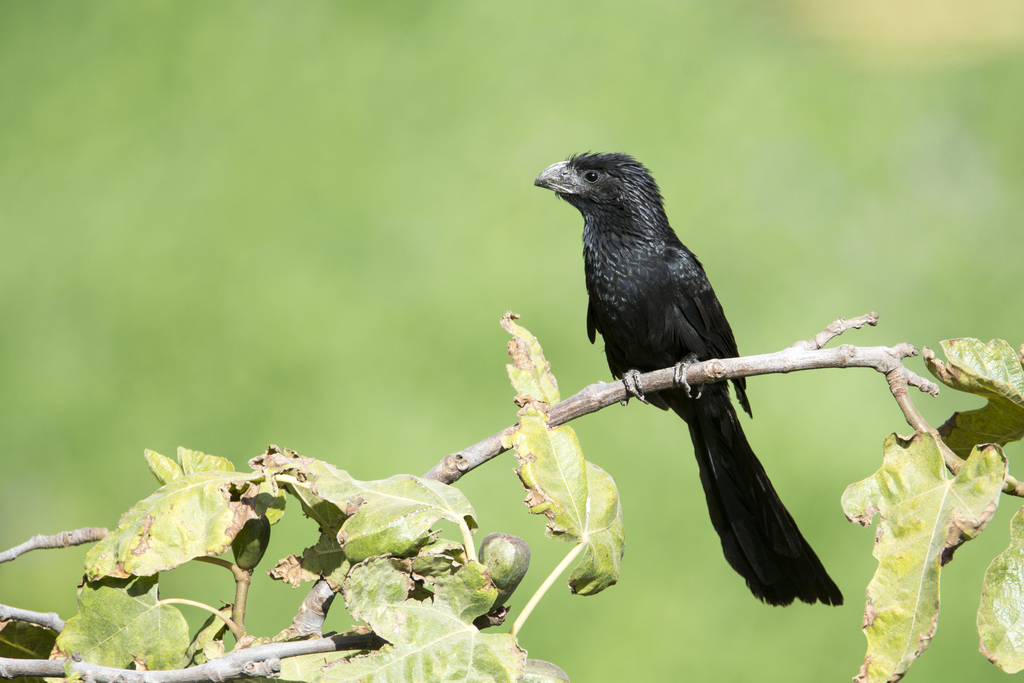
Garrapatero Asurcado
Photo © David F. Belmonte
Photo © David F. Belmonte — CC BY 4.0 — Source: iNaturalist photo #113247769Identificación
El ani piquiestriado es un ave tropical llamativa de color negro uniforme, mide aproximadamente 34 cm de largo, pesa 70–90 g y tiene una envergadura de 41–46 cm. Su rasgo más distintivo es un pico enorme muy curvado, adornado con prominentes estrías longitudinales que recorren la mandíbula superior, característica que le da nombre a esta especie. Su cola muy larga es casi tan larga como su cuerpo, lo que contribuye a su silueta algo desgarbada. En vuelo, exhibe un patrón distintivo de aleteos rápidos y entrecortados alternando con breves planeo.
El ani piquiestriado se parece mucho a su pariente cercano, el ani piquilliso, y ambas especies pueden ser difíciles de distinguir. Algunos especímenes de ani piquilliso tienen picos tan pequeños como los del ani piquiestriado e incluso desarrollan estrías en la mitad basal de sus picos. La forma más confiable de diferenciarlos es por su vocalización y rango de distribución, ya que el ani piquiestriado ocupa una distribución más hacia el norte.
Distribución y Hábitat
Esta especie tropical residente se encuentra a lo largo de la mayor parte de su rango, que se extiende desde el sur de Texas, centro de México y las Bahamas, hacia el sur a través de América Central hasta el norte de Colombia y Venezuela, y a lo largo de las costas de Ecuador y Perú. El ani piquiestriado solo se retira de los límites norteños de su rango en Texas y norte de México durante los meses de invierno, lo que lo convierte en parcialmente migratorio en el extremo norte de su distribución.
La especie prefiere zonas abiertas y semiabiertas, prosperando en pastizales, sabanas y huertos donde puede forrajear fácilmente entre la vegetación baja y el pastizal.
Comportamiento y Dieta
El ani piquiestriado es un ave sumamente social, vive en pequeños grupos familiares compuestos por una a cinco parejas reproductoras. Estos grupos son notablemente cooperativos, defienden un territorio compartido y crían a sus polluelos comunalmente en un solo nido. Todos los miembros del grupo participan en la incubación de huevos y el cuidado de los polluelos, una estrategia reproductiva fascinante que refuerza los lazos dentro de estas unidades muy cohesionadas.
El ani piquiestriado se alimenta de una dieta mixta y oportunista de insectos, semillas y frutas, lo que lo adapta bien a las diversas fuentes de alimento disponibles en sus hábitats de zonas abiertas.
Mejor Época y Lugares para Observarlo
Para los viajeros en el sur de Texas y norte de México, el ani piquiestriado se observa mejor durante los meses de reproducción y verano, ya que la especie se retira hacia el sur en invierno. En el resto de su rango—desde el centro de México a través de América Central hasta el norte de Sudamérica y el litoral de Ecuador y Perú—es un residente permanente y puede encontrarse en cualquier época del año. Busque pequeños grupos en pastizales abiertos, sabanas y hábitats de huertos donde las aves forrajean de manera activa y visible.
Consejos Fotográficos
El plumaje negro uniforme del ani piquiestriado puede resultar desafiante de fotografiar bajo la luz solar intensa, ya que a menudo aparece como una silueta. Las condiciones nubladas o la luz del amanecer y atardecer revelarán la textura y el brillo sutil del ave. El pico grande y distintivo del ave y su cola larga deben ser elementos clave en la composición de su encuadre. Dado que los anis suelen verse en pequeños grupos moviéndose por zonas abiertas, la paciencia le permitirá capturar tomas de comportamiento alimenticio e interacciones sociales. Su patrón de vuelo deliberado—alternando entre aleteo y planeo—ofrece buenas oportunidades para fotografía en vuelo.
Corcovado National Park
Manuel Antonio National Park
Arenal Volcano National Park
Tortuguero National Park
Braulio Carrillo National Park
Piedras Blancas National Park
Santa Rosa National Park
Guanacaste National Park
Volcán Poás National Park
Big Bend National Park
Carlsbad Caverns National Park
Everglades National Park
Cerros de Amotape National Park
Podocarpus National Park
Morrocoy National Park
Huascarán National Park
Coiba National Park
Baru Volcano National Park
General de División Omar Torrijos Herrera National Park
Chagres National Park
Darién National Park
Portobelo National Park
Marino Golfo de Chiriquí National Park
Dzibilchantún National Park
Lagunas de Montebello National Park
Sian Ka’an
Sierra de Tamaulipas
Parque Nacional Grutas de Cacahuamilpa
Parque Nacional Isla Isabel
Montes Azules
Tikal National Park
Laguna del Tigre National Park
Sierra del Lacandón National Park
Laguna Atascosa National Wildlife Refuge
Santa Ana National Wildlife Refuge
Lower Rio Grande Valley National Wildlife Refuge
St. Marks National Wildlife Refuge
Carara National Park
Palo Verde National Park
Cahuita National Park
Rincón de la Vieja National Park
Tapantí Macizo de la Muerte National Park
La Amistad International Park
Barbilla National Park
Volcán Tenorio National Park
Marino Ballena National Park
Marino Las Baulas National Park
Caño Negro National Wildlife Refuge
Gandoca-Manzanillo National Wildlife Refuge
Barra del Colorado National Wildlife Refuge
Curú National Wildlife Refuge
Aún no hay fotos de la comunidad. Inicia sesión para añadir la primera.
Aún no hay observaciones de la comunidad de esta especie.