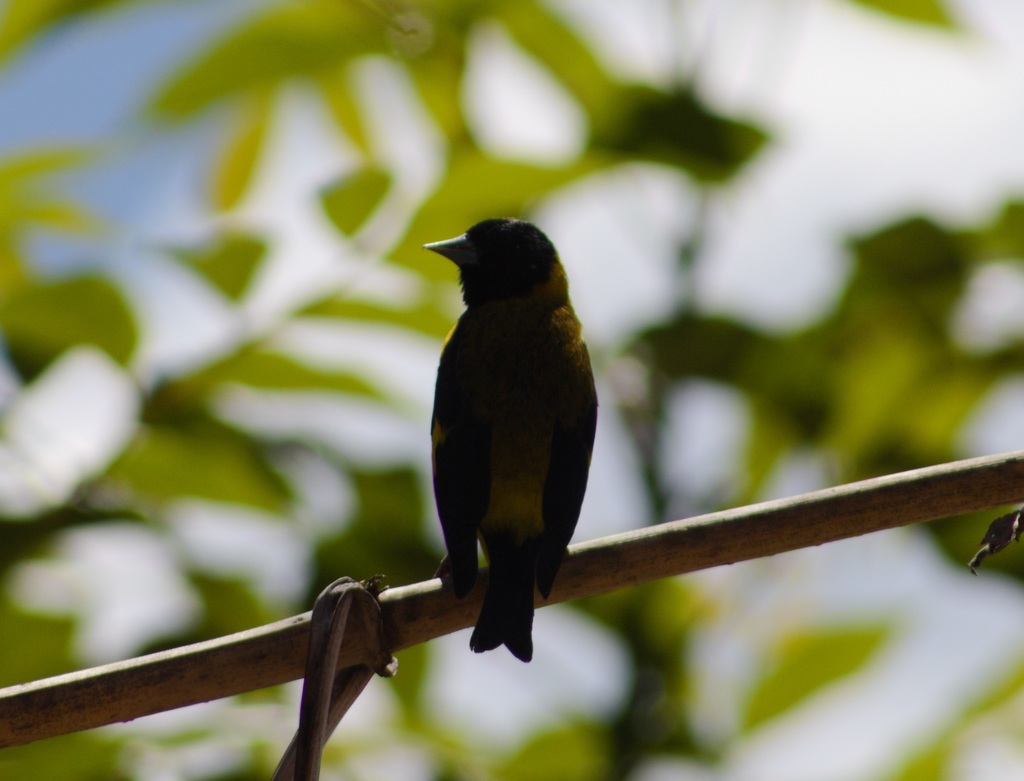
Jilguero Cabecinegro
Photo © ELOYJIMENEZ13
Photo © ELOYJIMENEZ13 — CC BY 4.0 — Source: iNaturalist #71765872Identificación
El jilguero cabecinegro es un pequeño pinzón que mide entre 10,2 y 11,5 cm de largo y pesa solo 10 a 14 gramos. La especie presenta un marcado dimorfismo sexual. Los machos adultos son llamativos, con la cabeza y pecho superior negro azabache que contrasta fuertemente con las partes superiores amarillo-verdosas oliváceas y un obispillo amarillo brillante. Sus alas y cola son mayormente negras, pero presentan bases amarillo brillante en las plumas de vuelo y barras alares amarillas prominentes formadas por las puntas de las coberteras mayores. El pecho inferior y las partes inferiores son amarillo intenso. Las hembras son notoriamente más opacas en general, con menos amarillo en alas y cola. Ambos sexos comparten un iris marrón, pico azul grisáceo y patas grises. Los juveniles son más apagados, con plumaje de tonos oliváceos, alas negruzcas con marcas ante en lugar de amarillas, y partes inferiores amarillo sucio pálido.
Distribución y Hábitat
El jilguero cabecinegro se encuentra en México, Belice, El Salvador, Guatemala, Honduras y Nicaragua, con una distribución disyunta dividida entre tres subespecies. La subespecie nominal habita en el este y centro de México y Guatemala, mientras que la subespecie más grande S. n. forreri se encuentra en el occidente de México desde Sonora y Chihuahua hasta Guerrero. La subespecie más pequeña, S. n. oleaceus, se encuentra en Belice, Honduras, El Salvador y Nicaragua.
Esta especie habita principalmente bosques de pino-roble y roble semiabertos, junto con áreas adyacentes más abiertas incluyendo bosque secundario joven, campos con malezas y plantaciones de café. Típicamente se encuentra a elevaciones entre 600 y 3.100 metros, aunque ocasionalmente desciende a cotas más bajas, alcanzando una elevación máxima de 2.750 metros fuera de México.
Comportamiento y Dieta
El jilguero cabecinegro es residente permanente en toda su área de distribución. Se alimenta predominantemente de semillas, forrajeando en parejas y pequeños grupos que se mueven a través de todos los niveles del dosel del bosque. La especie posee un canto animado y distintivo descrito como "un trino variado, rápido, metálico y gorjeante, a menudo prolongado, con repetición de frases y notas nasales y metálicas extrañas", durando hasta 15 segundos. Sus vocalizaciones incluyen elementos nasales, prolongados y secos que son igualmente característicos.
Poco se conoce sobre la biología reproductiva de la especie más allá del hecho de que pone una nidada de dos huevos. El jilguero cabecinegro permanece poco estudiado en muchos aspectos de su historia natural.
Mejor Época y Lugares para Verlo
Como residente permanente, el jilguero cabecinegro puede encontrarse durante todo el año en su área de distribución. La especie se considera bastante común a común en general y bastante común fuera de México. Su preferencia por bosques semiabertos de pino-roble, vegetación secundaria y áreas agrícolas como plantaciones de café la hacen relativamente accesible para visitantes que exploran estos hábitats a elevaciones moderadas y mayores.
Consejos para Fotografía
El contraste llamativo entre la cabeza negra del macho y sus partes inferiores amarillas lo convierten en un sujeto fotográfico gratificante, particularmente con buena luz que enfatice su plumaje vibrante. Concéntrate en capturar las distintivas barras alares amarillas y el obispillo, que son características clave de identificación. Busca aves forrajeando en pequeños grupos en bosque secundario más abierto o campos con malezas, donde la visibilidad es mejor que en densos bosques de pino-roble. Las vocalizaciones animadas y gorjeantes de la especie a menudo revelan su presencia antes de verla, permitiendo a los fotógrafos anticiparse y posicionarse estratégicamente. La paciencia en hábitats semiabertos a elevaciones entre 1.500 y 2.500 metros generalmente rendirá las mejores oportunidades.
Aún no hay fotos de la comunidad. Inicia sesión para añadir la primera.
Aún no hay observaciones de la comunidad de esta especie.