Identification
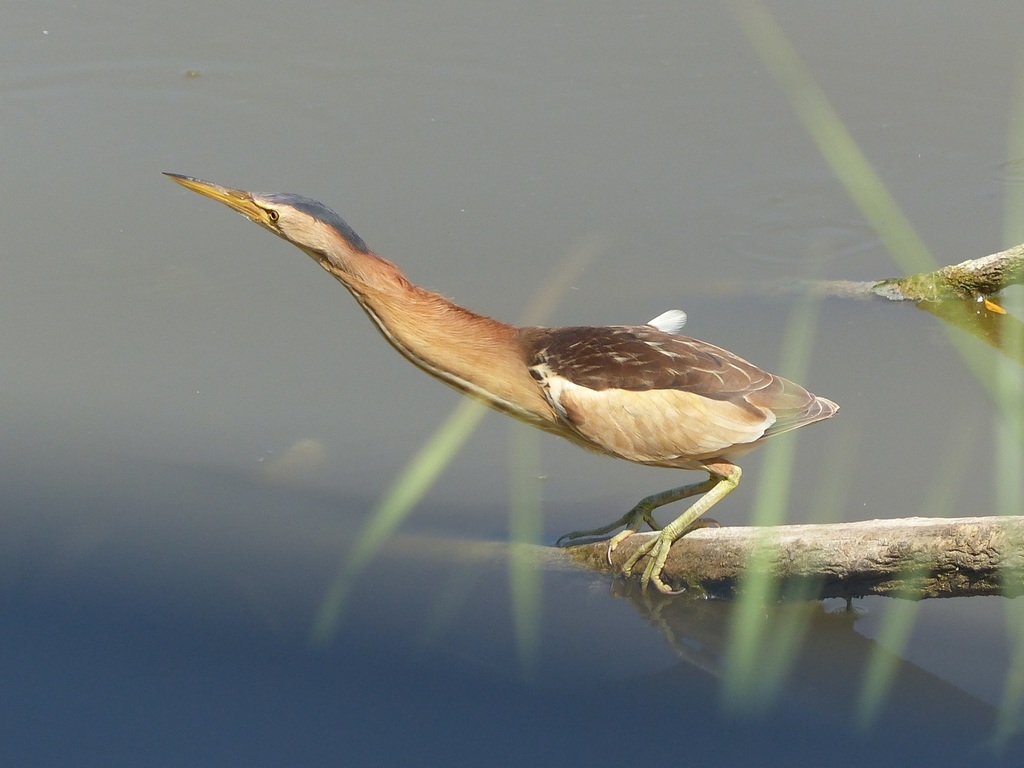
The Little Bittern is the smallest breeding heron of Europe, measuring just 33–38 centimetres in length with a wingspan of 52–58 centimetres. Despite its diminutive size, it is a distinctive and striking bird characterised by its long, sharp bill and notably thick neck. Males are boldly patterned with black upperparts showing a faint green sheen on the crown, nape, back, tail and scapulars. A distinctive feature is the pinkish-buff oval wing panel formed by the inner wing coverts, which contrasts sharply against otherwise black wings. The underparts are pale buff and the underwing is whitish. Females are considerably duller, with brownish-black upperparts and paler feather margins visible at close range. Their underparts are streaked with dark buff and brown, and the wing panel is less prominent than in males. Both sexes display pale forewing panels. Juveniles are duller and more rufous than females, heavily streaked on both upper and underparts.
Range & Habitat
The Little Bittern is native to the Old World, with breeding populations across Africa, central and southern Europe, western and southern Asia, and Madagascar. European and western Asian birds are migratory, wintering in Africa and further south in Asia, while tropical populations are sedentary. The species occurs from Europe (excluding regular breeding in Great Britain, Ireland and Scandinavia) to West Siberia, with isolated populations in Madagascar and Australia. It is a poorly distributed lowland breeding bird, occurring sporadically up to low mountain ranges. The Little Bittern is rare north of its established breeding range. In Britain, breeding records remained unproven until the first confirmed nesting in Yorkshire in 1984, followed by the Avalon Marshes in Somerset in 2010, where the species was present for nine consecutive years by 2017.
Behaviour & Diet
The Little Bittern is a crepuscular species, skulking and typically solitary in habit. It feeds on fishes, amphibians and insects, which it catches within reedbeds or at their edges by slowly stalking its prey. Males claim territories in spring, advertising their presence with a deep barking or croaking call. The species is monogamous, with pairs remaining together for at least one breeding season. Eggs are laid from mid-May onwards in nests situated in dense reedbeds, rushes or bushes above water. A single brood of normally 5–6 eggs is typical, with incubation lasting 17–19 days and fledging occurring after 25–30 days. In Europe, spring migration from Africa begins in early spring, with birds arriving at breeding wetlands from mid-April onwards. Return migration to Africa occurs in August and September, with few juveniles remaining in Europe by October. European breeders migrate as far south as the Eastern Cape and Transvaal regions.
Best Time & Places to See It
For European observers, the best time to encounter Little Bitterns is from mid-April through September during the breeding season. The species should be sought in extensive reedbeds and wetland habitats where it remains characteristically secretive. Key populations exist across Central Europe, particularly in Hungary, which hosts most Central European breeding pairs. Significant populations also occur in Russia, Ukraine, Romania and Turkey. Britain remains a rare destination for this species, though the Avalon Marshes in Somerset has proven reliable in recent years. The bird's crepuscular habits mean dawn and dusk provide the best viewing opportunities.
Photography Tips
Photographing the Little Bittern presents considerable challenges due to its skulking, secretive nature and preference for dense reedbed cover. Success requires patience and early morning or evening visits when the bird is most active. The species' small size demands a good telephoto lens to capture useful detail. Males are far more distinctive and photogenic than females, displaying their striking black and buff plumage and characteristic pale wing panel. Position yourself near reedbed edges and margins where birds hunt for fish and amphibians. Silence and slow, deliberate movement are essential to avoid flushing this wary species. The bird's habit of slowly stalking prey provides fleeting opportunities for action shots, though static perched birds in reeds offer the most reliable photographic chances.
Serra D’Irta Nature Park
Alcossebre, España
+129 aves+22 mamíferos
Where limestone cliffs plunge into the crystalline Mediterranean, a ribbon of protected coastline unfolds along Spain’s eastern seaboard. The Serra […]
VER PARQUE NATURALS’Albufera Nature Park
Platja de Muro, España
+133 aves+15 mamíferos
Dawn breaks across a mosaic of shallow lagoons and reed beds where the Mediterranean meets one of Europe’s most vital […]
VER PARQUE NATURALMarjal Pego-Oliva Nature Park
Molinell, España
+132 aves+19 mamíferos
Where freshwater marshes meet Mediterranean scrubland, one of Spain’s most vital wetland systems unfolds across the Valencian coast. Brackish lagoons […]
VER PARQUE NATURALCap de Ferrutx Nature Reserve
Artà, España
+137 aves+12 mamíferos
Where limestone cliffs plunge into crystalline Mediterranean waters, a mosaic of Mediterranean scrubland, pine forest, and rocky terrain defines one […]
VER RESERVA NATURALL’Albufera Nature Park
València, España
+130 aves+22 mamíferos
Dawn breaks over a vast lagoon where freshwater meets saltmarsh, creating one of Spain’s most biodiverse wetland mosaics. This protected […]
VER PARQUE NATURALDoñana National Park
Hinojos, España
+146 aves+12 mamíferos
Where the Guadalquivir River spills into the Atlantic, Spain’s southwestern corner erupts into one of Europe’s most biodiverse wetlands. Vast […]
VER PARQUE NACIONALTablas de Daimiel National Park
Daimiel, España
+137 aves+14 mamíferos
Where two rivers converge across a vast, flat plain in central Spain, shallow wetlands stretch toward an endless horizon—a landscape […]
VER PARQUE NACIONALSierra de Tejeda, Almijara y Alhama Nature Park
Frigiliana, España
+127 aves+24 mamíferos
Where limestone peaks thrust skyward between the Costa del Sol and the Axarquia plain, dramatic gorges and cascading waterfalls carve […]
VER PARQUE NATURALPenínsula de Llevant Nature Park
Betlem, España
+138 aves+12 mamíferos
Where Mediterranean limestone cliffs plunge toward turquoise shallows, the eastern peninsula of Mallorca reveals one of Spain’s most ecologically pristine […]
VER PARQUE NATURALSerra de Montsant Nature Park
La Morera de Montsant, España
+129 aves+27 mamíferos
Where limestone ridges thrust skyward above rolling Mediterranean scrubland, a landscape of dramatic contrasts rewards the discerning traveler. Montsant’s jagged […]
VER PARQUE NATURALEbro Delta Natural Park
Eucaliptus, España
+147 aves+6 mamíferos
Where the Ebro River surrenders to the Mediterranean, a vast mosaic of lagoons, reed beds, and salt marshes unfolds across […]
VER PARQUE NATURALMabamba Swamp
Memere, Uganda
150+ aves
Where papyrus stands shoulder-high and water mirrors an infinite sky, one of Africa’s most biodiverse wetland systems unfolds across 283 […]
VER RESERVA NATURALDanube Delta Biosphere Reserve
Tulcea, Rumanía
+123 aves+30 mamíferos
Where Europe’s mightiest river dissolves into the Black Sea, a labyrinth of reed beds, shallow lagoons, and floating islands creates […]
VER PARQUE NACIONALTúria Nature Park
València, España
+103 aves+11 mamíferos
Where limestone cliffs rise dramatically above the sinuous Túria River, one of Spain’s most compelling natural laboratories unfolds across nearly […]
VER PARQUE NATURALHortobágy National Park
Hortobágy, Hungría
+132 aves+19 mamíferos
Where the Great Hungarian Plain stretches endlessly toward the horizon, vast wetlands and grasslands create one of Europe’s most dynamic […]
VER PARQUE NACIONALGarden Route National Park
George, Sudáfrica
+126 aves+30 mamíferos
Where fynbos-clad mountains plunge into temperate forests and pristine coastline, one of Africa’s most ecologically diverse reserves sprawls across nearly […]
VER PARQUE NACIONALKolkheti National Park
Nigvziani, Georgia
+149 aves+6 mamíferos
Where the Caucasus descends to meet the Black Sea, a mosaic of wetlands, reed beds, and coastal lagoons creates one […]
VER PARQUE NACIONALMachakhela Planned National Park
Skurdidi, Georgia
+138 aves+12 mamíferos
Where the Lesser Caucasus mountains plunge toward the lowlands of southern Georgia, a landscape of dramatic contrasts unfolds. Steep limestone […]
VER PARQUE NACIONALPirin National Park
Bansko, Bulgaria
+133 aves+21 mamíferos
Where jagged limestone peaks pierce the Macedonian sky, ancient glacial valleys cradle some of Bulgaria’s most pristine wilderness. This southwestern […]
VER PARQUE NACIONALEspai d’interès natural de les Gavarres
Cruïlles, Monells i Sant Sadurní de l'Heura, España
+116 aves+14 mamíferos
Where Mediterranean scrubland meets temperate forest, rolling granite hills define one of Catalonia’s most biodiverse landscapes. Across nearly 600 square […]
VER RESERVA NATURALCirceo National Park
Italia
+140 aves+10 mamíferos
Where the Tyrrhenian Sea collides with limestone ridges and Mediterranean scrub, an ancient landscape unfolds along Italy’s southern Lazio coast. […]
VER PARQUE NACIONALDelle Incisioni Rupestri di Naquane National Park
Capo di Ponte, Italia
+120 aves+30 mamíferos
Where Alpine valleys descend into the Lombardy foothills, glacier-carved granite formations rise in dramatic tiers above the Oglio River valley. […]
VER PARQUE NACIONALDell’Appennino Tosco-Emiliano National Park
Reggio nell'Emilia, Italia
+120 aves+30 mamíferos
Where the Apennine spine rises between Tuscany and Emilia-Romagna, beech forests give way to windswept alpine meadows and dramatic limestone […]
VER PARQUE NACIONALBwabwata National Park
Namibia
150+ aves+23 mamíferos
Where the Kavango and Zambezi rivers converge across northeastern Namibia, a vast wilderness of 14,249 square kilometres unfolds in layers […]
VER PARQUE NACIONALPindos National Park
Ioannina Regional Unit, Grecia
+128 aves+22 mamíferos
Where granite peaks pierce the clouds above Greece’s spine, the Pindos Mountains harbour one of southern Europe’s wildest and most […]
VER PARQUE NACIONALVikos–Aoos National Park
Ioannina Regional Unit, Grecia
+126 aves+24 mamíferos
Where granite gorges plunge nearly 1,000 metres through the Pindus Mountains, one of Europe’s most dramatic wilderness areas unfolds. The […]
VER PARQUE NACIONALMount Parnitha National Park
Municipal Unit of Acharnes, Grecia
+135 aves+15 mamíferos
Where granite ridges rise dramatically above the Athenian sprawl, a remarkable wilderness unfolds across nearly 38,000 hectares of Mediterranean terrain. […]
VER PARQUE NACIONALSounio National Park
Municipal Unit of Ayios Konstantinos, Grecia
+135 aves+15 mamíferos
Where the Athenian coast fractures into dramatic rocky promontories, ancient marble cliffs plunge toward the Aegean in a landscape that […]
VER PARQUE NACIONALSarakinikou National Park
Chania Regional Unit, Grecia
+134 aves+4 mamíferos
Where limestone cliffs plunge toward turquoise waters and endemic Mediterranean scrub clings to rocky slopes, Greece’s most dramatic coastal wilderness […]
VER PARQUE NACIONALSamaria National Park
Chania Regional Unit, Grecia
+138 aves+12 mamíferos
Where granite gorges plunge nearly a kilometer into the Cretan landscape, a dramatic wilderness unfolds across 4,850 hectares of Crete’s […]
VER PARQUE NACIONALKerkini Lake National Park
Serres, Grecia
+132 aves+25 mamíferos
Where the Strymon River winds through northeastern Greece, a sprawling freshwater lake mirrors the dramatic Belasitsa Mountains, creating one of […]
VER PARQUE NACIONALAún no hay fotos de la comunidad. Inicia sesión para añadir la primera.
Aún no hay observaciones de la comunidad de esta especie.