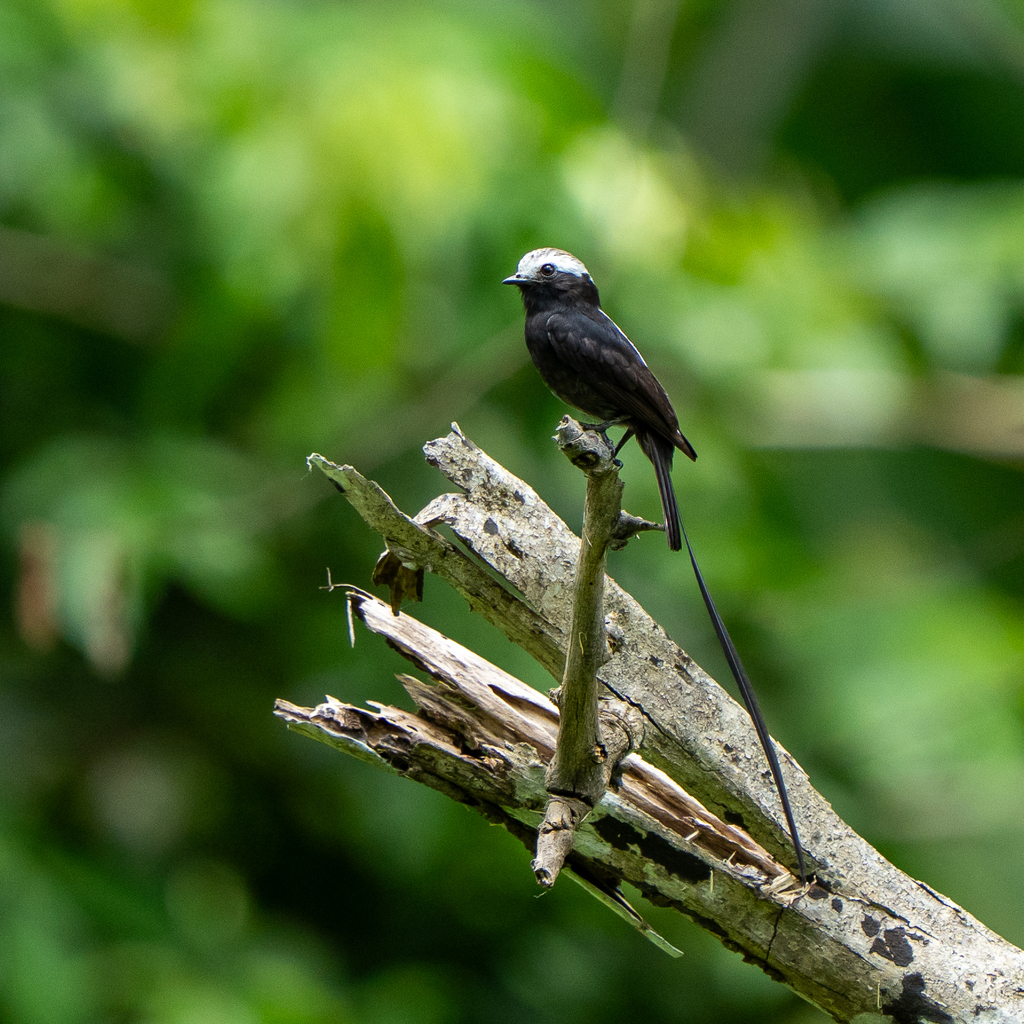
Mosquero Colilargo
Photo © Anthony Batista
Photo © Anthony Batista — CC BY 4.0 — Source: iNaturalist photo #503861386The long-tailed tyrant (Colonia colonus) is a species of bird in the family Tyrannidae, the tyrant flycatchers. It is found in Central America from Honduras to Panama and in every mainland South American country except Chile and Uruguay. == Taxonomy and systematics == The long-tailed tyrant was originally described as Muscicapa colonus, erroneously including it in the Old World flycatcher family. The long-tailed tyrant is the only member of genus Colonia. It has these five subspecies: C. c. leuconota (Lafresnaye, 1842) C. c. fuscicapillus (Sclater, PL, 1862) C. c. poecilonota (Cabanis, 1849) C. c. niveiceps Zimmer, JT, 1930 C. c. colonus (Vieillot, 1818) == Description == Male long-tailed tyrants are 23 to 28 cm (9.1 to 11 in) and females 18 to 22 cm (7.1 to 8.7 in) long; these measurements do not include the elongated central tail feathers. Adults weigh 15 to 18 g (0.53 to 0.63 oz). Adult males of the nominate subspecies C. c. colonus are mostly dull black with a white forehead and forecrown, a whitish rump, and a grayish black belly. Their central pair of tail feathers can extend up to 13 cm (5.1 in) beyond the others and have somewhat widened tips. They are…
Arenal Volcano National Park
Peñas Blancas, Costa Rica
+131 aves+30 mamíferos
Where a perfect cone of dark basalt rises 1,633 metres above rainforest canopy, Costa Rica’s most iconic volcano commands a […]
VER PARQUE NACIONALNatural Utría National Park
Alto Baudó (Pie de Pató), Colombia
+144 aves+15 mamíferos
Where the Chocó rainforest plunges headlong into the Pacific, a pristine coastal wilderness unfolds across 1,287 square kilometers of Colombia’s […]
VER PARQUE NACIONALNatural Serranía de los Churumbelos National Park
Santa Rosa, Colombia
+145 aves+15 mamíferos
Where the Andes’ western cordillera surrenders to the Pacific watershed, a fortress of granite peaks and cloud-draped valleys rises across […]
VER PARQUE NACIONALItatiaia National Park
Brasil
+141 aves+19 mamíferos
Where granite peaks thrust through Atlantic Forest mist, Brazil’s oldest national park commands the border between Rio de Janeiro and […]
VER PARQUE NACIONALSerra da Bocaina National Park
Brasil
+132 aves+30 mamíferos
Where Atlantic rainforest meets coastal escarpment, a landscape of dramatic elevation transforms within mere kilometers from sea level to peaks […]
VER PARQUE NACIONALIguaçu National Park
Brasil
+133 aves+29 mamíferos
Where the Paraná Plateau drops away in a thunderous cascade, one of Earth’s most spectacular waterfall systems tears through subtropical […]
VER PARQUE NACIONALSerra do Gandarela National Park
Brasil
150+ aves+9 mamíferos
Where granite peaks thrust upward through Atlantic Forest mist, the landscape reveals itself in dramatic relief—a montane wilderness sprawling across […]
VER PARQUE NACIONALBrasília National Park
Plano Piloto, Brasil
+122 aves+30 mamíferos
Where granite escarpments rise above the cerrado grasslands of central Brazil, a vast sanctuary unfolds across 1,077 square kilometres of […]
VER PARQUE NACIONALAraucárias National Park
Brasil
+54 aves+2 mamíferos
Where subtropical mountain forests rise above the Brazilian plateau, ancient Araucaria angustifolia trees tower like cathedral pillars through the mist. […]
VER PARQUE NACIONALOtishi National Park
Río Tambo, Perú
+21 aves+3 mamíferos
Where the eastern slopes of the Andes plunge into the Amazon basin, a wilderness of extraordinary biological complexity unfolds across […]
VER PARQUE NACIONALTingo Maria National Park
Mariano Dámaso Beraún, Perú
+48 aves
Where the eastern slopes of the Peruvian Andes descend into the Amazon basin, a 84-square-kilometre sanctuary of extraordinary biodiversity unfolds […]
VER PARQUE NACIONALDarién National Park
Tucutí, Panamá
+132 aves+30 mamíferos
Where rainforest swallows the horizon and rivers carve through primordial wilderness, one of Central America’s last great untamed frontiers unfolds […]
VER PARQUE NACIONALAún no hay fotos de la comunidad. Inicia sesión para añadir la primera.
Aún no hay observaciones de la comunidad de esta especie.