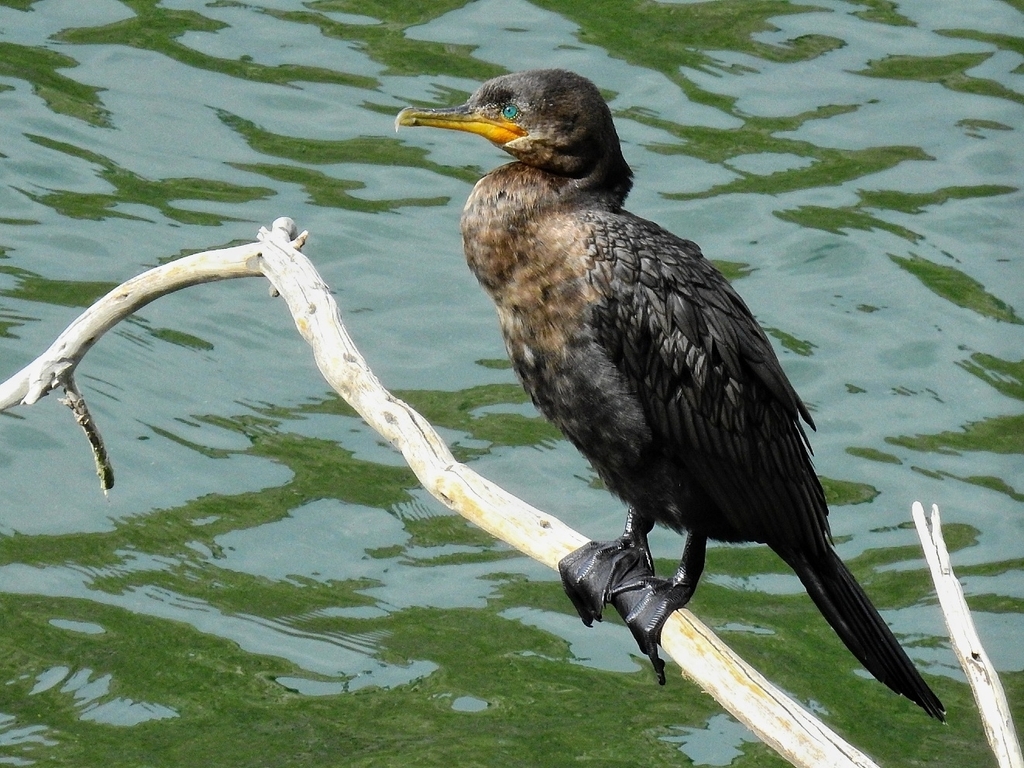
Cormorán biguá
Photo © Esteban Poveda
Photo © Esteban Poveda — CC BY 4.0 — Source: iNaturalist photo #179140956Identification
The Neotropic Cormorant is a medium-sized cormorant measuring 64 cm in length with a 100 cm wingspan. It is notably small and slender compared to the larger double-crested cormorant, with a characteristically long tail and a distinctive S-shaped neck posture. Adult birds are predominantly black with a yellow-brown throat patch that develops a white edge during breeding season. At this time, white tufts appear on the sides of the head, accompanied by scattered white filoplumes along the head and neck. The upper wings are somewhat grayer than the rest of the body. Juveniles are brownish in color, making them distinguishable from adults. Males are larger than females, weighing 1.1 to 1.5 kg compared to females which weigh 50 to 100 g less.
Range & Habitat
Found throughout the American tropics and subtropics, the Neotropic Cormorant ranges from the middle Rio Grande and the Gulf and Californian coasts of the United States south through Mexico and Central America to southern South America. It also breeds in the Bahamas, Cuba, and Trinidad. The species inhabits both coastal areas—including some mangrove regions—and inland waters, making it highly adaptable to diverse aquatic environments. Two subspecies are recognized: N. b. mexicanum occupies the northern range from the central USA through Nicaragua, while N. b. brasilianum is found from Costa Rica to Tierra del Fuego. Southern populations tend to be larger than their northern counterparts.
Behaviour & Diet
Unlike most other cormorants, the Neotropic Cormorant frequently perches on wires, a distinctive behavioral trait. It feeds primarily on small fish but also consumes tadpoles, frogs, aquatic insects such as dragonfly nymphs, and shrimp. Inland birds favor small, abundant fish species found in ponds and sheltered inlets, typically less than 10 cm in length. The bird forages by diving underwater, propelling itself with its feet in brief dives lasting 5 to 15 seconds. Notably, it sometimes forages in groups, with several birds beating the water with their wings to drive fish into shallows.
Best Time & Places to See It
The Neotropic Cormorant is largely a permanent resident throughout its range, though some birds occasionally wander northward during warmer months. Look for this species along coastlines, in mangrove areas, and around inland water bodies throughout the American tropics and subtropics. In Peru, the species is particularly notable as it is traditionally used by the Uru people for fishing, offering unique cultural and wildlife viewing opportunities in that region.
Photography Tips
The bird's habit of perching on wires provides excellent opportunities for photography in accessible locations. Look for the distinctive white head tufts and filoplumes during breeding season to capture the most visually striking plumage. The bird's slender profile and characteristic S-shaped neck posture make for distinctive silhouettes. Photographing foraging behavior—particularly group feeding where birds beat the water—requires patience but rewards the photographer with dynamic action shots. The contrast between the black body plumage and the yellow-brown throat patch provides good compositional opportunities.
Tijuca National Park
Brasil
+127 aves+30 mamíferos
Where Atlantic rainforest clings to steep granite slopes mere kilometres from Rio de Janeiro’s urban sprawl, one of Brazil’s most […]
VER PARQUE NACIONALSerra do Cipó National Park
Brasil
+137 aves+24 mamíferos
Where granite peaks claw through the Brazilian cerrado and Atlantic Forest transition zones, crystalline streams cascade down escarpments carved over […]
VER PARQUE NACIONALCorcovado National Park
Puerto Jiménez, Costa Rica
+132 aves+30 mamíferos
Rain hammers the canopy as moisture-laden clouds collide with the Osa Peninsula’s mountainous spine, birthing one of the planet’s most […]
VER PARQUE NACIONALManuel Antonio National Park
Quepos, Costa Rica
+125 aves+30 mamíferos
White sand beaches curve between steep jungle walls where the Pacific laps against Costa Rica’s most biodiverse coastal sanctuary. Rainforest […]
VER PARQUE NACIONALTortuguero National Park
Roxana, Costa Rica
+124 aves+30 mamíferos
Where emerald waterways thread through impenetrable rainforest and pristine Caribbean beaches merge with lagoons, one of Costa Rica’s most biodiverse […]
VER PARQUE NACIONALPiedras Blancas National Park
Golfito, Costa Rica
+132 aves+30 mamíferos
Where misty lowland rainforest plunges toward the Pacific through a labyrinth of river valleys, one of Costa Rica’s most pristine […]
VER PARQUE NACIONALSanta Rosa National Park
Santa Elena, Costa Rica
+129 aves+30 mamíferos
Dawn breaks over a mosaic of dry forest and humid woodland where Costa Rica’s northwestern peninsula juts into the Pacific. […]
VER PARQUE NACIONALSaguaro National Park
Tucson, Estados Unidos
+126 aves+28 mamíferos
Towering sentinels of the Sonoran Desert rise across nearly two thousand square kilometers of Arizona’s most iconic terrain. These magnificent […]
VER PARQUE NACIONALCerros de Amotape National Park
District of San Jacinto, Ecuador
+117 aves+6 mamíferos
Where granite peaks pierce the tropical sky above northwestern Ecuador, a landscape of extraordinary ecological complexity unfolds across nearly 4,800 […]
VER PARQUE NACIONALAntisana National Park
Quijos, Ecuador
+141 aves+21 mamíferos
Where the Andes spine rises above 4,700 meters, volcanic peaks pierce perpetual cloud forests in Ecuador’s eastern cordillera. This sprawling […]
VER PARQUE NACIONALNatural Utría National Park
Alto Baudó (Pie de Pató), Colombia
+144 aves+15 mamíferos
Where the Chocó rainforest plunges headlong into the Pacific, a pristine coastal wilderness unfolds across 1,287 square kilometers of Colombia’s […]
VER PARQUE NACIONALNatural Serranía de los Churumbelos National Park
Santa Rosa, Colombia
+145 aves+15 mamíferos
Where the Andes’ western cordillera surrenders to the Pacific watershed, a fortress of granite peaks and cloud-draped valleys rises across […]
VER PARQUE NACIONALMorrocoy National Park
Municipio Silva
+91 aves+4 mamíferos
Where crystalline Caribbean waters meet Venezuela’s northern coast, a mosaic of coral reefs, white-sand beaches, and mangrove forests creates one […]
VER PARQUE NACIONALAmacayacu National Park
Leticia, Colombia
+133 aves+29 mamíferos
Where the Amazon’s dark waters merge with flooded forest and terra firme upland, five thousand square kilometres of pristine wilderness […]
VER PARQUE NACIONALPeixe National Park Lagoon
Brasil
150+ aves+5 mamíferos
Coastal lagoons and barrier-island ecosystems unfold across southern Brazil’s Rio Grande do Sul, where freshwater meets Atlantic salt in an […]
VER PARQUE NACIONALSuperagui National Park
Brasil
+43 aves+1 mamíferos
Where the Atlantic rainforest meets the subtropical coast of southern Brazil, a labyrinth of islands, mangrove channels, and pristine beaches […]
VER PARQUE NACIONALSerra da Bocaina National Park
Brasil
+132 aves+30 mamíferos
Where Atlantic rainforest meets coastal escarpment, a landscape of dramatic elevation transforms within mere kilometers from sea level to peaks […]
VER PARQUE NACIONALIguaçu National Park
Brasil
+133 aves+29 mamíferos
Where the Paraná Plateau drops away in a thunderous cascade, one of Earth’s most spectacular waterfall systems tears through subtropical […]
VER PARQUE NACIONALPantanal Matogrossense National Park
Brasil
+139 aves+21 mamíferos
Where water and grassland merge in the heart of Brazil’s Mato Grosso do Sul, one of South America’s most biodiverse […]
VER PARQUE NACIONALLençóis Maranhenses National Park
Brasil
+60 aves+3 mamíferos
Across 3,670 square kilometres of northeastern Brazil, an improbable landscape unfolds: a vast mosaic of freshwater lagoons, palm-studded dunes, and […]
VER PARQUE NACIONALSerra do Gandarela National Park
Brasil
150+ aves+9 mamíferos
Where granite peaks thrust upward through Atlantic Forest mist, the landscape reveals itself in dramatic relief—a montane wilderness sprawling across […]
VER PARQUE NACIONALBrasília National Park
Plano Piloto, Brasil
+122 aves+30 mamíferos
Where granite escarpments rise above the cerrado grasslands of central Brazil, a vast sanctuary unfolds across 1,077 square kilometres of […]
VER PARQUE NACIONALMapinguari National Park
Brasil
+120 aves+30 mamíferos
Where the Amazon’s southwestern frontier meets the Xingu Basin, vast tracts of pristine tropical forest rise and fall across nearly […]
VER PARQUE NACIONALSerra Geral National Park
Brasil
+124 aves+14 mamíferos
Where granite escarpments rise abruptly from the Atlantic Forest canopy, a landscape of dramatic canyons and windswept plateaus defines one […]
VER PARQUE NACIONALAnavilhanas National Park
Brasil
+132 aves+30 mamíferos
Where the Rio Negro braids into a labyrinth of islands and waterways, one of the Amazon’s most pristine archipelagos unfolds […]
VER PARQUE NACIONALManu National Park
Manu, Perú
+131 aves+30 mamíferos
Where the Andes plunge into the Amazon basin, a wilderness of uncompromising scale unfolds across 1.5 million hectares. Spanning three […]
VER PARQUE NACIONALBahuaja Sonene National Park
San Pedro de Putina Punco, Perú
+132 aves+30 mamíferos
Where granite ridges rise above the confluence of Peru’s Río Heath and Río Tambopata, one of the Amazon’s most pristine […]
VER PARQUE NACIONALCoiba National Park
Montijo, Panamá
+104 aves+7 mamíferos
Where the Pacific swallows a crown of emerald islands and pristine jungle canopy, one of Central America’s most biodiverse sanctuaries […]
VER PARQUE NACIONALChagres National Park
Caimitillo, Panamá
+131 aves+30 mamíferos
Where rainforest canopy meets mountain spine, the Chagres River carves through some of Central America’s most pristine tropical wilderness. Spanning […]
VER PARQUE NACIONALDarién National Park
Tucutí, Panamá
+132 aves+30 mamíferos
Where rainforest swallows the horizon and rivers carve through primordial wilderness, one of Central America’s last great untamed frontiers unfolds […]
VER PARQUE NACIONALPortobelo National Park
Portobelo, Panamá
+115 aves+16 mamíferos
Where Caribbean waters dissolve into rainforest, a protected realm of pristine coastal wilderness unfolds across 570 square kilometers of northern […]
VER PARQUE NACIONALAlerce Costero National Park
Corral, Chile
+36 aves+1 mamíferos
Ancient alerce forests rise like living cathedrals from the temperate rainforests of southern Chile, where mist clings to canopy and […]
VER PARQUE NACIONALPan de Azúcar National Park
Chañaral, Chile
+40 aves+5 mamíferos
Where the hyperarid Atacama Desert plunges dramatically into the Pacific, 727 square kilometres of raw coastal wilderness unfold across northern […]
VER PARQUE NACIONALCorcovado National Park
Chaitén, Chile
+32 aves+2 mamíferos
Where temperate rainforests collide with fjord systems and windswept coastline, one of South America’s most pristine wilderness areas unfolds across […]
VER PARQUE NACIONALLauca National Park
Putre, Chile
+106 aves+14 mamíferos
Where the Andes pierce the Chilean altiplano at heights exceeding 4,500 meters, a landscape of extraordinary geological drama unfolds across […]
VER PARQUE NACIONALVicente Pérez Rosales National Park
Puerto Varas, Chile
+62 aves
Where turquoise lakes meet temperate rainforest and snow-capped volcanoes pierce the southern Chilean sky, one of South America’s most pristine […]
VER PARQUE NACIONALPatagonia National Park
Cochrane, Chile
+92 aves+12 mamíferos
Where granite towers pierce the Patagonian sky and turquoise rivers carve through windswept steppe, one of South America’s most dramatic […]
VER PARQUE NACIONALMonte León National Park
Argentina
+53 aves+6 mamíferos
Where the Patagonian steppe meets the Atlantic, windswept plateaus descend abruptly to a dramatic coastline carved by relentless tidal forces […]
VER PARQUE NACIONALEl Palmar National Park
Distrito Sexto, Argentina
+132 aves+21 mamíferos
Where the Paraná River winds through northern Argentina, vast groves of yatay palms rise from rolling grassland like a botanical […]
VER PARQUE NACIONALRío Pilcomayo National Park
Argentina
150+ aves+10 mamíferos
Where wetlands sprawl across the Argentine Chaco, the Pilcomayo River carves a vital ribbon of life through one of South […]
VER PARQUE NACIONALEl Rey National Park
Municipio de Las Lajitas, Argentina
+59 aves+8 mamíferos
Where subtropical mountain forests merge with humid lowland savannas, northwestern Argentina guards one of South America’s most biodiverse yet underexplored […]
VER PARQUE NACIONALNahuel Huapi National Park
Argentina
+120 aves+30 mamíferos
Where granite peaks plunge into crystalline alpine lakes, the southern Andes create one of South America’s most dramatic wilderness theaters. […]
VER PARQUE NACIONALLago Puelo National Park
Argentina
+45 aves
Where temperate rainforest meets crystalline alpine waters, one of Argentina’s most pristine wilderness jewels unfolds across the Andes foothills of […]
VER PARQUE NACIONALLos Alerces National Park
Argentina
+55 aves
Where temperate rainforests give way to glacial lakes and ancient monkey puzzle forests, Argentina’s southwestern treasure unfolds across 3,007 square […]
VER PARQUE NACIONALLagunas de Montebello National Park
Laguna de Montebello, México
+126 aves+3 mamíferos
Crystalline waters pierce through limestone plateaus in the borderlands of Chiapas, where over fifty interconnected lakes create a landscape of […]
VER PARQUE NACIONALSian Ka’an
Chunyaxché, México
+115 aves
Where mangrove labyrinths dissolve into turquoise shallows and jungle canopy meets pristine Caribbean shoreline, one of Mexico’s most biodiverse reserves […]
VER RESERVA DE LA BIOSFERAParque Nacional Cerro de la Estrella
México
+123 aves+30 mamíferos
Volcanic ridges rise abruptly from the valley floor south of Mexico City, their slopes clothed in a mosaic of pine-oak […]
VER PARQUE NACIONALAún no hay fotos de la comunidad. Inicia sesión para añadir la primera.
Aún no hay observaciones de la comunidad de esta especie.