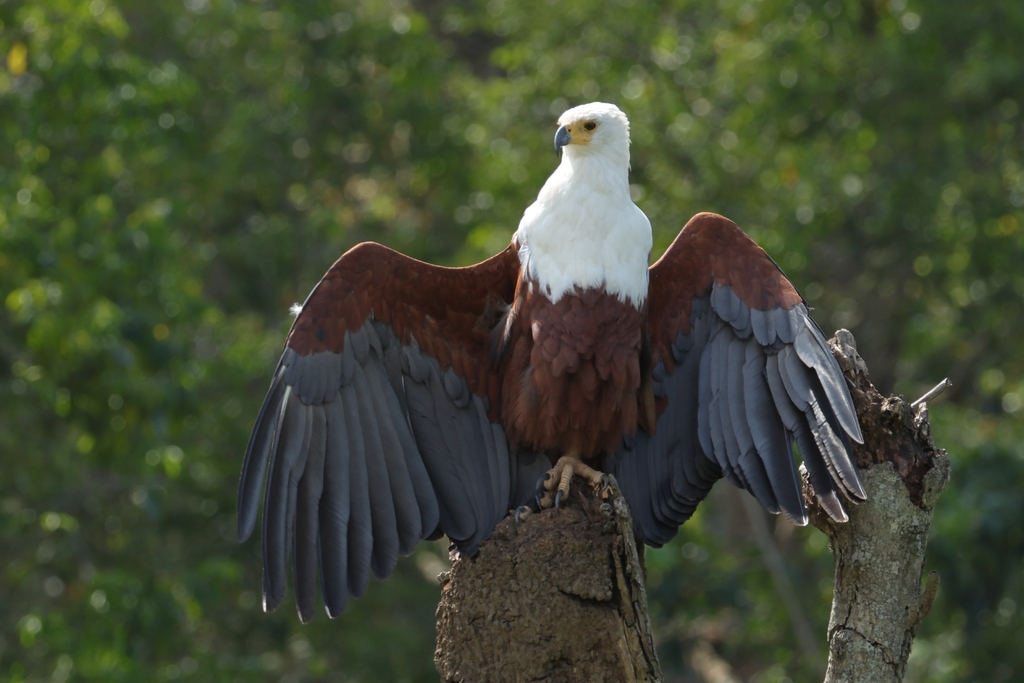
Pigargo Vocinglero
Photo © Barry Stewart
Photo © Barry Stewart — CC BY 4.0 — Source: iNaturalist photo #660124280Identification
The African fish eagle is a large and unmistakable bird of prey. Adults are highly distinctive, with snowy white heads, breasts, and tails contrasting sharply against dark brown bodies and powerful black wings. The face is bare and yellow, as is the hook-shaped beak, which is tipped in black—perfectly adapted for its carnivorous lifestyle. Dark brown eyes and rough-soled feet equipped with powerful talons complete the formidable predator's appearance. Females are noticeably larger than males, weighing 3.2–3.6 kg compared to males at 2.0–2.5 kg, with females achieving wingspans of up to 2.4 m. Juveniles appear entirely brown with paler eyes and gradually acquire the distinctive white head and tail plumage of adults. The species is superficially similar to the bald eagle but the two are not closely related and occur on different continents.
The African fish eagle's most iconic feature is its distinctive cry—a weee-ah, hyo-hyo or heee-ah, heeah-heeah call that many consider evocative of the spirit of Africa itself. Males produce shriller vocalizations than females.
Range & Habitat
This species is found throughout sub-Saharan Africa wherever large bodies of open water with abundant food supply occur. It is the national bird of Malawi, Namibia, Zambia, and Zimbabwe. African fish eagles remain quite common near freshwater lakes, reservoirs, and rivers, though they can occasionally be found near coastal areas at river mouths and lagoons. Key locations include the Orange River in South Africa and Namibia, the Okavango Delta in Botswana, Lake Malawi, Lake Victoria, and the Rift Valley lakes of Central Africa.
This is a generalist species requiring only open water with sufficient prey and good perching trees. It thrives in diverse habitats including grasslands, swamps, marshes, tropical rainforests, fynbos, and even desert-bordering coastlines such as those of Namibia. The species is notably absent from arid areas with little surface water.
Behaviour & Diet
The African fish eagle feeds primarily on fish, which it captures in a characteristic hunting technique: swooping down from a riverside or lakeside perch to snatch prey from the water with its large, clawed talons, then flying back to eat its catch. Like other sea eagles, it possesses specialized structures on its toes called spiricules that enable it to grip slippery fish. The eagle typically catches fish weighing 200 to 1,000 grams, though it can take fish up to 4,200 grams; if a catch proves too heavy to sustain flight, the bird will drop into the water and paddle to shore using its wings. Common prey includes mullets and catfish, though cichlids, tilapias, lungfish, characins, and eels are also taken. Remarkably, the eagle even preys upon African tigerfish, especially when hunting barn swallows in flight.
Beyond fish, the African fish eagle is opportunistic and regularly hunts waterbirds including ducks, coots, cormorants, grebes, darters, and young herons and egrets. Pairs are believed to mate for life and maintain two or more nests built from sticks in large trees, with some nests reaching 2.0 m across after years of reuse and renovation. Breeding occurs during the dry season when water levels are low. Females lay one to three white eggs with reddish speckles, with incubation lasting 42 to 45 days. Chicks fledge at 70 to 75 days old and remain dependent for up to three months before becoming nomadic. Survivors of the first year can live 12 to 24 years.
Best Time & Places to See It
The African fish eagle is still quite common throughout its range, making it a reliable species for dedicated birdwatchers and wildlife travelers. The best locations are near large bodies of open freshwater: Lake Malawi, the Okavango Delta, Lake Victoria, the Rift Valley lakes, and river systems such as the Orange River offer excellent viewing opportunities. The species occurs in substantial numbers around these major water bodies across Malawi, Tanzania, Mozambique, Botswana, South Africa, and Namibia.
Since African fish eagles breed during the dry season and require good perches overlooking water, they are most easily spotted from accessible vantage points along lakes and rivers during this period. Early morning hours are typically best for observing hunting activity, as eagles often perch conspicuously in large riverside or lakeside trees.
Photography Tips
The African fish eagle's striking white head and dark plumage provide excellent contrast for photography, particularly when perched against green vegetation or blue water. Early morning and late afternoon light will enhance the brilliant white of the head and tail. Position yourself with the sun behind you to avoid backlighting the white plumage, which can fool camera meters into underexposure.
For action shots, position yourself near a productive fishing location and wait for hunting activity. The eagle's characteristic hunting stoop and water-skimming approach offer dynamic photographic opportunities. The massive wingspan of females (up to 2.4 m) is best captured with the bird in flight against a clear sky or across water. Patience and a good telephoto lens of at least 400–600 mm will reward you with memorable images of this iconic African predator.
Safari de 3 días a Murchison Falls vía Ziwa
Serengeti National Park
Arusha National Park
Rubondo Island National Park
Mapungubwe National Park
Chobe National Park
Nxai Pan National Park
Virunga National Park
Bwindi Impenetrable National Park
Kidepo Valley National Park
Murchison Falls National Park
Mgahinga Gorilla National Park
Lake Mburo National Park
Tsavo East National Park
Tsavo West National Park
Amboseli National Park
Mount-Kenya National Park
Tarangire National Park
Ngorongoro Conservation Area
Toro-Semliki Proposed National Park
Queen Elizabeth National Park
Mabamba Swamp
Garden Route National Park
Pilanesberg National Park
Mokala National Park
Kruger National Park
Agulhas National Park
Tankwa-Karoo National Park
Mountain Zebra National Park
Bontebok National Park
Augrabies Falls National Park
Addo Elephant National Park
Ithala Game Reserve
Marakele National Park
Camdeboo National Park
Ziwa Rhino and Wildlife Ranch
Khaudum National Park
Sperrgebiet National Park
Nkasa Rupara National Park
Bwabwata National Park
Etosha National Park
Abijata-Shalla Lakes National Park
Bale Mountains National Park
Mago National Park
Awash National Park
Nech Sar National Park
Yabelo Wildlife Sanctuary
Makgadikgadi Pans National Park
Nairobi National Park
Lake Nakuru National Park
Aberdare National Park
Meru National Park
Samburu National Reserve
Hell’s Gate National Park
Ruma National Park
Ol Donyo Sabuk National Park
Central Island National Park
South Island National Park
Sibiloi National Park
Arabuko Sokoke Forest Reserve
Watamu Marine National Park
Aún no hay fotos de la comunidad. Inicia sesión para añadir la primera.
Aún no hay observaciones de la comunidad de esta especie.