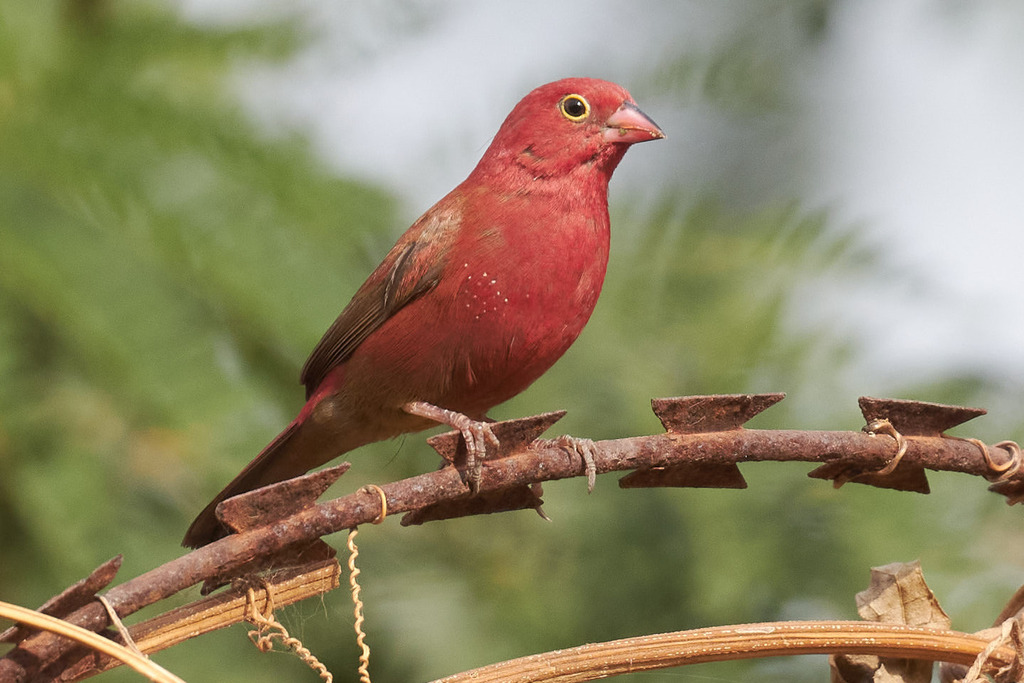
Amaranta Senegalesa
Photo © andygpos
Photo © andygpos — CC BY 4.0 — Source: iNaturalist photo #471356129Identificación
El capuchino senegalés es un diminuto pájaro granívoro que mide apenas 10 cm de largo, lo que facilita pasarlo por alto a pesar de su plumaje llamativo. Los machos adultos son inconfundibles, luciendo plumaje completamente rojo escarlata excepto por las alas marrones—una combinación deslumbrante que los convierte en algunos de los pájaros pequeños más vistosos de África. Ambos sexos comparten un pico rosado distintivo y un anillo ocular amarillo. Las hembras son más discretas, con partes superiores uniformemente marrones y partes inferiores ante, aunque conservan los parches rojos característicos frente a ambos ojos y el pico rosado que las identifican como capuchinos.
Distribución y Hábitat
Esta especie ampliamente distribuida y abundante es un ave residente reproductora en la mayor parte del África subsahariana, con una extensión global estimada de 10,000,000 km². Se reconocen seis subespecies, que van desde poblaciones de África occidental en Mauritania y Senegal a través del Sahel, África oriental, y hacia el sur hasta poblaciones de Mozambique y Sudáfrica. La especie también ha sido introducida en el sur de Argelia, donde actualmente se expande hacia el norte, aunque una introducción anterior a Egipto no se estableció permanentemente.
El capuchino senegalés es un ave gregaria que prospera en praderas abiertas y áreas cultivadas, y frecuentemente se encuentra cerca de asentamientos humanos junto con otros pequeños pinzones como el cordonblú morado. Construye un gran nido abovedado de pasto con entrada lateral, edificado bajo en un arbusto, pared o paja, donde pone entre tres y seis huevos blancos.
Comportamiento y Dieta
Fiel a su familia de pinzones de cera y afines, el capuchino senegalés es principalmente granívoro, alimentándose principalmente de grano y otras semillas. Es un ave claramente social, frecuentemente encontrada en pequeños bandos. La especie tiene vocalizaciones características: un suave y familiar reclamo "queet-queet" que es un sonido reconocible en los paisajes africanos, y un canto ascendente descrito como "chick-pea-pea-pea". Un detalle ecológico de interés es que el nido de esta especie a veces es parasitado por el indigobird aldeano, que puede poner sus propios huevos dentro del cuidadosamente construido hogar del capuchino.
Mejor Época y Lugares para Verlo
El estatus del capuchino senegalés como ave residente reproductora significa que está presente todo el año en toda su distribución, lo que la hace accesible a los viajeros que visitan el África subsahariana en cualquier estación. Su abundancia y preferencia por praderas abiertas y áreas cultivadas cerca de asentamientos humanos la convierten en uno de los pájaros pequeños más confiables de encontrar. Búscala en áreas con arbustos dispersos y estructuras de paja, particularmente en pueblos y regiones agrícolas donde el cultivo de grano proporciona alimento abundante.
Consejos para Fotografía
El brillante plumaje rojo escarlata de los machos ofrece excelentes oportunidades fotográficas, particularmente en luz matutina temprana cuando los colores son más vibrantes. El pequeño tamaño del pájaro y su naturaleza gregaria significan que los fotógrafos pacientes pueden capturar múltiples individuos en una sola toma. Enfócate en los machos para obtener las imágenes más llamativas, utilizando su coloración roja y marrón distintiva contra fondos naturales. La familiaridad de la especie con la habitación humana significa que frecuentemente puede aproximarse más que especies más salvajes, aunque un lente teleobjetivo seguirá siendo valioso para capturar detalles finos del anillo ocular y la coloración del pico.
Arusha National Park
Tanzania
+132 aves+30 mamíferos
Where the slopes of Mount Mawenzi rise above the Arusha region, a compact yet ecologically rich national park unfolds across […]
VER PARQUE NACIONALRubondo Island National Park
Tanzania
+84 aves+14 mamíferos
Across the waters of Lake Victoria’s northeastern arm, Rubondo Island rises as a freshwater wilderness where papyrus swamps grade into […]
VER PARQUE NACIONALMapungubwe National Park
Musina Local Municipality, Botsuana
+132 aves+30 mamíferos
Where the Limpopo River cuts through sandstone ridges at the convergence of South Africa, Botswana, and Zimbabwe, Mapungubwe National Park […]
VER PARQUE NACIONALChobe National Park
Botsuana
+122 aves+30 mamíferos
Where the Chobe River cuts a sinuous path through northern Botswana, the landscape transforms into one of Africa’s most dynamic […]
VER PARQUE NACIONALVirunga National Park
Uganda
+132 aves+30 mamíferos
Where the Western Rift Valley fractures the landscape of North Kivu, Virunga National Park sprawls across terrain as geologically dramatic […]
VER PARQUE NACIONALBwindi Impenetrable National Park
Kanyashogi, Uganda
+132 aves+29 mamíferos
Steep ridges cloaked in montane forest rise from Uganda’s southwestern borderlands, where the landscape grows so dense and tangled that […]
VER PARQUE NACIONALVolcanoes National Park
Musanze District, Uganda
+111 aves+14 mamíferos
Where volcanic cones rise sharply above the montane forests of northern Uganda, Volcanoes National Park protects one of East Africa’s […]
VER PARQUE NACIONALMgahinga Gorilla National Park
Cyanika, Uganda
+132 aves+30 mamíferos
Where the Virunga Mountains rise steeply from the Uganda–Rwanda–Democratic Republic of Congo frontier, montane forest cloaks the volcanic slopes in […]
VER PARQUE NACIONALLake Mburo National Park
Uganda
+124 aves+30 mamíferos
Rolling acacia woodland and scattered lakes define this intimate savanna preserve in southwestern Uganda, where the rift valley’s geological drama […]
VER PARQUE NACIONALAmboseli National Park
Etonet/Lenkism ward, Kenya
+124 aves+30 mamíferos
Where the Amboseli basin opens toward the Tanzanian frontier, a shallow alkaline lake mirrors vast skies across one of East […]
VER PARQUE NACIONALKilimanjaro National Park
Kenya
+132 aves+30 mamíferos
Africa’s highest mountain rises not in isolation but as the centerpiece of a vast national park that sweeps across the […]
VER PARQUE NACIONALMount-Kenya National Park
Abothuguchi west ward, Kenya
+132 aves+30 mamíferos
Where the slopes of Kenya’s second-highest mountain rise steeply from the Meru County foothills, a landscape of profound ecological richness […]
VER PARQUE NACIONALTarangire National Park
Tanzania
+124 aves+30 mamíferos
Acacia woodland and grassland sweep across the Manyara Region where the Tarangire River carves through low hills and volcanic soils, […]
VER PARQUE NACIONALKitulo National Park
Tanzania
+94 aves+15 mamíferos
Where the southern highlands of Tanzania rise above two thousand metres, rolling grasslands and montane meadows create a landscape rarely […]
VER PARQUE NACIONALQueen Elizabeth National Park
Uganda
+129 aves+30 mamíferos
Across the southwestern escarpment of Uganda, where the Western Rift Valley descends through ancient volcanic terrain, Queen Elizabeth National Park […]
VER PARQUE NACIONALMabamba Swamp
Memere, Uganda
150+ aves
Across the Central Region of Uganda spreads one of Africa’s most biodiverse freshwater wetlands, a sprawling nature reserve of roughly […]
VER RESERVA NATURALMokala National Park
Siyancuma Local Municipality, Sudáfrica
+123 aves+30 mamíferos
Across the semi-arid savanna of the Northern Cape, where red earth meets sparse acacia woodland and open grassland punctuated by […]
VER PARQUE NACIONALKruger National Park
Ba-Phalaborwa Local Municipality, Sudáfrica
+132 aves+30 mamíferos
Across the low-lying savanna of northeastern South Africa unfolds one of Africa’s largest and most ecologically intact protected areas, where […]
VER PARQUE NACIONALMountain Zebra National Park
Inxuba Yethemba Local Municipality, Sudáfrica
+123 aves+30 mamíferos
Across the windswept plateaus and deeply incised valleys of the Eastern Cape’s interior, Mountain Zebra National Park unfolds as a […]
VER PARQUE NACIONALMarakele National Park
Modimolle Local Municipality, Sudáfrica
+122 aves+30 mamíferos
Granite ridges and sprawling grasslands dominate this 1,176-square-kilometre reserve in Limpopo’s heartland, where bushveld transitions between rocky outcrops and open […]
VER PARQUE NACIONALCamdeboo National Park
Camdeboo Local Municipality, Sudáfrica
+124 aves+30 mamíferos
Granite ridges and weathered sandstone cliffs rise across a semi-arid landscape where the Karoo transitions into the eastern escarpment of […]
VER PARQUE NACIONALZiwa Rhino and Wildlife Ranch
Nakasongola, Uganda
+131 aves+17 mamíferos
Where papyrus wetlands merge into sprawling savanna, Uganda’s central landscape opens into one of East Africa’s most vital rhino recovery […]
VER SANTUARIO DE VIDA SILVESTREAbijata-Shalla Lakes National Park
Etiopía
+135 aves+22 mamíferos
Two crater lakes of contrasting chemistry define this remote corner of Ethiopia’s Rift Valley, where soda lakes and freshwater basins […]
VER PARQUE NACIONALAwash National Park
Didiga, Etiopía
+134 aves+29 mamíferos
Where the Ethiopian Rift Valley carves through volcanic plateaus, a ribbon of riverine forest winds through acacia scrubland and grassland, […]
VER PARQUE NATURALSimien Mountains National Park
Debark, Etiopía
+61 aves+13 mamíferos
Where granite escarpments plunge thousands of metres into misty valleys, the Ethiopian highlands reveal a landscape of almost mythical drama. […]
VER PARQUE NACIONALNech Sar National Park
Arba Minch, Etiopía
+109 aves+17 mamíferos
Where the East African Rift Valley plateaus drop dramatically toward the shore of Lake Abaya, a mosaic of habitats unfolds […]
VER PARQUE NACIONALMakgadikgadi Pans National Park
Gucta, Botsuana
+107 aves+22 mamíferos
Where salt-crusted flatlands stretch endlessly toward a shimmering horizon, one of Africa’s most extraordinary ecosystems awakens with the rains. The […]
VER PARQUE NACIONALAún no hay fotos de la comunidad. Inicia sesión para añadir la primera.
Aún no hay observaciones de la comunidad de esta especie.