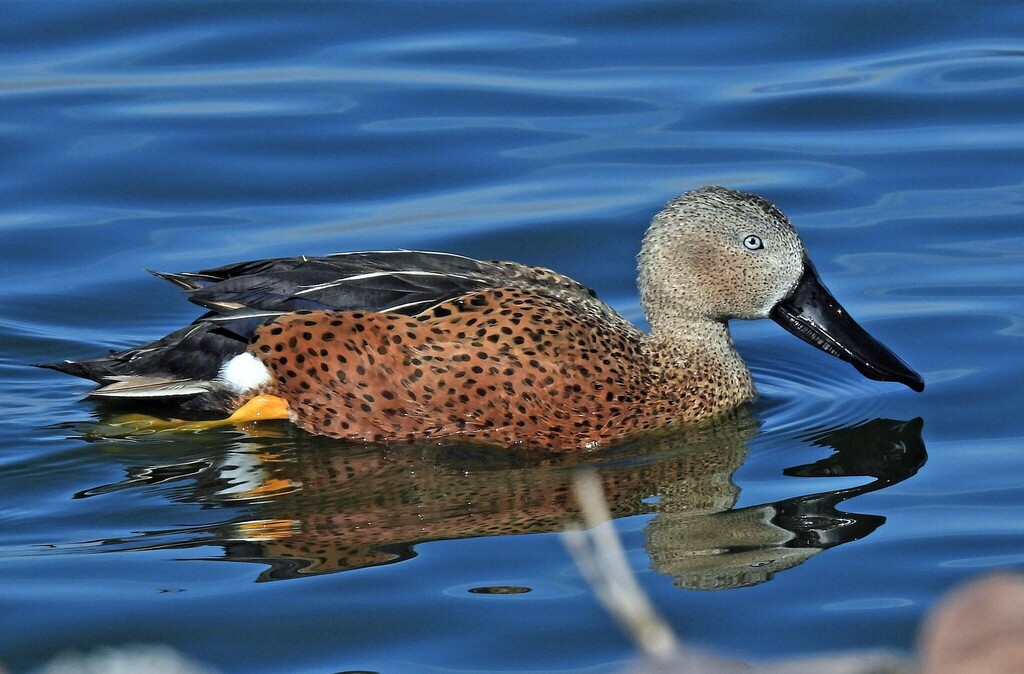
Cuchara Argentino
Photo © Hugo Hulsberg
Photo © Hugo Hulsberg — CC0 1.0 — Source: iNaturalist photo #295509101Identification
The red shoveler is a medium-sized dabbling duck, measuring 45–56 centimetres in length with a wingspan of 66–73 centimetres and weighing around 523–608 grams. The species is instantly recognizable by its distinctive spatula-shaped bill—the source of both its common and scientific names. Males display striking plumage ranging from deep red to paler shades of red and pink, while females are more subdued and notable for their large, dark bills. Both sexes share a green speculum (the iridescent patch on the wing) and light blue upper wing coverts, which are visible in flight.
Range & Habitat
Native to southern South America, the red shoveler breeds across a broad range extending from Tierra del Fuego northwards through Chile and most of Argentina, reaching the Falkland Islands. Smaller, isolated breeding populations exist in the southern regions of Peru, Bolivia, and Paraguay, with additional populations in the extreme south of Brazil and Uruguay. These ducks favour shallow lakes and pools with dense reed beds, as well as intertidal mangrove swamps and marshes. They are equally at home in brackish waters, including coastal lagoons, deltas, and estuaries.
Behaviour & Diet
Red shovelers are dabbling ducks adapted to filter-feeding in shallow water. Their specialized lamellate bill mechanism allows them to extract small food items from the water column with remarkable efficiency. Their diet is diverse, consisting of herbs, grasses, pond weeds, widgeon grass, algae, eelgrass, and small invertebrates. The species is partially migratory, with southernmost populations moving north during winter months to escape the harshest conditions.
Breeding pairs form on the wintering grounds following often noisy courtship displays. Females lay clutches of 7–8 eggs, with an incubation period of approximately 25–26 days. Ducklings remain dependent for 40–45 days before fledging.
Best Time & Places to See It
The red shoveler is relatively common and widespread throughout its southern South American range, making it accessible to wildlife travellers visiting Patagonia, the Falkland Islands, or wetland areas of Argentina and Chile. The species is classified as Least Concern, with a stable population and extremely large range. Breeding season offers opportunities to observe courtship behaviour and family groups, while winter months may bring northern visitors to lower-latitude wetlands in Paraguay, Bolivia, and Peru.
Photography Tips
The red shoveler's distinctive bill and colourful plumage, particularly in males, make it an rewarding photographic subject. The light blue upper wing coverts and green speculum are best captured in flight photography. Early morning visits to shallow lakes, reed-fringed pools, and coastal lagoons offer the best lighting and activity levels. Photograph during breeding season to capture males in full plumage or document family groups with ducklings, though approach carefully to avoid disturbing nesting birds concealed in dense vegetation.
Peixe National Park Lagoon
Brasil
150+ aves+5 mamíferos
Coastal lagoons and barrier-island ecosystems unfold across southern Brazil’s Rio Grande do Sul, where freshwater meets Atlantic salt in an […]
VER PARQUE NACIONALTorres del Paine National Park
Torres del Paine, Chile
+129 aves+8 mamíferos
Where granite spires pierce the Patagonian sky, Torres del Paine sprawls across nearly 4,200 square kilometres of some of Earth’s […]
VER PARQUE NACIONALPatagonia National Park
Cochrane, Chile
+92 aves+12 mamíferos
Where granite towers pierce the Patagonian sky and turquoise rivers carve through windswept steppe, one of South America’s most dramatic […]
VER PARQUE NACIONALAún no hay fotos de la comunidad. Inicia sesión para añadir la primera.
Aún no hay observaciones de la comunidad de esta especie.