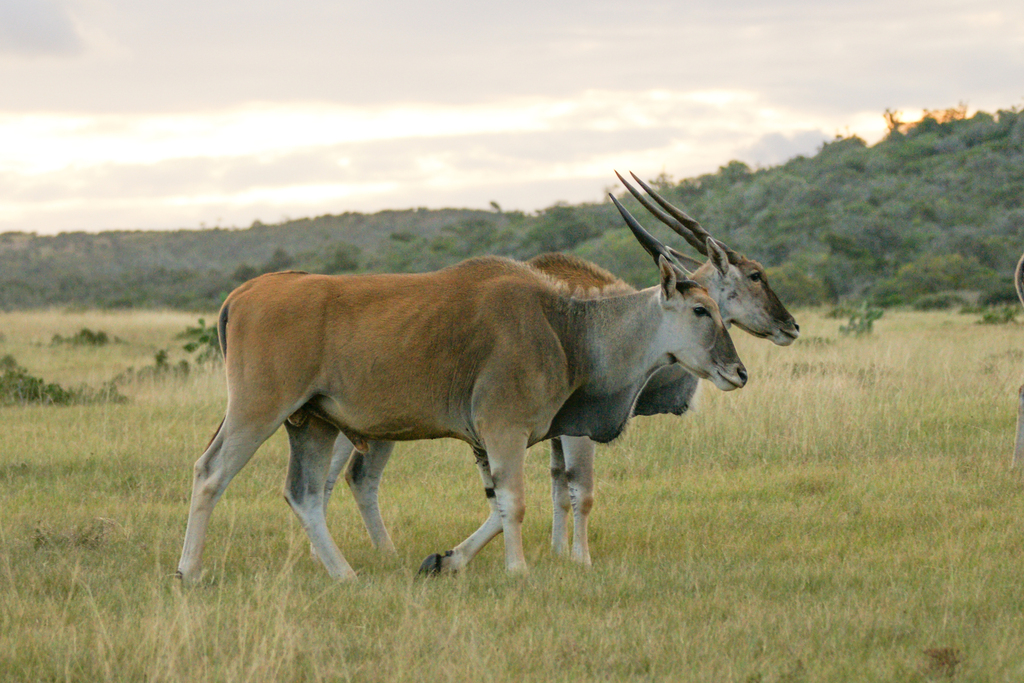
Antílope Eland
Photo © martin ingemansson
Photo © martin ingemansson — CC BY 4.0 — Source: iNaturalist photo #475339228Identificación
El antílope sable es el antílope más grande de África, inconfundible por su tamaño y presencia imponente. Los machos adultos miden alrededor de 1,6 m a la altura del hombro y generalmente pesan 500–600 kg, aunque algunos individuos superan los 900 kg. Las hembras son notablemente más pequeñas, con 1,4 m de altura y 340–445 kg. Ambos sexos poseen cuernos espirales distintivos con una arista constante; los cuernos de los machos son más cortos y robustos (43–66 cm), mientras que los de las hembras son más largos y esbeltos (51–69 cm).
El dimorfismo sexual se extiende al color y patrón del pelaje. Las hembras exhiben un pelaje beige, mientras que los machos son más oscuros con un matiz gris azulado que se intensifica con la edad. En la parte norte de su distribución, los antílopes sable muestran franjas dorsales llamativas, marcas en las patas y una cresta espinal oscura; las poblaciones del sur carecen de estas características. Los machos desarrollan pelaje denso en la frente y una papada prominente en la garganta. Los machos también pueden exhibir franjas blancas verticales en los flancos, particularmente en las poblaciones de Sudáfrica.
Distribución y Hábitat
El antílope sable es nativo de África Oriental y Meridional, con una distribución amplia que abarca Angola, Botsuana, la República Democrática del Congo, Esuatini, Etiopía, Kenia, Lesoto, Malaui, Mozambique, Namibia, Ruanda, Sudáfrica, Sudán del Sur, Tanzania, Uganda, Zambia y Zimbabue. Ya no está presente en Burundi, aunque las poblaciones persisten en gran parte de su rango histórico.
Estos antílopes prefieren paisajes abiertos y variados—sabanas, bosques y pastizales montanos con diversas plantas florales—y evitan activamente los bosques densos. Prosperan en hábitats que ofrecen una amplia variedad de vegetación, lo que los hace bien adaptados a entornos semiáridos y pastizales en todo el continente.
Comportamiento y Dieta
Los antílopes sable son herbívoros altamente gregarios, formando manadas de hasta 500 animales que vagan libremente sin defender territorios. Se alimentan principalmente de pastos y hojas, adaptando su dieta a la vegetación disponible. Estos antílopes masivos se comunican mediante ladridos sonoros, movimientos visuales y posturales, y la respuesta del flehmén (curvatura del labio superior para analizar olores). Un sonido de clic distintivo frecuentemente acompaña a las manadas en movimiento, causado por su peso pesado haciendo que las mitades de las pezuñas se abran y cierren con cada paso—un sonido que probablemente sirva como forma de comunicación de largo alcance entre la manada.
A pesar de su tamaño impresionante, los antílopes sable son sorprendentemente ágiles, capaces de saltar 2,5–3 m desde una posición estacionaria cuando se asustan. Sin embargo, son los antílopes más lentos de todos, con una velocidad máxima de solo 40 km/h que rápidamente los agota; pueden mantener un trote de 22 km/h indefinidamente. Los machos utilizan sus cuernos durante la temporada de celo para luchar y embestir, mientras que las hembras usan sus cuernos defensivamente para proteger a las crías de los depredadores.
Mejor Época y Lugares para Verlo
Los antílopes sable están ampliamente distribuidos en áreas protegidas y regiones de vida silvestre en toda África Oriental y Meridional. Su preferencia por pastizales abiertos y bosques los hace relativamente conspicuos en comparación con especies de antílopes forestales. Habitan tanto reservas de sabana como hábitats de pastizales montanos, ofreciendo oportunidades para avistamientos en diversos paisajes y ecosistemas.
Aunque su población está en declive, la especie sigue clasificada como de menor preocupación por la UICN, con poblaciones establecidas en gran parte de su rango. Los antílopes sable no son migratorios y ocupan territorios año redondo dentro del hábitat adecuado, haciéndolos potencialmente visibles durante todas las estaciones en áreas donde persisten.
Consejos de Fotografía
El tamaño masivo del antílope sable y sus cuernos distintivos lo convierten en un sujeto fotográfico cautivador. El dimorfismo sexual entre machos y hembras ofrece oportunidades para capturar diferentes tonos de color—el beige más cálido de las hembras contrasta hermosamente con el gris azulado más frío de los machos. La variación regional en los patrones del pelaje, particularmente las franjas llamativas en las poblaciones del norte, merece ser documentada.
El sonido característico de clic de las pezuñas, aunque inaudible en las fotografías, añade una dimensión de audio a los encuentros con antílopes sable—un complemento sensorial memorable para la documentación visual. Para tomas de acción, captura su capacidad impresionante de salto cuando las manadas se asustan, o fotografía los despliegues posturales dramáticos y las embestidas de cabeza durante la temporada de celo. Las tomas de gran angular funcionan bien para transmitir la escala de la manada y sus hábitats de paisaje abierto preferidos.
Serengeti National Park
Mapungubwe National Park
Chobe National Park
Khaudum National Park
Kidepo Valley National Park
Lake Mburo National Park
Tsavo East National Park
Tsavo West National Park
Amboseli National Park
Tarangire National Park
Ngorongoro Conservation Area
Garden Route National Park
Pilanesberg National Park
Mokala National Park
Kruger National Park
Tankwa-Karoo National Park
Mountain Zebra National Park
Augrabies Falls National Park
Addo Elephant National Park
Ithala Game Reserve
Marakele National Park
Camdeboo National Park
Khaudum National Park
Etosha National Park
Waterberg Plateau National Park
Nairobi National Park
Lake Nakuru National Park
Aberdare National Park
Meru National Park
Hell’s Gate National Park
Chyulu Hills National Park
Aún no hay fotos de la comunidad. Inicia sesión para añadir la primera.