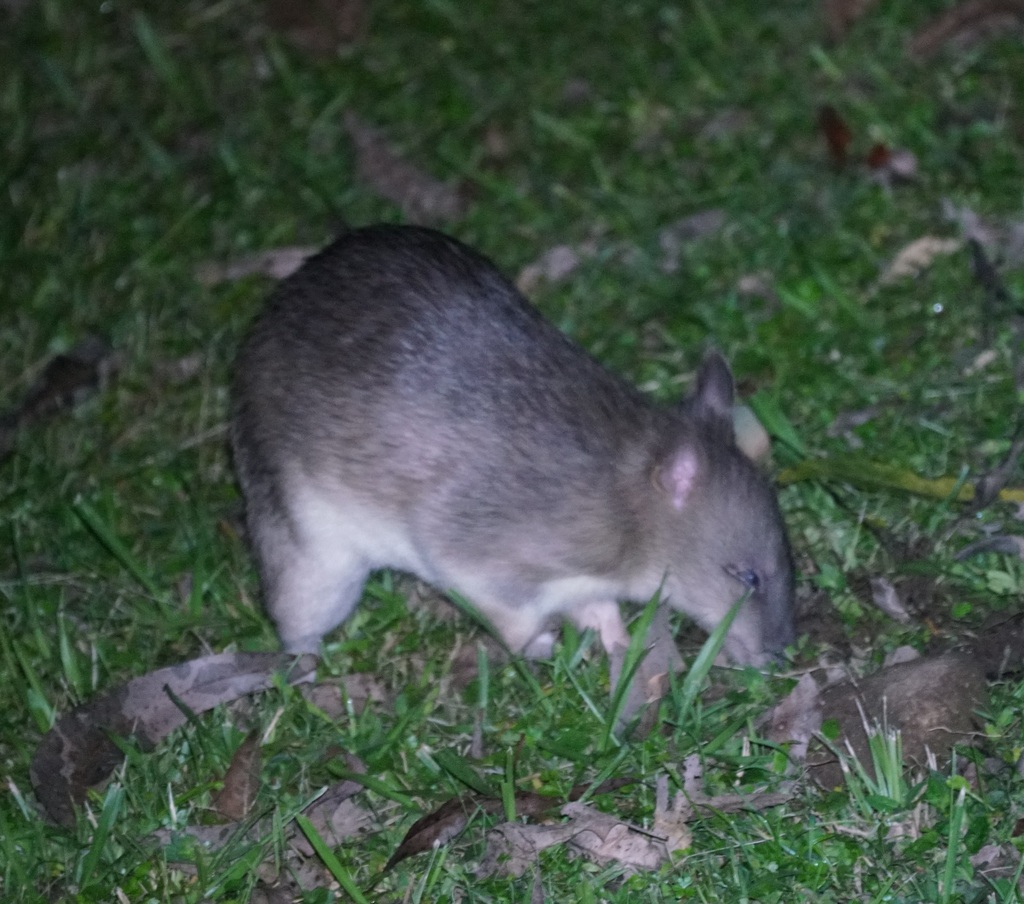
Bandicut Listado Hociquilargo
Photo © Tim
Photo © Tim — CC BY 4.0 — Source: iNaturalist #213903754The long-nosed bandicoot (Perameles nasuta), a marsupial, is a species of bandicoot found in eastern Australia, from north Queensland along the east coast to Victoria. Around 40 centimetres (16 in) long, it is sandy- or grey-brown with a long snouty nose. Omnivorous, it forages for invertebrates, fungi and plants at night. == Taxonomy == French naturalist Étienne Louis Geoffroy described the long-nosed bandicoot in 1804. Swiss naturalist Heinrich Rudolf Schinz described a large specimen from near Bathurst in the Blue Mountains as a new species, Perameles lawson, in 1825, though the specimen was lost at sea in shipwreck. French naturalist Pierre Boitard described Isoodon musei in 1841, both are now classified as P. nasuta. Two subspecies are recognised: P. nasuta subspecies nasuta is found from western Victoria through eastern New South Wales and north to central Queensland, and P. nasuta subspecies pallescens, found from central Queensland through to the Cape York Peninsula. The long-nosed bandicoot is the largest member of its genus, which also includes the eastern barred bandicoot and the western barred bandicoot. It is most closely related to the eastern barred bandicoot, the two species having diverged from one another in the late Pliocene. Their ancestors diverged from…
Bunya Mountains National Park
Daintree National Park
Springbrook National Park
Lamington National Park
Sydney Harbour National Park
Royal National Park
Lockyer National Park
Bald Rock National Park
Girraween National Park
Morton National Park
Wilsons Promontory National Park
Great Sandy National Park
Blue Mountains National Park
Kosciuszko National Park
Bouddi National Park
Ku-ring-gai Chase National Park
Barrington Tops National Park
Dorrigo National Park
Oxley Wild Rivers National Park
New England National Park
Budawang National Park
Ben Boyd National Park
Great Otway National Park
Aún no hay fotos de la comunidad. Inicia sesión para añadir la primera.
Aún no hay observaciones de la comunidad de esta especie.