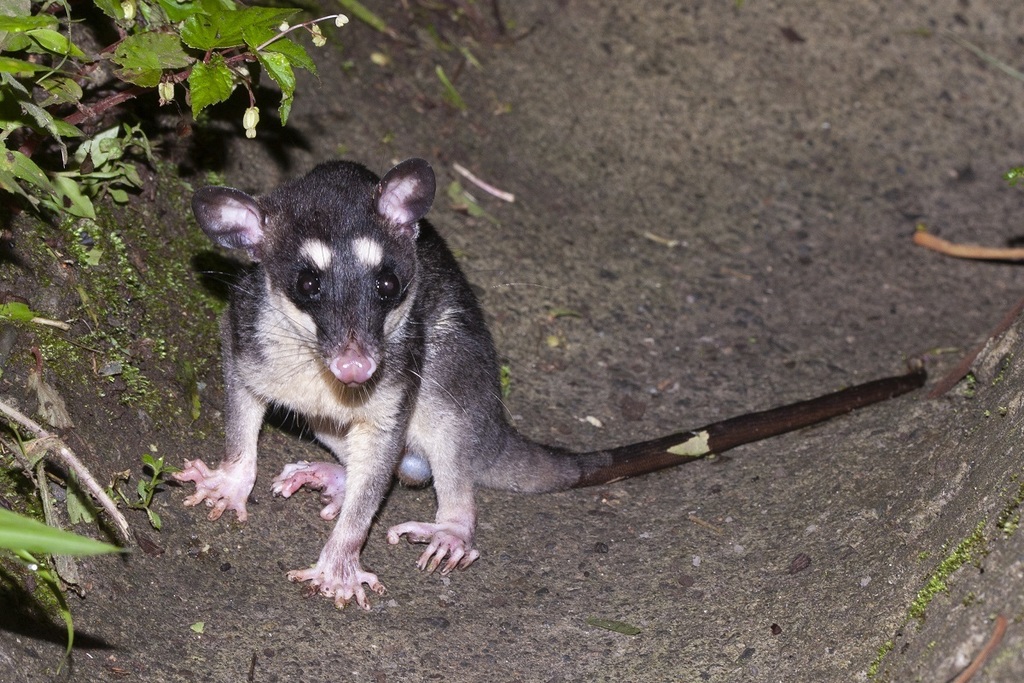
Zarigüeya gris de cola oscura
CC BY 4.0
CC BY 4.0 — Source: iNaturalist photo #96004280The dark four-eyed opossum (Philander melanurus) is a species of opossum from Central and South America. == Taxonomy == This species was originally described as a subspecies of Philander opossum, and was considered a subspecies until the late 2010s. Some sources, such as GBIF and the IUCN do not recognize this species's validity yet, while others, such as the American Society of Mammalogists, do recognize it as valid. The subspecies Philander opossum fuscogriseus was sometimes recognized as a valid subspecies, but is now considered a junior synonym of P. melanurus. If fuscogriseus would be revalidized, it would include populations in Central America, while the nominate subspecies would be the South American populations. When considered valid the two forms could be differentiated by fuscogriseus having a lighter-tipped tail and lighter fur color on average, while melanurus has a unicolored tail and darker upperparts. == Etymology == The common name "four-eyed opossum" comes from the spots above the eyes of this species looking like another set of eyes. The specific name "melanurus" is derived from the Greek "melas" meaning "black" and "oura" meaning "the tail". == Description == This species ranges from 483 to 582 mm (19.0 to 22.9 in), averaging 527…
Corcovado National Park
Puerto Jiménez, Costa Rica
+132 aves+30 mamíferos
Where the Osa Peninsula juts into the Pacific, rainforest descends almost to the tide line, and Corcovado National Park protects […]
VER PARQUE NACIONALManuel Antonio National Park
Quepos, Costa Rica
+125 aves+30 mamíferos
Where tropical rainforest descends steeply to a rocky Pacific coastline, Manuel Antonio National Park distills Central American biodiversity into one […]
VER PARQUE NACIONALArenal Volcano National Park
Peñas Blancas, Costa Rica
+131 aves+30 mamíferos
Straddling the border between Alajuela and Guanacaste in northwestern Costa Rica, this national park rises dramatically around one of Central […]
VER PARQUE NACIONALTortuguero National Park
Roxana, Costa Rica
+124 aves+30 mamíferos
Canals and lagoons thread through a labyrinth of lowland rainforest where the Caribbean coast of Costa Rica meets the wetland […]
VER PARQUE NACIONALBraulio Carrillo National Park
Las Horquetas, Costa Rica
+132 aves+30 mamíferos
Where the Caribbean slope descends from the central volcanic cordillera toward the humid lowlands of Heredia, Braulio Carrillo National Park […]
VER PARQUE NACIONALPiedras Blancas National Park
Golfito, Costa Rica
+132 aves+30 mamíferos
Where the Golfo Dulce meets the southwestern Pacific coast of Costa Rica, Piedras Blancas National Park protects a dramatic transition […]
VER PARQUE NACIONALVolcán Poás National Park
Toro Amarillo, Costa Rica
+132 aves+30 mamíferos
Where volcanic slopes rise sharply from the Central Valley floor, Volcán Poás National Park protects one of Costa Rica’s most […]
VER PARQUE NACIONALNatural Utría National Park
Alto Baudó (Pie de Pató), Colombia
+144 aves+15 mamíferos
Where the Chocó’s coastal mountains plunge toward the Pacific, Utría National Park preserves one of Colombia’s most biodiverse and least-visited […]
VER PARQUE NACIONALSoberanía National Park
Cristóbal, Panamá
+132 aves+30 mamíferos
Rainforest and riverine woodland blanket the rolling terrain of this 714-square-kilometre national park in Colón Province, where the Caribbean watershed […]
VER PARQUE NACIONALChagres National Park
Caimitillo, Panamá
+131 aves+30 mamíferos
Where the Chagres River carves through the humid tropics of central Panama, a vast montane and lowland forest sprawls across […]
VER PARQUE NACIONALAún no hay fotos de la comunidad. Inicia sesión para añadir la primera.
Aún no hay observaciones de la comunidad de esta especie.