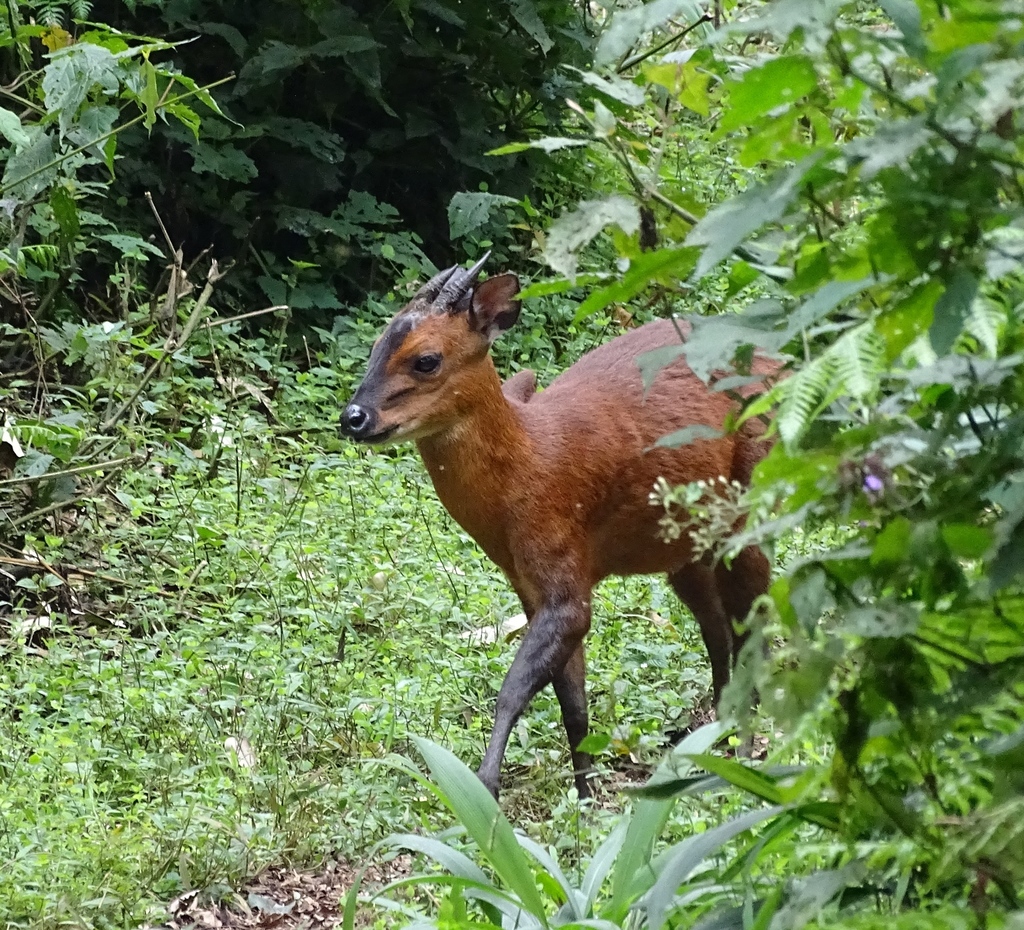
Duiker del Lago Kivu
Photo © Sandra Keller
Photo © Sandra Keller — CC BY 4.0 — Source: iNaturalist #28587586The black-fronted duiker (Cephalophus nigrifrons) is a small antelope found in central and west-central Africa. == Description == The black-fronted duiker is a compact, short-necked, and active antelope that gets its name from the broad black streak that runs from the nose to its forehead, a feature distinguishing it from its congeners. It has a glossy coat that is deep reddish-mahogany to a lighter orange-chestnut in colour, the hair becoming sparser and darker on the long legs. It has a short tail that is black with a white tip and short, pointed horns, measuring 4–12 cm (1.6–4.7 in), which are carried by both sexes and are used for defense against other duikers and predators. Their elongated hooves appear to be an adaptation to the wet habitats they seem to prefer. It weighs 14–18 kg (31–40 lb) and has a shoulder height of 43 cm (17 in). == Distribution == The black-fronted duiker is found in central and west-central Africa, with an isolated population in the Niger Delta in eastern Nigeria and then from southern Cameroon east to western Kenya and south to northern Angola. == Habitat == The black-fronted duiker occurs in montane, lowland, and swamp forests, from near sea…
Bwindi Impenetrable National Park
Kanyashogi, Uganda
+132 aves+29 mamíferos
Steep ridges cloaked in montane forest rise from Uganda’s southwestern borderlands, where the landscape grows so dense and tangled that […]
VER PARQUE NACIONALVolcanoes National Park
Musanze District, Uganda
+111 aves+14 mamíferos
Where volcanic cones rise sharply above the montane forests of northern Uganda, Volcanoes National Park protects one of East Africa’s […]
VER PARQUE NACIONALMgahinga Gorilla National Park
Cyanika, Uganda
+132 aves+30 mamíferos
Where the Virunga Mountains rise steeply from the Uganda–Rwanda–Democratic Republic of Congo frontier, montane forest cloaks the volcanic slopes in […]
VER PARQUE NACIONALAún no hay fotos de la comunidad. Inicia sesión para añadir la primera.
Aún no hay observaciones de la comunidad de esta especie.