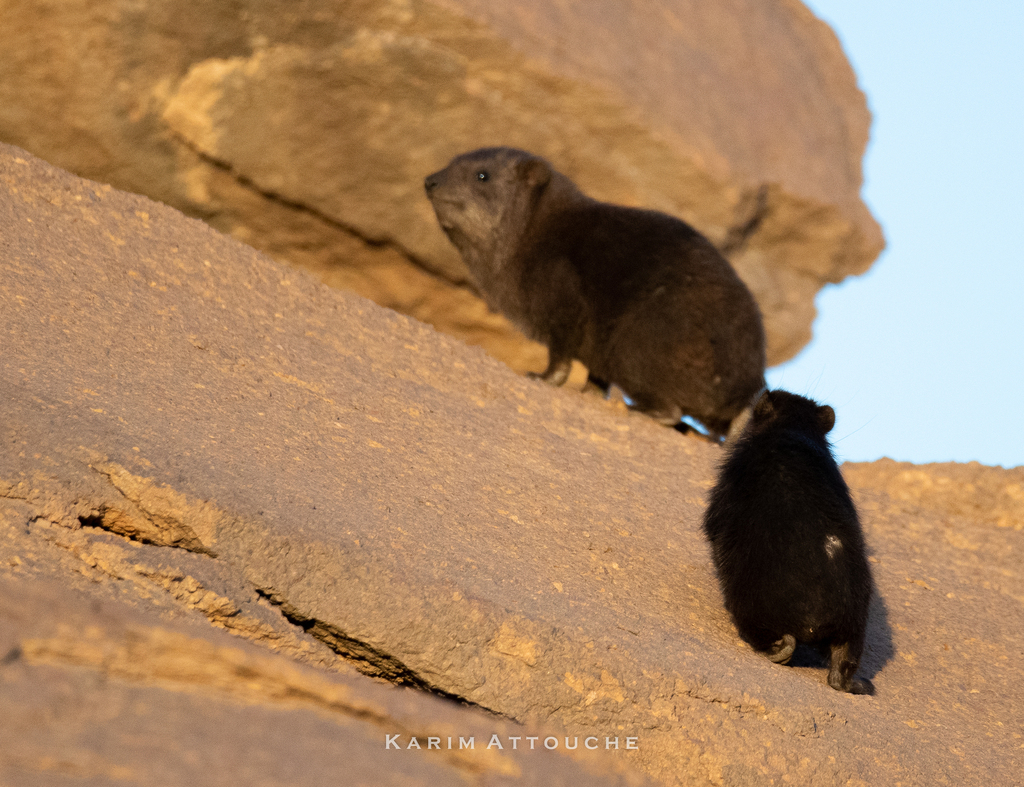
Damán de el Cabo
Photo © karim Attouche
Photo © karim Attouche — CC0 1.0 — Source: iNaturalist #258146045Identification
Rock hyraxes are squat, heavily built mammals weighing 4–5 kg and measuring around 50 cm in length. Their thick fur is grey-brown, though coloration varies regionally from dark brown in wetter habitats to light grey in desert-dwelling populations. They have a pointed head, short neck, and rounded ears adorned with long black whiskers. Most distinctive are their prominent, long, pointed upper incisors that resemble tusks—a surprising feature shared with their distant relatives, elephants.
A unique characteristic of hyraxes is the dorsal gland, a scent-producing organ used for territorial marking and social communication, most visible in dominant males. Their feet are specially adapted for climbing: the fore feet are plantigrade (flat-footed) while the hind feet are semi-digitigrade, with large, soft pads kept moist by sweat-like secretions that provide excellent grip on rock surfaces.
Range & Habitat
Rock hyraxes are found across sub-Saharan Africa in disjunct populations, absent only from the Congo Basin and Madagascar. Their range extends northward to southern Algeria, Libya, and Egypt, and reaches the Middle East with populations in Israel, Jordan, Lebanon, and the Arabian Peninsula. They inhabit areas from sea level up to 4,200 m elevation, making them the only extant terrestrial afrotherians in the Middle East.
These animals require habitats with rock crevices that provide essential refuge from predators. Rock hyraxes have been introduced to Jebel Hafeet on the Oman-United Arab Emirates border. Pelage color varies by subspecies and region: the Cape rock hyrax displays black dorsal patches, the Kaokoveld form has cream patches, and the red-headed variety sports orange markings. A notably larger, long-haired population inhabits the alpine moraines of Mount Kenya.
Behaviour & Diet
Rock hyraxes are highly social, living in groups of 10–80 animals that forage together and employ a sophisticated sentry system—individuals take turns watching from prominent lookouts while others feed, sounding alarm calls to alert the group to approaching predators. The dominant male defends the group and marks territory using his dorsal gland. These animals are crepuscular, most active during morning and evening hours, though activity patterns vary with season and climate. They have incomplete thermoregulation and maintain a body temperature that fluctuates in a daily rhythm.
Rock hyraxes are herbivorous, feeding on a wide variety of plants including Lobelia and broad-leafed species, and occasionally consuming insects and grubs. They forage within about 50 m of their rocky refuges and are capable of going many days without drinking water, obtaining sufficient moisture from their food. Despite their apparently clumsy build, they are surprisingly adept climbers and readily raid residential gardens for vegetation.
Best Time & Places to See It
The best time to observe rock hyraxes is during early morning and late evening when they are most active. Mount Kenya, with its abundant alpine populations, offers excellent viewing opportunities. Throughout their African range, particularly in South Africa, Namibia, and East Africa, rocky outcrops and cliff faces are reliable locations. In the Middle East, populations in Israel and Jordan are accessible to travelers. Rock hyraxes are generally not endangered and in some areas are considered minor pests, meaning populations are stable across much of their range.
Photography Tips
Position yourself near rocky outcrops and crevices during early morning or late evening light when hyraxes are most active and the sun is favorable for photography. Watch for sentry individuals perched on prominent rocks—these alert animals provide excellent opportunities for portraits with natural lookout behavior. The hyrax's distinctive features—long incisors, whiskers, and soft foot pads—reward close-focus photography and macro work when animals are resting.
Because hyraxes forage as groups, shoot in burst mode to capture multiple animals and dynamic social behavior. Their tendency to quickly retreat into rock crevices means patience and stillness are essential. The variation in pelage color between individuals and populations makes comparative photography worthwhile. Early morning mist in highland areas, such as Mount Kenya, can add atmospheric depth to your images.
Serengeti National Park
Tanzania
+131 aves+30 mamíferos
Dawn breaks over an endless golden savanna where acacia-studded plains stretch to distant volcanic highlands, their slopes cloaked in montane […]
VER PARQUE NACIONALMapungubwe National Park
Musina Local Municipality, Botsuana
+132 aves+30 mamíferos
Where the Limpopo River carves a boundary between nations, ancient sandstone cliffs rise in sculptured isolation above riverine woodland and […]
VER PARQUE NACIONALKidepo Valley National Park
Uganda
+133 aves+29 mamíferos
Where granite peaks rise above sweeping savanna and acacia woodlands meet riverine forests, one of Africa’s most remote wilderness sanctuaries […]
VER PARQUE NACIONALLake Mburo National Park
Uganda
+124 aves+30 mamíferos
Dawn breaks across a mosaic of acacia woodland, papyrus swamps, and open grassland where Uganda’s southwestern savanna meets the edge […]
VER PARQUE NACIONALMount Elgon National Park
Matumbei ward, Kenya
+142 aves+20 mamíferos
Where ancient volcanic slopes rise across the Kenya-Uganda border, Mount Elgon commands the landscape as one of East Africa’s most […]
VER PARQUE NACIONALMount-Kenya National Park
Abothuguchi west ward, Kenya
+132 aves+30 mamíferos
Where volcanic peaks pierce the equatorial sky and glaciers crown Africa’s second-highest mountain, an extraordinary ecosystem unfolds across five distinct […]
VER PARQUE NACIONALGarden Route National Park
George, Sudáfrica
+126 aves+30 mamíferos
Where fynbos-clad mountains plunge into temperate forests and pristine coastline, one of Africa’s most ecologically diverse reserves sprawls across nearly […]
VER PARQUE NACIONALPilanesberg National Park
Moses Kotane Local Municipality, Sudáfrica
+130 aves+30 mamíferos
Where ancient volcanic calderas rise above the surrounding lowveld, a 734-square-kilometre sanctuary unfolds across the North West Province of South […]
VER PARQUE NACIONALCederberg Wilderness Area
Cederberg Local Municipality, Sudáfrica
+106 aves+26 mamíferos
Where granite gorges slice through weathered sandstone mountains, the Cederberg’s dramatic topography reveals a landscape shaped by ancient geological forces. […]
VER PARQUE NACIONALMountain Zebra National Park
Inxuba Yethemba Local Municipality, Sudáfrica
+123 aves+30 mamíferos
Jagged sandstone peaks rise abruptly from the high interior plateau of the Eastern Cape, their weathered faces sculpted by millennia […]
VER PARQUE NACIONALBontebok National Park
Swellendam Local Municipality, Sudáfrica
+101 aves+30 mamíferos
Dawn breaks over rippling grasslands where the Breede River carves a verdant ribbon through the Western Cape lowlands. This intimate […]
VER PARQUE NACIONALAugrabies Falls National Park
Kai !Garib Local Municipality, Sudáfrica
+48 aves+14 mamíferos
Where granite gorges plunge 56 metres into churning white water, the Orange River has carved one of Africa’s most dramatic […]
VER PARQUE NACIONALIthala Game Reserve
uPhongolo Local Municipality, Sudáfrica
+133 aves+29 mamíferos
Where granite ridges thrust upward through acacia woodland, the landscape shifts between intimate valleys and sweeping grasslands across nearly 500 […]
VER PARQUE NACIONALMarakele National Park
Modimolle Local Municipality, Sudáfrica
+122 aves+30 mamíferos
Where granite gorges slice through the bushveld and ancient mountains rise in weathered majesty, southern Africa’s most underrated wilderness unfolds […]
VER PARQUE NACIONALCamdeboo National Park
Camdeboo Local Municipality, Sudáfrica
+124 aves+30 mamíferos
Where granite gorges slice through semi-arid plateaus, ancient dolerite formations rise like sentinels above the Sundays River valley. Sprawling across […]
VER PARQUE NACIONALSperrgebiet National Park
Barcelona, Namibia
+119 aves+30 mamíferos
Where the Namib Desert’s red dunes collide with the Atlantic’s cold embrace, over 56,000 square kilometers of raw wilderness unfolds […]
VER PARQUE NACIONALDorob National Park
Henties Bay, Namibia
+118 aves+30 mamíferos
Where the Skeleton Coast’s haunting dunes surrender to gravel plains and rocky outcrops, an extraordinary expanse of Namibian wilderness unfolds […]
VER PARQUE NACIONALNamib-Naukluft National Park
Namibia
+119 aves+30 mamíferos
Where rust-coloured dunes rise like frozen waves against an impossibly blue sky, Africa’s oldest desert unfolds across nearly 95,000 square […]
VER PARQUE NACIONALNamibRand Nature Reserve
Hammerstein, Namibia
+66 aves+30 mamíferos
Where rust-coloured dunes surrender to sculpted granite outcrops and vast plains stretch toward an endless horizon, one of southern Africa’s […]
VER RESERVA NATURALWaterberg Plateau National Park
Okambukonde, Namibia
+124 aves+31 mamíferos
Where ancient sandstone cliffs rise 200 metres above the surrounding bushveld, a fortress of geology creates one of southern Africa’s […]
VER PARQUE NACIONALBale Mountains National Park
Etiopía
+126 aves+29 mamíferos
Where volcanic plateaus rise above 4,000 meters and alpine meadows give way to Afromontane forest, one of Africa’s most pristine […]
VER PARQUE NACIONALAwash National Park
Didiga, Etiopía
+134 aves+29 mamíferos
Where the Ethiopian Rift Valley carves through volcanic plateaus, a ribbon of riverine forest winds through acacia scrubland and grassland, […]
VER PARQUE NATURALSimien Mountains National Park
Debark, Etiopía
+61 aves+13 mamíferos
Where granite escarpments plunge thousands of metres into misty valleys, the Ethiopian highlands reveal a landscape of almost mythical drama. […]
VER PARQUE NACIONALTable Mountains National Park
Karłów, Polonia
150+ aves+30 mamíferos
Where sandstone plateaus rise like ancient fortresses above forested valleys, Poland’s 108-square-kilometre wilderness unfolds across the Table Mountains. Vertical rock […]
VER PARQUE NACIONALAún no hay fotos de la comunidad. Inicia sesión para añadir la primera.
Aún no hay observaciones de la comunidad de esta especie.