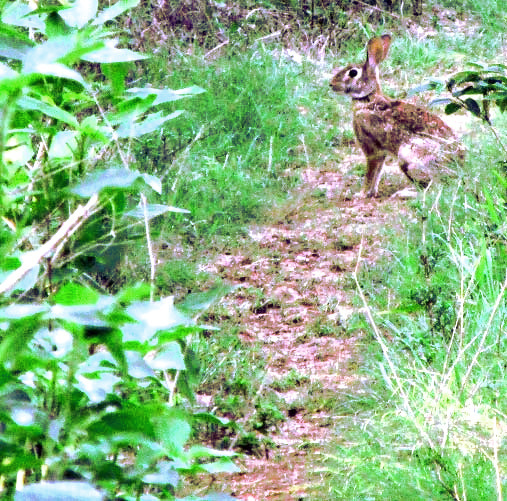
Sylvilagus yucatanicus
Photo © Jim
Photo © Jim — CC0 1.0 — Source: iNaturalist photo #415885535Identification
Sylvilagus yucatanicus is a medium-sized cottontail, typically around 35–45 cm in head-body length with a tail of roughly 3–5 cm. Its fur is a grizzled mix of brown, grey and buff above, with a paler, often buffy or whitish belly and a characteristic short, fluffy white cotton tail. The ears are relatively short and rounded compared with many other cottontails, and the hind legs are moderately long and powerful. The face is fairly plain, with a dark eye ring and pale fur around the muzzle. It can be confused with other Sylvilagus species where ranges overlap, so observers should note ear length, overall size and subtle pelage tones rather than relying on a single feature.
Range & habitat
This species is associated with the Yucatán Peninsula and adjacent parts of southeastern Mexico, with populations also reported from northern Belize and possibly the Petén region of Guatemala. It inhabits tropical dry forest, scrub, thorn woodland, forest edges and disturbed or agricultural areas, generally below around 1,000 m elevation. It tends to favour dense low cover that provides concealment, and is often found in mosaics of open ground for feeding and thick vegetation for shelter.
Behaviour & diet
Sylvilagus yucatanicus is primarily crepuscular and nocturnal, resting in dense cover or shallow forms during the day and emerging in the early morning and evening to feed. It is generally solitary and secretive, relying on stillness and camouflage before fleeing in short, zigzag bursts when approached. Its diet is herbivorous, consisting of grasses, herbs, leaves, shoots and bark, with seasonal shifts depending on what is available. Like other cottontails, it is an important prey species for a range of predators, from raptors and snakes to carnivorous mammals.
Best time & places to see it
The best chances come at dawn and dusk, when the animals are most active, and on quiet trails through dry forest, scrub or edge habitat. Protected areas and reserves across the Yucatán Peninsula and northern Belize offer good opportunities, particularly where low scrub and grassy clearings meet. Sightings are often brief, so patience and slow, quiet walking are essential; spotlighting after dark can also reveal animals, though care should be taken not to disturb them.
Photography tips
Use a long lens and a fast shutter speed, as cottontails are quick to bolt; a beanbag or monopod helps in low light. Position yourself downwind and move slowly, stopping frequently to let the animal settle. Early and late light flatters the grizzled fur, and a low angle at eye level gives more intimate portraits. Avoid flash where possible, or use it diffused and sparingly, and never approach so closely that the animal is forced to flee.
Aún no hay fotos de la comunidad. Inicia sesión para añadir la primera.
Aún no hay observaciones de la comunidad de esta especie.