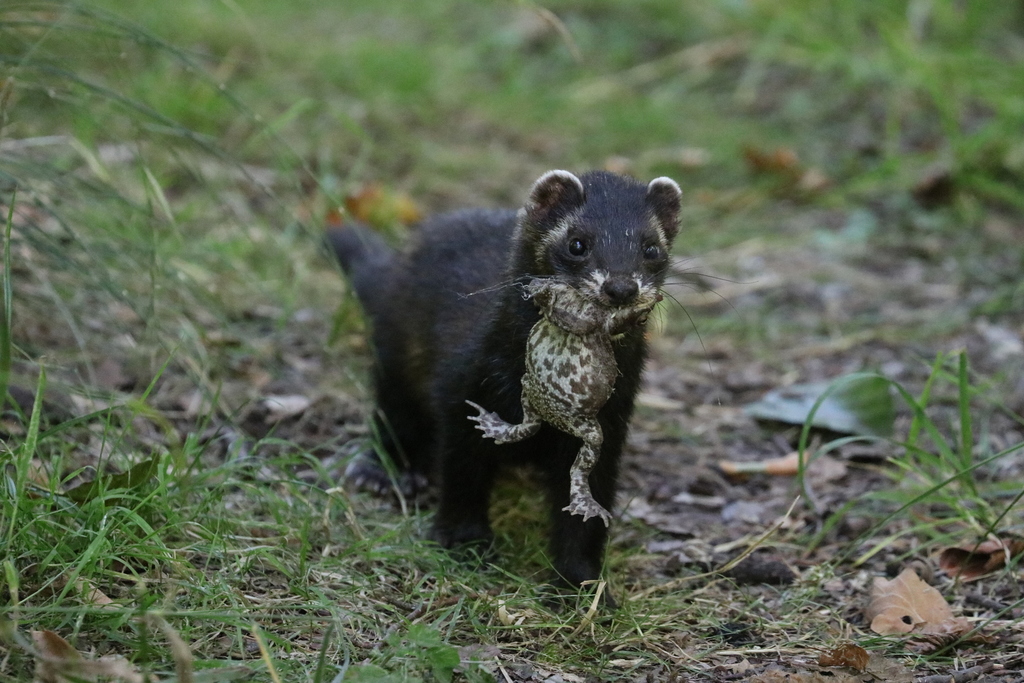
Turón europeo
Photo © Manuel Schwarz
Photo © Manuel Schwarz — CC BY 4.0 — Source: iNaturalist photo #87401526Identification
The European polecat is a compact mustelid with a generally dark brown coat and pale underbelly, distinguished by a characteristic dark mask across its face. Compared to other Mustela species, it has a shorter, more compact body, a more powerfully built skull and dentition, and is less agile. Colour mutations occasionally occur, including albinos, leucists, isabellinists, xanthochromists, amelanists, and erythrists. The species is perhaps best known for its ability to secrete a particularly foul-smelling liquid to mark its territory—a trait reflected in its scientific name, putorius, meaning "stench."
Range & Habitat
The European polecat occurs across Europe and in the Rif mountains. The species originated in Western Europe during the Middle Pleistocene and has maintained a wide range, which contributed to its classification as Least Concern on the IUCN Red List since 2008.
Behaviour & Diet
Unlike most mustelids, the European polecat is much less territorial, with animals of the same sex frequently sharing home ranges. Like other mustelids, it is polygamous, with pregnancy following induced ovulation after mating. Females usually give birth in early summer to litters of five to ten kits, which become independent at two to three months of age.
The polecat feeds on small rodents, birds, amphibians, and reptiles. It has a remarkable hunting strategy: it occasionally cripples prey by piercing their brain with its teeth and stores them, still living, in its burrow for future consumption. The species is historically notable as the sole ancestor of the domesticated ferret, which was developed more than 2,000 years ago for hunting vermin.
Best Time & Places to See It
As a nocturnal and secretive species, the European polecat is challenging to observe in the wild. The source material does not specify optimal seasons or particular locations for viewing, though the species' wide European range and large population numbers suggest opportunities across much of the continent where suitable habitat remains.
Photography Tips
Photographing European polecats presents considerable challenges due to their secretive, nocturnal nature and lower agility compared to other mustelids. Patience and night-vision equipment or infrared technology would be essential. The species' striking dark mask and contrasting pale underbelly offer compelling subjects when sightings do occur, and the compact, powerfully built form provides distinctive compositional opportunities for wildlife photographers.
Söderåsens National Park
Skåne län, Suecia
+130 aves+26 mamíferos
Dramatic limestone gorges slice through beech and oak forest where the Helge River carves its way southward across Skåne’s rolling […]
VER PARQUE NACIONALHarz National Park
Harz (LK Goslar), Alemania
+122 aves+30 mamíferos
Where dense beech and spruce forests rise across rolling highlands, ancient granite peaks emerge from blankets of mist, creating one […]
VER PARQUE NACIONALLower Saxon Wadden Sea National Park
Dunum, Alemania
+124 aves+28 mamíferos
Tidal mud flats stretch to the horizon where the North Sea exhales and inhales twice daily, sculpting one of Europe’s […]
VER PARQUE NACIONALHamburgisches Wattenmeer National Park
Hamburg, Alemania
+134 aves+21 mamíferos
Where the Elbe River surrenders to the North Sea, a vast tapestry of mud flats, salt marshes, and shallow tidal […]
VER PARQUE NACIONALSchleswig-Holsteinisches Wattenmeer National Park
Alemania
+130 aves+21 mamíferos
Twice daily, the North Sea withdraws from an immense stage of mud, sand, and salt marsh, revealing one of Europe’s […]
VER PARQUE NACIONALŠumava National Park
Alemania
+120 aves+29 mamíferos
Where ancient spruce forests rise and peat bogs stretch beneath mist-laden skies, the Bavarian borderlands hold one of Central Europe’s […]
VER PARQUE NACIONALExmoor National Park
Somerset, Gran Bretaña
+103 aves+21 mamíferos
Windswept moorlands rise abruptly from the Bristol Channel, where heather and gorse blanket rolling uplands carved by Iron Age settlements […]
VER PARQUE NACIONALEryri National Park
Gwynedd, Gran Bretaña
+122 aves+29 mamíferos
Where granite peaks pierce the Welsh sky, alpine meadows cascade into oak-clad valleys and windswept moorlands define the horizon. This […]
VER PARQUE NACIONALYorkshire Dales National Park
North Yorkshire, Gran Bretaña
+104 aves+22 mamíferos
Where limestone escarpments rise above verdant valleys, a patchwork of moorland, grassland, and woodland creates one of England’s most ecologically […]
VER PARQUE NACIONALBannau Brycheiniog National Park
Powys, Gran Bretaña
+120 aves+29 mamíferos
Red sandstone peaks rise abruptly from rolling moorland in South Wales, where wind-sculpted ridges and glacial valleys create some of […]
VER PARQUE NACIONALSouth Downs National Park
Chichester, Gran Bretaña
+122 aves+28 mamíferos
Rolling chalk downlands rise and fall across southern England in a landscape sculpted by millennia of grazing and cultivation. These […]
VER PARQUE NACIONALDanube Delta Biosphere Reserve
Tulcea, Rumanía
+123 aves+30 mamíferos
Where Europe’s mightiest river dissolves into the Black Sea, a labyrinth of reed beds, shallow lagoons, and floating islands creates […]
VER PARQUE NACIONALFertő–hanság National Park
Fertőszéplak, Hungría
+12 aves+27 mamíferos
Where shallow waters meet vast reed beds beneath wide Hungarian skies, one of Central Europe’s most dynamic wetland complexes unfolds […]
VER PARQUE NACIONALCamargue Regional Nature Park
Saintes-Maries-de-la-Mer, Francia
+122 aves+30 mamíferos
Where the Rhône Delta sprawls into the Mediterranean, a landscape of stark and haunting beauty emerges—vast salt marshes punctuated by […]
VER PARQUE NATURALD’Armorique Regional Nature Park
Le Faou, Francia
+124 aves+30 mamíferos
Where granite ridges meet Atlantic moorland, one of Brittany’s wildest regions reveals itself in layers of ecological richness. The landscape […]
VER PARQUE NATURALTsentralno-Lesnoy Gosudarstvennyy Prirodnyy Biosfernyy Nature Reserve
Nelidovsky District, Rusia
+82 aves+8 mamíferos
Ancient spruce and fir forests stretch across undulating terrain in western Russia, where primordial taiga landscape remains largely untouched by […]
VER PARQUE NACIONALPollino National Park
Viggianello, Italia
+102 aves+23 mamíferos
Where the southern Apennines rise toward the sky in jagged limestone peaks, forests of Bosnian pine cling to precipitous slopes […]
VER PARQUE NACIONALSila National Park
San Giovanni in Fiore, Italia
+133 aves+17 mamíferos
Where ancient beech forests rise above a high Calabrian plateau, Italy’s wilderness core reveals itself in dramatic relief. At elevations […]
VER PARQUE NACIONALCasentinesi Forests, Monte Falterona, Campigna National Park
Santa Sofia, Italia
+120 aves+30 mamíferos
Where granite ridges rise above 1,600 meters through the heart of Tuscany and Romagna, beech forests transition into alpine meadows […]
VER PARQUE NACIONALGran Sasso e Monti della Laga National Park
Pietracamela, Italia
+78 aves+18 mamíferos
Where granite massifs pierce the Apennine spine, weathered limestone cliffs rise from verdant beech forests in a landscape of dramatic […]
VER PARQUE NACIONALSibillini Mountains National Park
Ussita, Italia
+123 aves+27 mamíferos
Where limestone ridges claw toward 2,476 metres, ancient beech forests surrender to alpine meadows and windswept crags that define the […]
VER PARQUE NACIONALGargano National Park
Cagnano Varano, Italia
+133 aves+12 mamíferos
Where limestone plateaus rise abruptly from the Adriatic coast, a spur of land juts into southern Italy bearing one of […]
VER PARQUE NACIONALDell’Appennino Tosco-Emiliano National Park
Reggio nell'Emilia, Italia
+120 aves+30 mamíferos
Where the Apennine spine rises between Tuscany and Emilia-Romagna, beech forests give way to windswept alpine meadows and dramatic limestone […]
VER PARQUE NACIONALCilento, Vallo di Diano e Alburni National Park
Campora, Italia
+76 aves+17 mamíferos
Limestone cliffs plunge toward the Tyrrhenian Sea while ancient beech forests crown the interior highlands, creating a mosaic of Mediterranean […]
VER PARQUE NACIONALBiałowieża National Park
Bialowieza, Polonia
+105 aves+29 mamíferos
Ancient woodland sprawls across the Polish-Belarusian border where primordial forests have escaped the axe for centuries. This 198-square-kilometre sanctuary harbours […]
VER PARQUE NACIONALSomiedo Natural Park
Pola de Somiedo, España
+120 aves+30 mamíferos
Where granite gorges cleave through the Cantabrian Mountains of northern Spain, alpine meadows roll toward beech and oak forests in […]
VER PARQUE NATURALAún no hay fotos de la comunidad. Inicia sesión para añadir la primera.
Aún no hay observaciones de la comunidad de esta especie.