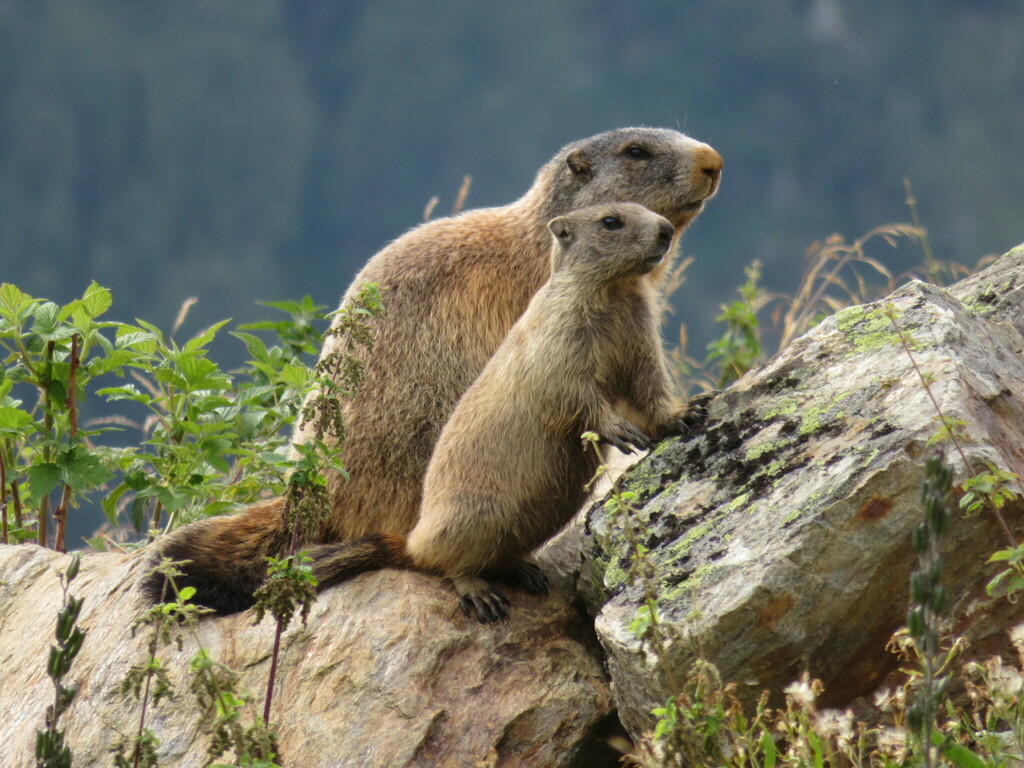
Alpine Marmot
Photo © Max G.W. Verheij
Photo © Max G.W. Verheij — CC0 1.0 — Source: iNaturalist photo #228607292Identification
The alpine marmot is a large ground-dwelling squirrel with a stocky build. Adults measure between 43 and 73 cm in head-and-body length, with tails of 13 to 20 cm. Body mass ranges from 1.9 to 8 kg, with animals noticeably lighter in spring (just after hibernation) than in autumn (before hibernation). The alpine marmot is sometimes considered the heaviest squirrel species. Its coat is a distinctive mixture of blonde, reddish and dark gray fur. A unique identifying feature is that while most fingers have claws, the thumbs bear nails instead.
Range & Habitat
Alpine marmots are found in high numbers throughout the mountainous areas of central and southern Europe, at elevations between 800 and 3,200 m. Their core range spans the Alps across France, Italy, Switzerland, Germany, Slovenia, and Austria. A distinct subspecies, the Tatra marmot, inhabits the Tatry Mountains and Nízke Tatry Mountains in eastern Europe. An endemic population also persists in the Northern Apennines.
Successfully reintroduced to the Pyrenees in 1948 after disappearing at the end of the Pleistocene epoch, alpine marmots now occupy sub-populations in France's Massif Central, Jura, Vosges, Black Forest, and the Romanian Carpathians (where the population is estimated at 1,500 individuals). They prefer alpine meadows and high-altitude pastures, establishing colonies in deep burrow systems situated in alluvial soil or rocky areas.
Behaviour & Diet
Alpine marmots are highly social animals living in family groups across multiple burrows, led by a dominant breeding pair. They are excellent diggers, capable of penetrating soil that would challenge a pickaxe. Burrows feature "living areas" lined with dried hay and grass, plus separate tunnel systems used as toilet areas. These burrows become increasingly complex as successive generations enlarge them. Marmots are highly defensive, using tail-beating, teeth-chattering, scent-marking, and loud whistles to warn colony members of danger. They are famous for their upright sentinel posture while watching for predators.
Alpine marmots are herbivorous, eating grasses, herbs, grain, insects, spiders and worms, preferring young and tender plants. They feed primarily during morning and afternoon hours, as they are sensitive to heat and may not feed on very warm days. Before hibernation, they consume large amounts to build essential fat reserves. They spend up to nine months per year in hibernation, an adaptation to their ice-age ancestry. Mating occurs in spring immediately after hibernation, maximizing offspring chances of storing sufficient fat for the following winter. Females give birth after a 33–34 day gestation to litters averaging three young, which are weaned after forty days.
Best Time & Places to See It
Alpine marmots are most active and visible during late spring through early autumn, when they emerge from hibernation and spend daylight hours feeding and maintaining their burrows. Summer is the prime season for observation, particularly in alpine meadows and high-altitude pastures. The Alps remain the most reliable location, especially in Switzerland, Austria, and the French Alps. The Carpathian Mountains in Romania and the Pyrenees also offer good viewing opportunities, with the advantage of somewhat less crowded terrain than the busiest Alpine regions.
Photography Tips
Photograph alpine marmots during early morning and late afternoon when they are most actively feeding and less heat-stressed. Their upright sentinel posture provides striking photographic opportunities—position yourself to capture them silhouetted against mountain vistas. The mixture of blonde, reddish and dark gray fur tones richly in natural light, so avoid harsh midday sun when possible. Look for family groups around burrow entrances and along rocky outcrops where they sun themselves (actually cooling on flat rocks). Patience is essential: remain quiet and still to avoid triggering their warning whistles and causing them to flee. Wide-angle lenses work well for environmental portraits showing them in their alpine meadow habitat, while telephoto lenses allow approach without disturbance.
Posets–maladeta Natural Park
Benasque, Spain
+122 birds+9 mammals
Where granite gorges cut through the High Pyrenees, Posets–Maladeta Natural Park rises as one of Spain's most formidable alpine landscapes. Straddling the Huesca province along the…
VIEW NATURAL PARKOrdesa y Monte Perdido National Park
Sobrarbe, Spain
+162 birds+13 mammals
Where limestone cliffs soar a thousand metres above cascading rivers, the Pyrenean massif reveals itself in its most dramatic form. Ordesa y Monte Perdido National Park…
VIEW NATIONAL PARKVanoise National Park
Val-Cenis, France
+107 birds+29 mammals
Where the French Alps rise in serrated ranks above the Maurienne valley, Vanoise National Park sprawls across more than 1,700 square kilometres of high-altitude wilderness—a realm…
VIEW NATIONAL PARKCadí Moixeró Natural Park
Bor, Spain
+172 birds+21 mammals
Cadí-Moixeró Natural Park is one of the largest and most spectacular protected areas in Catalonia, located in the heart of the eastern Pyrenees. Covering more than…
VIEW NATURAL PARKValles Occidentales Natural Park
Siresa, Spain
+168 birds+20 mammals
Where granite gorges slice through the western Pyrenean foothills, steep valleys carved by ancient rivers create a mosaic of Mediterranean scrubland, beech forests, and alpine meadows.…
VIEW NATURAL PARKBosques de Plan
San Juan de Plan, Spain
+124 birds+4 mammals
Where granite peaks plunge into beech and fir forests, the Pyrenean valleys of Bosques de Plan unfold in dramatic tiers of ancient woodland. This wilderness in…
VIEW FOREST & JUNGLERegional Park of the Catalan Pyrenees
Olette, France
+244 birds+63 mammals
Where granite peaks thrust skyward above cloud-laden valleys, a wild tapestry of Mediterranean and alpine ecosystems interweaves across the Franco-Spanish frontier. These Pyrenean slopes harbour extraordinary…
VIEW NATURE RESERVECapçaleres del Ter i del Freser Natural Park
La Farga, Spain
+125 birds+20 mammals
Where the eastern Pyrenees yield their first waters, granite gorges slice through dense forests of beech and fir, creating one of Catalonia's most hydrologically vital landscapes.…
VIEW NATURAL PARKStelvio National Park
Valfurva, Italy
+116 birds+17 mammals
Where granite peaks rise above three thousand metres and alpine meadows give way to rocky scree, Stelvio National Park guards one of Europe's most dramatically vertical…
VIEW NATIONAL PARKGran Paradiso National Park
Cogne, Italy
+120 birds+16 mammals
Where the western Alps rise steeply above the Aosta Valley, granite ridges and alpine meadows converge in a landscape shaped as much by glacial history as…
VIEW NATIONAL PARKAppennino Tosco-Emiliano National Park
Ventasso, Italy
+86 birds+8 mammals
Where the northern Apennines rise in folded ridges across the Emilia-Romagna borderland, the Dell'Appennino Tosco-Emiliano National Park protects one of Italy's most geologically complex mountain landscapes.…
VIEW NATIONAL PARKDolomiti Bellunesi National Park
Sospirolo, Italy
+76 birds+11 mammals
Where the Dolomites descend into the Veneto foothills near Sospirolo, a landscape of limestone massifs, forested valleys, and rushing waterways creates one of northern Italy's most…
VIEW NATIONAL PARKTatra National Park
Zakopane, Poland
+126 birds+17 mammals
Where the High Tatras rise abruptly from the Carpathian foothills, Tatra National Park protects one of Europe's most dramatic mountain landscapes across its 507 square kilometres.…
VIEW NATIONAL PARKColl de Pal
La Molina, Spain
+142 birds+12 mammals
Where the eastern Pyrenees descend into Catalonia, alpine meadows and rocky slopes define the character of this mountain pass, a threshold between the high Iberian interior…
VIEW MOUNTAIN & ALPINEPyrénées National Park
Hautes Pyrenees, France
+150 birds+35 mammals
Where alpine meadows give way to limestone cliffs and rushing torrents carve through ancient stone, the Pyrénées National Park spans a landscape of austere beauty along…
VIEW NATIONAL PARKBelluno Dolomites National Park
Sospirolo, Italy
+72 birds+10 mammals
Where the Dolomites' pale limestone ramparts rise above the Veneto plain, the Belluno Dolomites National Park encompasses a landscape of profound ecological diversity. The park's subarctic-style…
VIEW NATIONAL PARKNo community observations of this species yet.