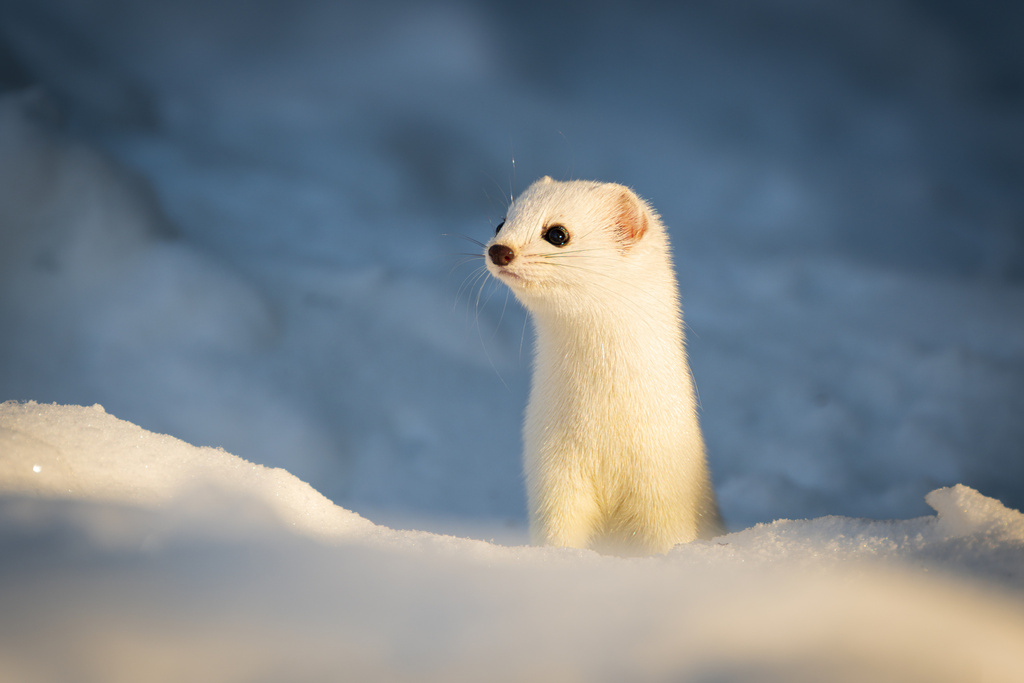
American Ermine
Photo © Troy B
Photo © Troy B — CC BY 4.0 — Source: iNaturalist photo #255235158Identification
The American ermine is a small mustelid with the characteristic weasel body plan: short legs, an elongated body and neck, and a small triangular head with short round ears. Its coat is brown on the back with a white underside, though it turns entirely white during winter. A distinctive short black-tipped tail is a key field mark; the black coloring may serve to distract predators and divert attacks away from the body. American ermines are sexually dimorphic, with males approximately 30% larger than females.
Range & Habitat
The American ermine is found throughout most of North America, with a range extending from Ellesmere Island and eastern Nunavut in the north south to northern New Mexico in the west and northern Virginia in the east. The species is notably absent from most of Alaska (except some southeastern islands), eastern Yukon, much of Arctic Canada, Greenland, and the southeastern United States and Great Plains, where it is replaced by the Eurasian stoat or other species.
American ermines inhabit diverse terrestrial environments including wetlands, woodlands, forests, and alpine terrain. They show a strong preference for thick understory vegetation near water sources. These non-migratory animals maintain average home ranges of 12–16 hectares and shelter in hollow logs, beneath rocks or stumps, in burrows, or within man-made structures. During winter, they typically remain beneath the snow's surface.
Behaviour & Diet
American ermines are primarily nocturnal hunters, though they are also frequently active during daylight hours. Their main prey consists of mice and voles, which fill an ecological niche similar to that occupied by the larger long-tailed weasel. However, their diet is opportunistic and may include shrews, young cottontails, chipmunks, deer mice, jumping mice, and house mice. They occasionally consume small birds, frogs, fish, and earthworms, typically killing prey by biting at the base of the skull.
Breeding occurs from July to August, with females carrying litters of four to nine young (averaging six to seven) for approximately 255 days before giving birth in mid-April to early May. Males mature in one year, while females mature in three to four months. Ermines are preyed upon by minks, martens, fishers, bobcats, coyotes, large owls and hawks, and occasionally domestic cats and dogs. Their small, agile bodies allow them to evade these predators effectively and to compete for food resources in scarcer months.
Best Time & Places to See It
American ermines are elusive subjects due to their small size and primarily nocturnal activity, making observation challenging. They are most active during spring and summer months and may be spotted in suitable habitats across much of the northern and western United States and Canada. Look for them near water sources in areas with dense understory vegetation, particularly in forests and wetlands. Winter observations are possible, particularly in snowy regions where tracks may be visible on the snow surface, though the animals themselves remain largely beneath the snow.
Photography Tips
Photographing American ermines requires patience and specialized equipment due to their small size, speed, and nocturnal habits. A macro or telephoto lens is essential for capturing detail without disturbing the animal. Early morning or dusk may offer the best opportunities for daytime activity, and photographers should position themselves quietly near suitable habitat with thick understory vegetation near water. Winter offers an advantage when ermines are more visible against snow, and their white coat creates excellent contrast for photography. Look for movement along logs, rocks, or burrow entrances, and remember that sudden movements will cause these quick predators to disappear rapidly.
Glacier National Park
Glacier, Canada
+162 birds+12 mammals
Where granite peaks pierce the clouds above the Columbia River valley, Glacier National Park protects one of the most dramatic mountain wilderness areas in western Canada.…
VIEW NATIONAL PARKBanff National Park
Improvement District No. 9, Canada
+264 birds+33 mammals
Where the Canadian Rockies thrust skyward in a cathedral of limestone and ice, Banff National Park preserves a wilderness of astounding vertical drama. Glacier-carved valleys cradle…
VIEW NATIONAL PARKJasper National Park
Improvement District No. 12, Canada
+235 birds+34 mammals
Where the Canadian Rockies rise in dramatic succession across western Alberta, Jasper National Park spans over 11,000 square kilometres of subalpine and alpine terrain, glaciated valleys,…
VIEW NATIONAL PARKGrand Teton National Park
Teton County, United States
+247 birds+38 mammals
Where the Teton Range tears skyward in a dramatic escarpment above the Snake River valley, nearly 2,550 square kilometers of montane wilderness unfolds across Teton County,…
VIEW NATIONAL PARKYellowstone National Park
Park County, United States
+253 birds+43 mammals
Across nearly 11,400 square kilometres of the Rocky Mountain plateau, geothermal fury and pristine wilderness converge in one of Earth's most dynamic landscapes. Hot springs, geysers…
VIEW NATIONAL PARKMount Rainier National Park
Pierce County, United States
+187 birds+25 mammals
A volcanic colossus dominates the Cascade Range in western Washington, its 4,392-meter summit crowned year-round with glacial ice that cascades down toward temperate rainforest and subalpine…
VIEW NATIONAL PARKBlack Canyon of the Gunnison National Park
Montrose County, United States
+169 birds+13 mammals
Where the Gunnison River has carved one of North America's steepest and most dramatic canyons, ancient metamorphic rock walls plunge nearly 2,000 feet in places, creating…
VIEW NATIONAL PARKRocky Mountain National Park
Larimer County, United States
+259 birds+33 mammals
Where granite peaks rise above 12,000 feet and alpine tundra gives way to subalpine forest, Rocky Mountain National Park spans the Continental Divide across nearly 1,600…
VIEW NATIONAL PARKRedwood National Park
Humboldt County, United States
+343 birds+43 mammals
Where the Pacific fog rolls deep into northern California's coastal valleys, some of the tallest trees on Earth rise from a landscape shaped by tectonic forces…
VIEW NATIONAL PARKOlympic National Park
Jefferson County, United States
+263 birds+35 mammals
Where temperate rainforest meets alpine wilderness, Olympic National Park sprawls across nearly 11,000 square kilometers of the Pacific Northwest's most pristine landscape. The park's three distinct…
VIEW NATIONAL PARKYoho National Park
Area A (Kicking Horse/Kinbasket Lake), Canada
+207 birds+19 mammals
Where the Canadian Rockies meet the Columbia River watershed, a vast wilderness of 2,211 square kilometres unfolds across Yoho National Park in British Columbia. The landscape…
VIEW NATIONAL PARKFundy National Park of Canada
Alma Parish, Canada
+217 birds+24 mammals
Where the Bay of Fundy's tidal rhythms sculpt a landscape of dramatic cliffs, forested valleys, and boulder-strewn shorelines, Fundy National Park rises across approximately 345 square…
VIEW NATIONAL PARKGros Morne National Park
Canada
+180 birds+19 mammals
Where glacier-carved fjords pierce the interior of Newfoundland, Gros Morne National Park unfolds across nearly four thousand square kilometres of some of Canada's most dramatic coastal…
VIEW NATIONAL PARKGlacier National Park
United States
+246 birds+39 mammals
Where jagged peaks pierce a subarctic sky and glacial valleys carve through ancient rock, Glacier National Park spans the spine of the Northern Rockies along Montana's…
VIEW NATIONAL PARKNorth Cascades National Park
Whatcom County, United States
+120 birds+18 mammals
Jagged peaks rise abruptly from the western foothills of Washington's Cascade Range, where glaciers cling to elevations above 10,000 feet and meltwater feeds a landscape of…
VIEW NATIONAL PARKAlaska Maritime National Wildlife Refuge
Alaska, United States
+391 birds+58 mammals
Where the North Pacific collides with Alaska's rugged coastline, a sprawling archipelago of islands, rocky outcrops, and coastal headlands forms one of North America's most remote…
VIEW WILDLIFE SANCTUARYNo community photos yet. Log in to add the first one.
No community observations of this species yet.