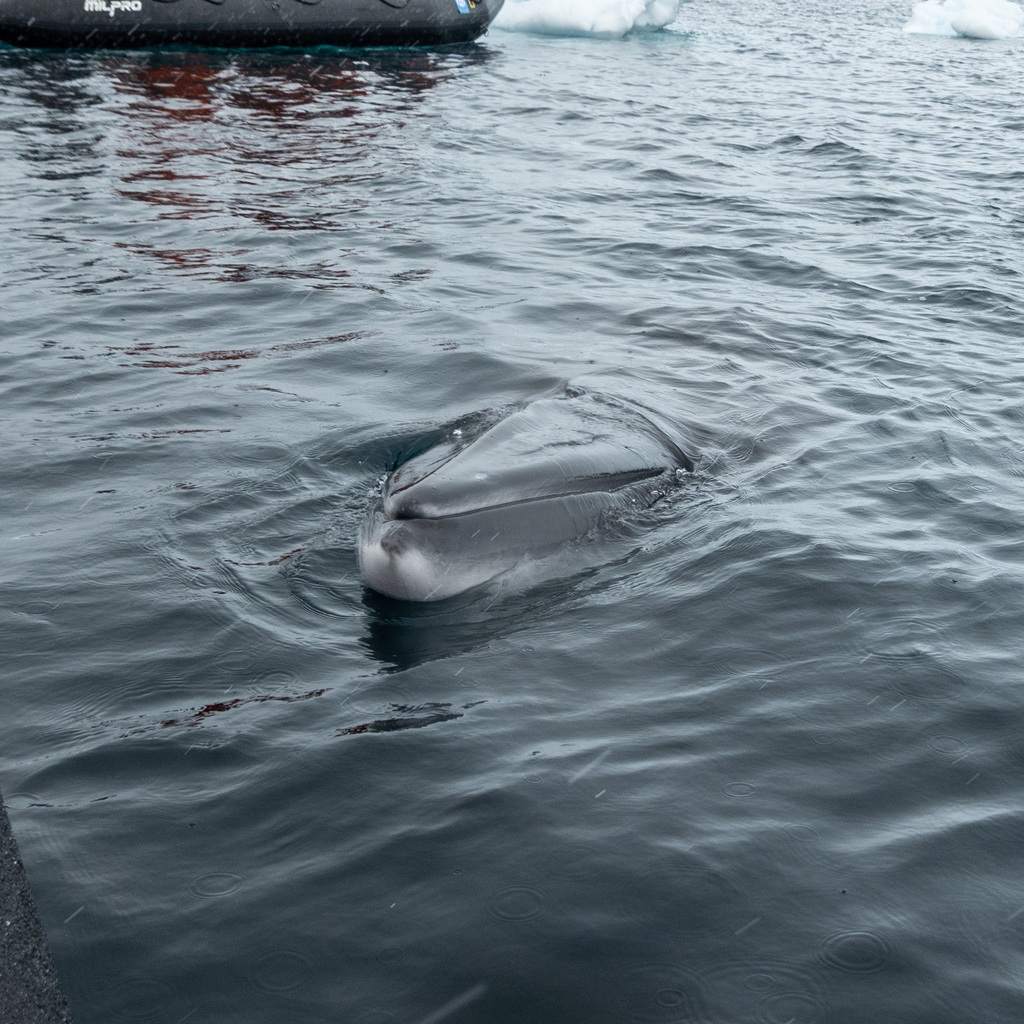
Antarctic Minke Whale
Photo © Bob Walker
Photo © Bob Walker — CC BY 4.0 — Source: iNaturalist #146841470Identification
The Antarctic minke whale is the second smallest rorqual and third smallest baleen whale overall. Adults average around 8.6–8.9 metres in length, though some individuals reach nearly 12 metres. These whales are streamlined and slender, built for speed and agility in Southern Ocean waters. The species was not formally recognized as distinct from the common minke whale until the 1990s, despite first being scientifically described in 1867. Look for a dark grey coloration on the back with a lighter underside, though detailed field identification can be challenging without close observation.
Range & Habitat
The Antarctic minke whale is primarily restricted to the Southern Hemisphere, though rare vagrants have been reported in the North Atlantic. These cetaceans inhabit the cold, productive waters surrounding Antarctica and sub-Antarctic regions, where they exploit rich feeding opportunities. The species' distribution reflects its adaptation to Southern Ocean conditions and the availability of its preferred prey.
Behaviour & Diet
Antarctic minke whales are baleen feeders that consume primarily euphausiids—small, shrimp-like crustaceans abundant in polar waters. Like other rorquals, they are active foragers, using their streamlined bodies to pursue and filter feed on dense swarms of krill. The species avoided the worst impacts of industrial whaling due to its small size and low oil yield, allowing populations to remain robust when other baleen whales were decimated. Today, it is the most abundant baleen whale in the world, with populations numbering in the hundreds of thousands.
Best Time & Places to See It
Antarctic minke whales are most reliably encountered in Antarctic and sub-Antarctic waters during the austral summer months when pack ice recedes and prey becomes abundant. Expeditions to the Antarctic Peninsula, sub-Antarctic islands, and surrounding waters offer the best opportunities for sightings. These whales are generally more common in specific regions of the Southern Ocean, making careful route planning essential for wildlife-focused travel.
Photography Tips
The small size and streamlined form of Antarctic minke whales means they can be challenging subjects compared to larger cetaceans. Position yourself on expedition vessels near known feeding areas during calm conditions for the best visibility. Use fast shutter speeds to capture breaching or surfacing behaviour, and be patient—these whales may spend extended periods underwater. The contrast between their dark backs and lighter undersides can be striking in good light, so photograph from angles that capture this colouration variation.
Brown Bluff
Cuverville Island
Danco Island
Half Moon Island
Lemaire Channel
Neko Harbour
Paradise Bay
Petermann Island
Port Lockroy
Nothing matches these filters.
No community photos yet. Log in to add the first one.
No community observations of this species yet.