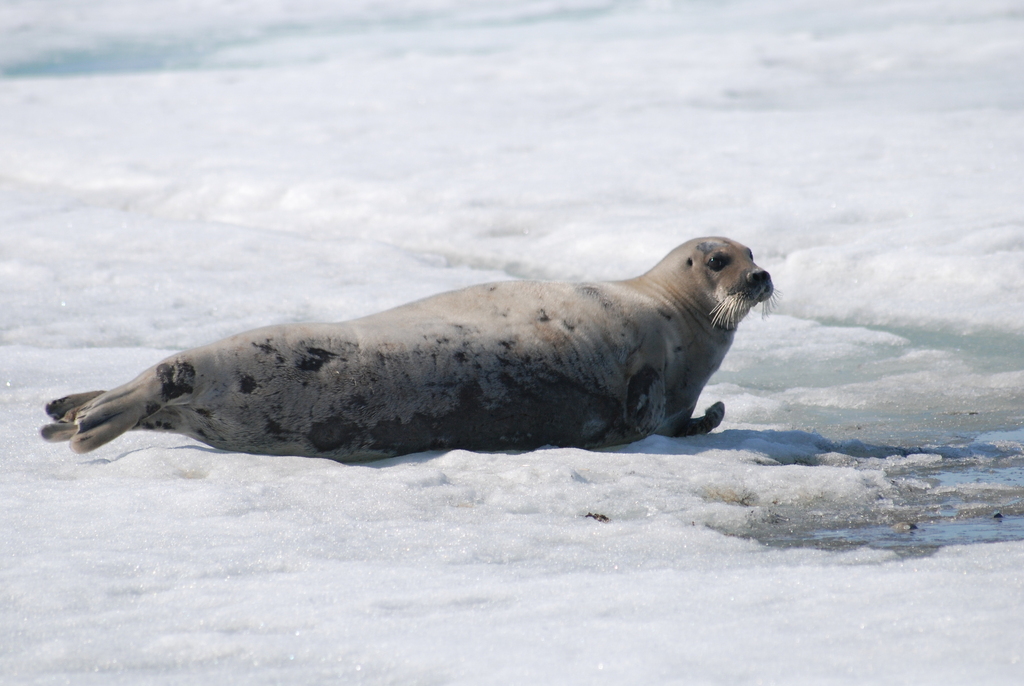
Bearded Seal
Photo © Игорь Загребин
Photo © Игорь Загребин — CC0 1.0 — Source: iNaturalist photo #254823469Identification
The bearded seal is the largest northern phocid and takes its name from its most distinctive feature: conspicuous, abundant whiskers that curl elegantly when dry, giving the animal a distinctive "raffish" appearance. Adults are greyish-brown in colour, darker on the back, with the face and neck occasionally tinged reddish-brown. They are distinguished by square fore flippers and thick bristles on the muzzle. Pups are born with greyish-brown fur with scattered patches of white on the back and head.
Bearded seals reach 2.1 to 2.7 metres in nose-to-tail length and weigh between 200 and 430 kilograms, with females being notably larger than males. This earless seal is unique among northern phocids in having two pairs of teats, a feature it shares with monk seals found in warmer waters.
Range & Habitat
Bearded seals inhabit Arctic and Subarctic regions across the Northern Hemisphere. In the Pacific, they range from the Chukchi Sea south into the Bering Sea, spanning from Bristol Bay on the Alaskan coast to the Sea of Okhotsk. They are found throughout the Arctic Ocean along northern Russia, Norway, Canada, and Alaska, including Svalbard and the Canadian Arctic Archipelago. In the Atlantic, they occur along Iceland, both coasts of Greenland, and the Canadian mainland as far south as Labrador.
Although rare, bearded seals have been recorded far south of their typical range in Japan, China, and Western Europe including Germany, the Netherlands, the United Kingdom, France, Spain, and Portugal. They favour shallow coastal areas for feeding.
Behaviour & Diet
Bearded seals are primarily benthic feeders, diving to the ocean floor to hunt small prey including clams, squid, crustaceans, and fish. Their characteristic whiskers function as sensitive feelers in soft bottom sediments. Adults typically hunt in waters no deeper than 300 metres, though pups up to one year old can dive as deep as 450 metres. Summer diets consist largely of flatfishes such as American plaice, sculpins, and Arctic cod, supplemented by invertebrates including anemones, sea cucumbers, and polychaete worms.
During the mating season, male bearded seals produce remarkable vocalizations unique among northern seals, possibly due to their unusual tracheal anatomy. Males emit long, oscillating trills lasting a minute or more, followed by deep moans—sounds that may attract females, proclaim territory, or signal breeding readiness. Males occupy the same areas year after year.
Best Time & Places to See It
Bearded seals give birth in spring, with timing varying by location: pups are born in May in the Canadian Arctic and in late April in Alaska. Mothers nurse their young for 18 to 24 days on small drifting ice floes in shallow waters, providing an opportunity to observe mothers with dependent young during this concentrated breeding period. The uniqueness of their vocalizations makes spring a particularly rewarding time for audio documentation.
The most accessible viewing opportunities occur in established range areas including Svalbard, the Canadian Arctic, and the Bering Sea regions. Bearded seals are believed to live up to 31 years, potentially allowing long-term study and observation of individual animals.
Photography Tips
The bearded seal's distinctive facial whiskers are their defining feature and should be the focus of close-up photography. When dry, these whiskers curl elegantly and photograph particularly well in natural light. The square fore flippers are also a unique identifying characteristic worth capturing. The greyish-brown coloration of adults and the contrasting white patches on pups offer good tonal variety for photography.
Spring is the prime season for photographing mothers with nursing pups on ice floes in shallow waters. The relatively short nursing period of 18 to 24 days means timing is critical. Wide-angle shots capturing seals on drifting ice in their Arctic habitat, combined with detailed portraits highlighting their whiskers and facial expression, will produce the most compelling documentation of this remarkable Arctic pinniped.
South Spitsbergen National Park
Norway
+41 birds+15 mammals
Glaciers and tundra meet in Norway's high Arctic, where South Spitsbergen National Park sprawls across the southernmost reaches of the Svalbard archipelago. Here, massive valley glaciers…
VIEW NATIONAL PARKNorthwest Spitsbergen National Park
Norway
+58 birds+17 mammals
Where the High Arctic converges with the Norwegian mainland, Northwest Spitsbergen National Park sprawls across one of Earth's most extreme and pristine wildernesses. Crowned by jagged…
VIEW NATIONAL PARKNorthern Isfjorden National Park
Norway
+40 birds+12 mammals
Where the Arctic fjord system cuts deep into Svalbard's northwestern coast, Northern Isfjorden National Park protects a landscape of stark geological drama—towering cliff faces, tidewater glaciers,…
VIEW NATIONAL PARKSassen-Bünsow Land National Park
Soere, Norway
+30 birds+10 mammals
Where Arctic tundra sprawls across glaciated plateaus in the remote Svalbard archipelago, a realm of raw geological drama unfolds. Sassen-Bünsow Land National Park encompasses a landscape…
VIEW NATIONAL PARKWrangel Island Nature Reserve
Wrangel Island, Russia
+25 birds+11 mammals
Where the Chukchi Sea fractures Arctic ice beneath an unforgiving sky, a lonely island holds one of Earth's most pristine ecosystems. Wrangel Island spans tundra so…
VIEW NATURE RESERVEScoresby Sund
Vandreblok, Greenland
+43 birds+9 mammals
Where granite peaks pierce an Arctic sky and the world's largest fjord system carves deep into northeastern Greenland, a primordial landscape unfolds in shades of ice-blue…
VIEW PROTECTED LANDSCAPENortheast Greenland National Park
Northeast Greenland National Park, Greenland
+34 birds+10 mammals
Where granite peaks plunge into the Arctic Ocean and pack ice dominates a landscape of incomparable vastness, one of Earth's most remote wildernesses reveals itself. Spanning…
VIEW NATIONAL PARKNo community photos yet. Log in to add the first one.
No community observations of this species yet.