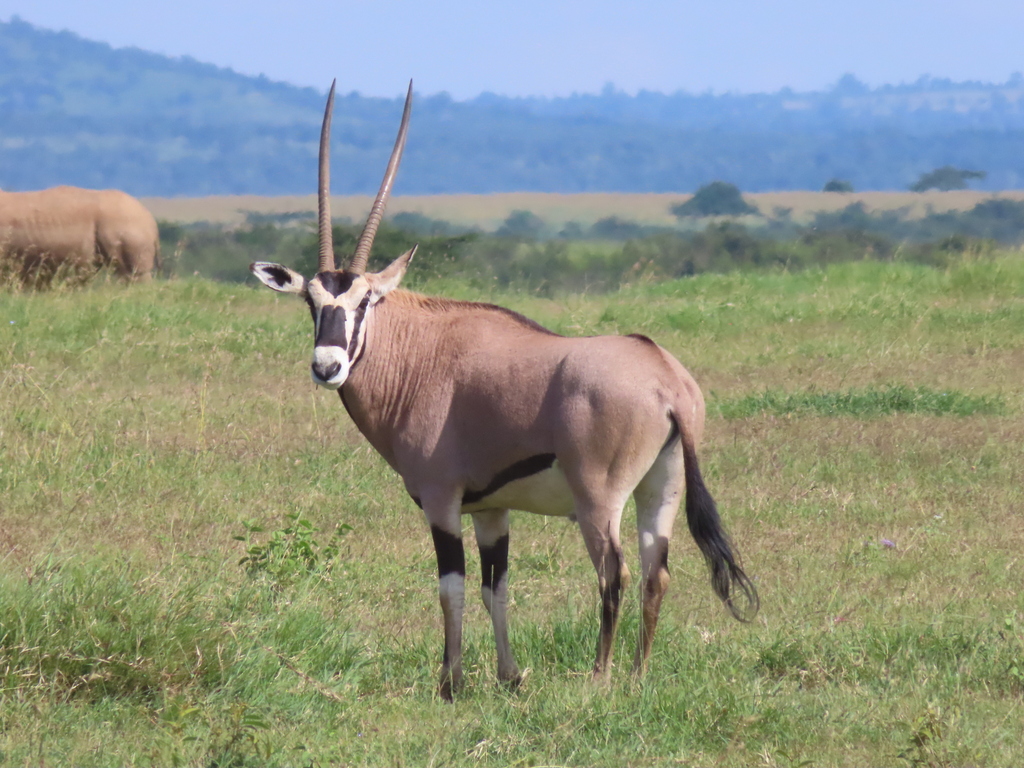
The East African oryx (Oryx beisa), also known as the beisa, is a species of medium-sized antelope from East Africa. It has two subspecies: the common beisa oryx (Oryx beisa beisa) found in steppe and semidesert throughout the Horn of Africa Somalia and north of the Tana River, and the fringe-eared oryx (Oryx beisa callotis) south of the Tana River in southern Kenya Somalia and parts of Tanzania. The species is listed as Endangered by the IUCN. In the past, some taxonomists considered it a subspecies of the gemsbok (Oryx gazella), but they are genetically distinct; the diploid chromosome count is 56 for the beisa and 58 for the gemsbok. == Description == The East African oryx stands between 0.79 and 1.25 m (2.6 and 4.1 ft) tall at the shoulder and typically weighs between 220 to 460 lb (100 to 209 kg). It has a grey coat with a white underside, separated from the grey by a stripe of black, with black stripes where the head attaches to the neck, along the nose, and from the eye to the mouth and on the forehead. The mane is small and chestnut-coloured; the ringed horns are thin and straight. They are…
Tsavo East National Park
Athi ward, Kenya
+468 birds+50 mammals
Across the semi-arid lowlands of southeastern Kenya, where acacia woodland fragments into scrubland and the landscape rolls toward the Indian Ocean horizon, lies one of Africa's…
VIEW NATIONAL PARKTsavo West National Park
Mwatate, Kenya
+513 birds+49 mammals
Where volcanic ridges and weathered lava flows meet the semi-arid lowlands of south-central Kenya, Tsavo West National Park unfolds across a landscape sculpted by fire and…
VIEW NATIONAL PARKTarangire National Park
Tanzania
+527 birds+50 mammals
Acacia woodland and grassland sweep across the Manyara Region where the Tarangire River carves through low hills and volcanic soils, creating one of East Africa's most…
VIEW NATIONAL PARKAwash National Park
Didiga, Ethiopia
+473 birds+23 mammals
Where the Ethiopian Rift Valley carves through volcanic plateaus, a ribbon of riverine forest winds through acacia scrubland and grassland, creating a mosaic of habitats that…
VIEW NATURAL PARKMeru National Park
Igembe Central, Kenya
+408 birds+38 mammals
Granite outcrops and acacia woodland rise across the northern reaches of Meru, where semi-arid savanna transitions into drier scrubland under the fierce equatorial sun. The park's…
VIEW NATIONAL PARKSamburu National Reserve
Samburu, Kenya
+430 birds+42 mammals
Across the arid plains of northern Kenya, where scattered acacia woodland gives way to rocky outcrops and dry riverbeds, Samburu National Park unfolds as one of…
VIEW NATURE RESERVENo community photos yet. Log in to add the first one.
No community observations of this species yet.