Wildlife & PhotographyEasy
Wildlife SafariEasy
Wildlife SafariEasy
Nothing matches these filters.
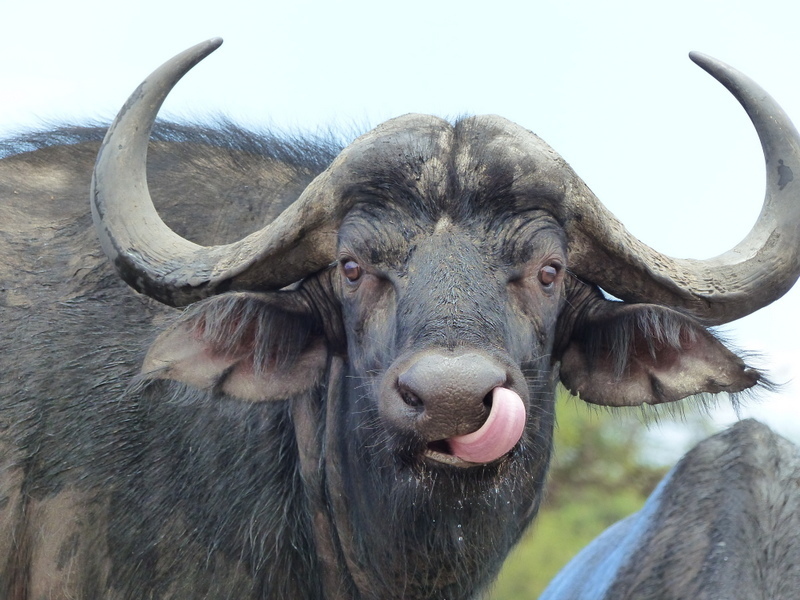
The Cape buffalo is a massive, powerfully built bovid with a shoulder height of 1.0 to 1.7 metres and weighing 425 to 870 kg, making it one of Africa's most imposing grazers. Its most distinctive feature is the boss—a continuous bone shield formed by the fused horn bases that spans the top of the head. Adult males typically have black or dark brown coats, while females tend toward reddish tones; older bulls often display whitish circles around their eyes. The horns of large bulls are spectacular, curving downward from the boss before sweeping upward and outward, with horn-tip distances sometimes exceeding one metre. Females have smaller horns and lack the boss entirely. The buffalo's body is long and stocky with relatively short, thick legs, and its head is carried low, sitting below the backline.
Cape buffaloes are found across Sub-Saharan Africa in disconnected ranges stretching from south-eastern Senegal through West and Central Africa to South Africa. The Cape buffalo (the largest subspecies) inhabits eastern and southern Africa. These highly adaptable grazers occupy savannas, swamps, floodplains, mopane grasslands, and mountain forests, though they prefer habitats with dense cover such as reeds and thickets. Critically, they depend on daily access to water and therefore require perennial water sources, which limits their distribution.
Cape buffaloes are pure grazers capable of feeding on tall, coarse grasses and sedges that other herbivores cannot exploit, particularly preferring grasses with high leaf-to-stem ratios. They employ their wide incisor rows and strong tongues to feed more rapidly than most African herbivores, followed by extended periods of cud-chewing to extract maximum nutrition. Herds actively manage their environment, mowing down grasses and creating conditions favourable for more selective grazers. These buffaloes do not linger on trampled or depleted areas. Despite their massive size, they are unpredictable and aggressive when threatened. Lions are their primary predators and regularly hunt buffalo, often requiring several individuals to bring down a single animal. African wild dogs, spotted hyenas, and Nile crocodiles also prey on buffaloes. Their formidable defensive capabilities mean buffalo are capable of killing lions.
As one of the Big Five game animals, Cape buffaloes are actively sought by wildlife photographers and safari enthusiasts throughout eastern and southern Africa. They are most reliably encountered in major protected areas and national parks where water sources concentrate populations during dry seasons. Their dependence on perennial water makes them predictable visitors to waterholes, offering excellent viewing and photographic opportunities.
The buffalo's iconic boss and massive horns are your primary compositional focus—position yourself to capture the frontal or three-quarter view that showcases these features. Early morning and late afternoon light enhances the texture of their dark coats and highlights facial details. When buffaloes approach water, be prepared for dynamic moments; their unpredictable nature means situations can change rapidly. Wide-angle lenses work well for herd scenes, but telephoto lenses allow you to isolate individuals and capture fine details of the boss and horn structure. Remember that buffaloes command respect; maintain safe distances and never position yourself between a buffalo and water or escape routes.
Nothing matches these filters.
Nothing matches these filters.
No community photos yet. Log in to add the first one.
We'd love to hear from you. We'll reply as soon as possible.
Found an error? Have a suggestion? We read every message.
A compact view of how this species lives, moves and responds to its environment.
Select a card to explore the details.
Please confirm the photo rights and credit terms first.
I'm the author of this photo or hold the rights to it, and I keep full ownership. I grant Wild Atlas Guide a free, non-exclusive licence to display it on the site and in Wild Atlas Guide's own channels, including social media, always credited to me by my display name or the Instagram handle I choose to provide. I confirm it does not reveal a sensitive wildlife location or a recognisable person without their permission. I can withdraw future social use for this photo or ask for it to be removed at any time.
Please accept the photo rights and credit terms to continue.
Uploading…
We use cookies to measure traffic and improve Wild Atlas Guide. You decide. Privacy policy