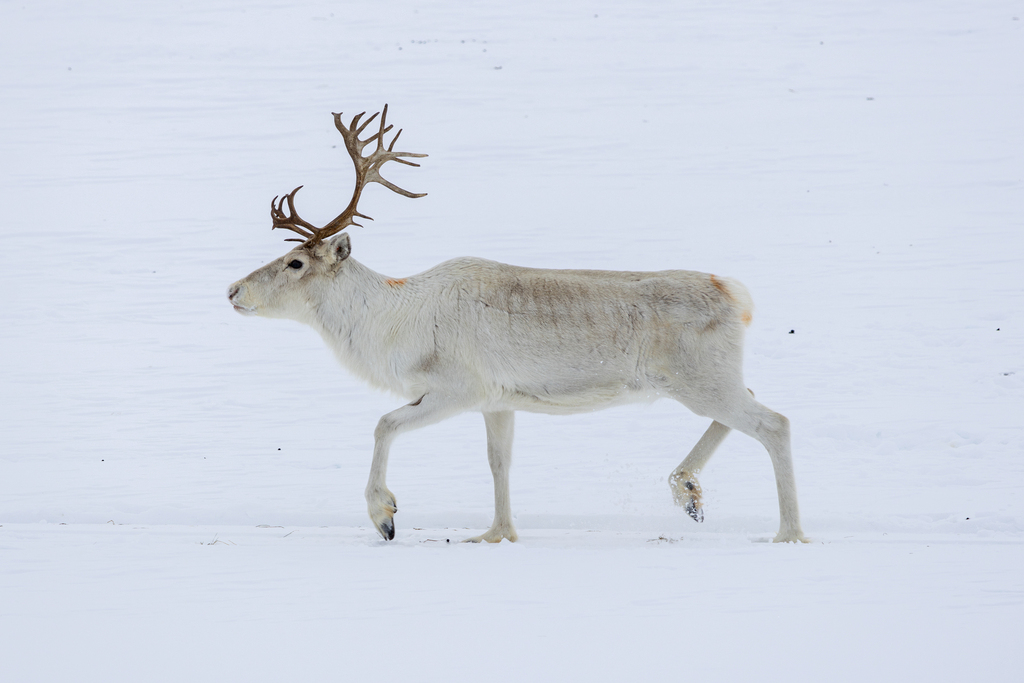
Reindeer
Photo © Diego González Dopico
Photo © Diego González Dopico — CC BY 4.0 — Source: iNaturalist photo #491820629Identification
Caribou and reindeer (Rangifer tarandus) are the only deer species where females regularly grow antlers, though the prevalence of antlered females varies significantly between populations. Males typically develop larger antlers than females. These animals vary dramatically in size across their seven subspecies, from the smallest Svalbard reindeer to the largest Osborn's caribou. Coat color and antler architecture also differ substantially between subspecies and can be used to distinguish between them in the field.
Range & Habitat
Caribou and reindeer have a circumpolar distribution across the Arctic, subarctic, tundra, boreal, and mountainous regions of Northern Europe, Siberia, and North America. In North America, they range from Alaska through the Yukon, Northwest Territories, and Nunavut, inhabiting tundra, taiga (boreal forest), and the Canadian Rocky Mountains. In Eurasia, wild and domestic reindeer are found across tundra and taiga zones, with populations in Scandinavia, Russia, and Siberia.
Different subspecies occupy distinct ecological niches. Migratory mainland barren-ground caribou summer in tundra and winter in taiga, while montane subspecies like Osborn's and Stone's caribou inhabit mountainous terrain. The Peary caribou occupies the polar desert of the high Arctic Archipelago, representing one of the most extreme habitats used by the species.
Behaviour & Diet
Reindeer occur in both migratory and sedentary populations, with herd sizes varying greatly by region. Some subspecies, particularly those inhabiting tundra, are adapted for extreme cold and long-distance migration. The Taimyr herd of Siberian tundra reindeer is the largest wild reindeer herd in the world, varying between 400,000 and 1,000,000 animals across several subpopulations with different migration routes and calving areas.
Best Time & Places to See It
For viewing wild caribou, the tundra regions of northern Alaska, Yukon, Northwest Territories, and Nunavut offer opportunities to see migratory populations. In Eurasia, Hardangervidda in Norway hosts about 20,000 mountain reindeer, while Sweden maintains approximately 250,000 reindeer in herds managed by Sámi villages. Russia's vast populations, including the Taimyr herd, offer remote viewing opportunities across Siberian tundra and taiga habitats.
Photography Tips
The dramatic size variation between subspecies and the unique presence of antlers on both males and females offer distinctive photographic subjects. Capture the distinctive antler architecture and coat color variations that characterize different populations. During migration periods, large herds moving across open tundra provide opportunities for wide-angle landscape photography. The extreme northern environments where caribou thrive—from polar deserts to boreal forests—offer visually striking backdrops for wildlife photography.
Tombstone Territorial Park
Alaska Maritime National Wildlife Refuge
Arctic National Wildlife Refuge
Cairngorms National Park
Denali National Park
Disko Bay
Dovrefjell-Sunndalsfjella National Park
Fortuna Bay
Foxe Basin
Nothing matches these filters.