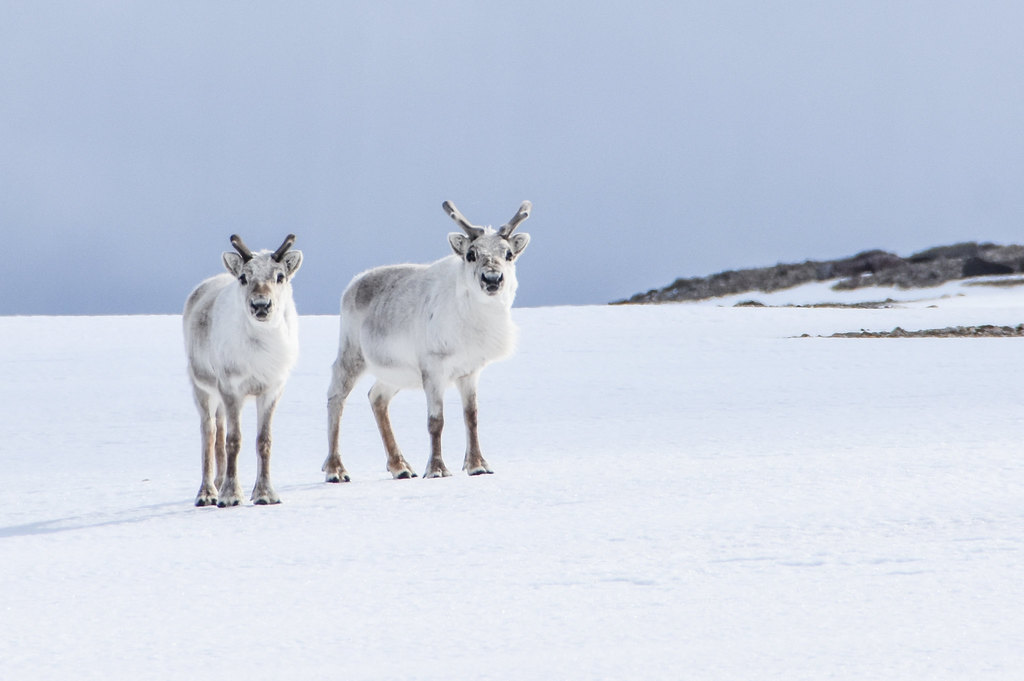
Svalbard reindeer
Photo © Jay Pruett
Photo © Jay Pruett — CC BY 4.0 — Source: iNaturalist photo #196603101The Svalbard reindeer (Rangifer tarandus platyrhynchus) is a small subspecies or species of reindeer found on the Svalbard archipelago of Norway. Males average 65–90 kg (143–198 lb) in weight, females 53–70 kg (117–154 lb), while for other reindeer generally body mass is 159–182 kg (351–401 lb) for males and 80–120 kg (180–260 lb) for females.
The subspecies is endemic to the islands of Svalbard, where it has lived for at least 5,000 years and has become well adapted to the harsh climate, being found on nearly all non-glaciated areas of the archipelago. By 1925 they had almost gone extinct due to over-hunting in the late 19th and early 20th centuries. Over recent decades, their population has increased. Between 1979 and 2013 the Adventdalen population varied between 400 and 1200 individuals – similar in Reindalen. As of 2019, the total population across the archipelago is approximately 22,000. They are the only large grazing mammal in the European High Arctic, and this makes them exceptional for studies concerning the introduction of pollutants to changing ecosystems. During the short Arctic summer, Svalbard reindeer feed on a lush tundra vegetation of vascular plants, including grasses, herbs, sedges and deciduous shrubs in the lowland plains and valleys, to accumulate fat for the winter. The fur of Svalbard reindeer contains elements and chemicals picked up from the vegetation they digest. They are relatively sedentary, and are thus highly vulnerable to changes in local conditions.
Compared to other reindeer, they are short-legged and have a small, rounded head. Their fur is also lighter in color and thicker during winter. The thickness of the coat contributes to the short-legged appearance and makes even starved animals appear fat in the winter. The males develop large antlers during the period from April to July and shed the velvet during August–September. Males lose their antlers in early winter. Females develop antlers starting in June and they are usually retained for a whole year. The expected lifespan of a Svalbard reindeer is around ten years. However, the oldest animal recorded was 17 years of age.
Arctic Ecology and Ecosystem Conservation Tour
South Spitsbergen National Park
Norway
+41 birds+15 mammals
Glaciers and tundra meet in Norway's high Arctic, where South Spitsbergen National Park sprawls across the southernmost reaches of the Svalbard archipelago. Here, massive valley glaciers…
VIEW NATIONAL PARKNorthwest Spitsbergen National Park
Norway
+58 birds+17 mammals
Where the High Arctic converges with the Norwegian mainland, Northwest Spitsbergen National Park sprawls across one of Earth's most extreme and pristine wildernesses. Crowned by jagged…
VIEW NATIONAL PARKNorthern Isfjorden National Park
Norway
+40 birds+12 mammals
Where the Arctic fjord system cuts deep into Svalbard's northwestern coast, Northern Isfjorden National Park protects a landscape of stark geological drama—towering cliff faces, tidewater glaciers,…
VIEW NATIONAL PARKSassen-Bünsow Land National Park
Soere, Norway
+30 birds+10 mammals
Where Arctic tundra sprawls across glaciated plateaus in the remote Svalbard archipelago, a realm of raw geological drama unfolds. Sassen-Bünsow Land National Park encompasses a landscape…
VIEW NATIONAL PARKForlandet National Park
Vera, Norway
+38 birds+12 mammals
Windswept Arctic tundra meets jagged coastal cliffs where the Barents Sea crashes against Norway's northernmost wilderness. This sliver of protected terrain on the Nordkapp Peninsula comprises…
VIEW NATIONAL PARKNo community photos yet. Log in to add the first one.
No community observations of this species yet.