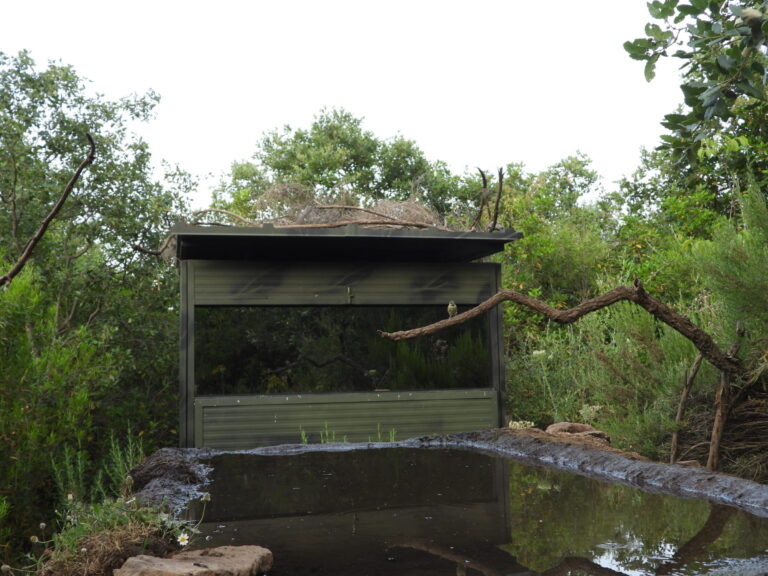
Hide el Venero de los Rabilargos
Great Spotted Woodpecker · Iberian Magpie+33
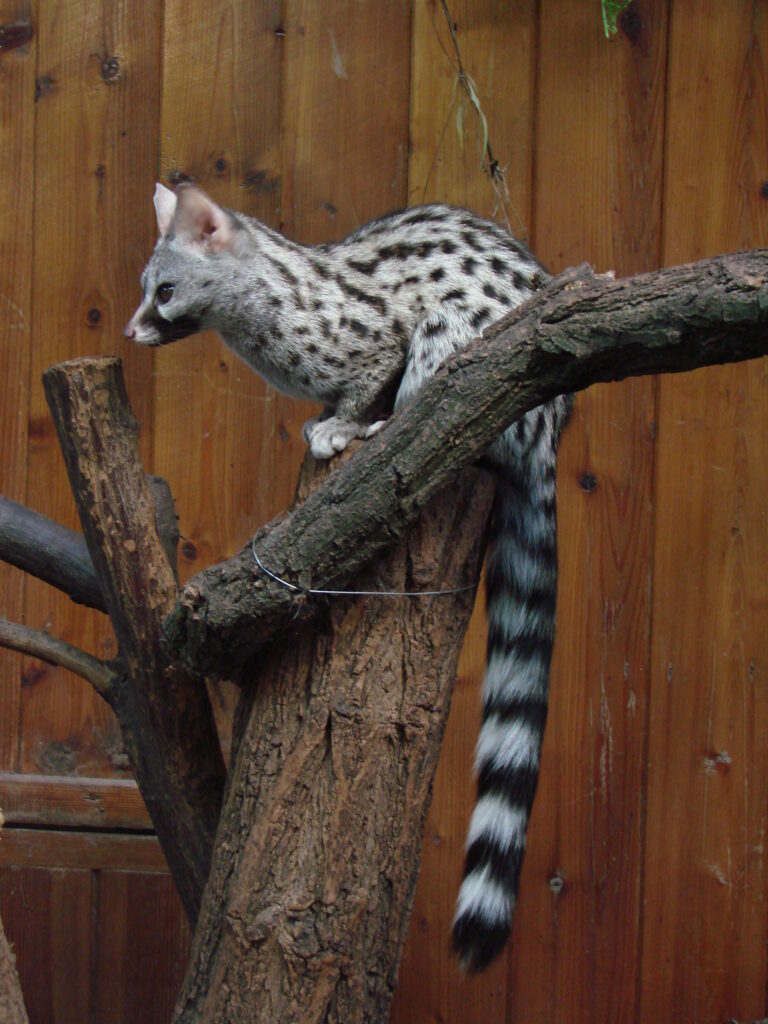
The common genet is a small, slender viverrid with a distinctly cat-like appearance, though it is not a true cat. It has a small head with a pointed muzzle, large oval ears, and large eyes enhanced by well-developed whiskers reaching up to 7 cm in length. The body measures 43 to 55 cm with a tail of 33 to 52 cm, and males average 2 kg and are about 10% larger than females. Short legs with cat-like feet and semi-retractile claws complete the feline resemblance.
The coat is pale grey with distinctive black markings: approximately five rows of black spots run along the back and flanks, while a long black stripe extends along the spine from shoulders to rump. A black stripe marks the forehead, and dark patches appear beneath the eyes, contrasting sharply with white fur on the chin and throat. The striped tail displays eight to thirteen rings, and the animal possesses an erectile crest of hair running from shoulder to tail base, a white tail tip, and black hind feet. Notably, a melanistic individual was recorded in southern Portugal in 2019.
The common genet is widely distributed across Africa, ranging north of the Sahara along the western Mediterranean coast and in a broad band from Senegal and Mauritania through the savannah zone to Somalia and Tanzania. Populations also occur in coastal regions of Saudi Arabia, Yemen, and Oman, and in southern Africa from Angola through Zambia and Zimbabwe to Mozambique. The species is common in Morocco and Algeria but rare in Libya, Egypt, and Zambia. In South Africa, it is common in west-central KwaZulu-Natal, the Cape Province, and QwaQwa National Park in the Free State.
Introduced to southwestern Europe approximately 1,000 to 1,500 years ago, the common genet spread from the Iberian Peninsula to the Balearic Islands and southern France, and has since established populations east of the Rhône river. Recent sightings in Italy's Regional Natural Park of the Ligurian Alps (first recorded in 2008) and the Beigua Natural Regional Park confirm ongoing range expansion. The species prefers dense vegetation including bushes, thickets, and evergreen oak forests, and uses trees with dense canopy foliage and climbing plants as resting sites. It tolerates proximity to human settlements and inhabits rocky terrain, but is rare in open areas and marshes.
The common genet is solitary and primarily nocturnal and crepuscular, showing highest activity levels following sunset and before sunrise, though juveniles may be active during daylight hours. Adults rest during the day in hollow trees or among thickets, often reusing the same sites. Males are more active at night than females due to their larger size and greater energy requirements. Females typically weigh less and maintain smaller home ranges, with females averaging 72 hectares compared to males' mean of 113 hectares. These territorial differences are most pronounced during winter months, and home ranges expand slightly in spring due to increased activity levels.
Travellers seeking the common genet should visit during their active periods around dusk and dawn, though nocturnal observations require patience and appropriate lighting. In Africa, Morocco and Algeria offer the best opportunities, while in Europe, southwestern Spain and southern France provide reliable sightings. In South Africa, west-central KwaZulu-Natal, the Cape Province, and QwaQwa National Park are productive locations. The species favours areas with dense vegetation, rocky terrain, and proximity to forests, so focus on oak and pine forests, scrubland, and riparian zones. Protected areas such as the Dinder–Alatash protected area complex in the East Sudanian Savanna and mountainous regions like Ethiopia's Degua Tembien district offer additional opportunities.
Photographing genets requires patience and preparation for nocturnal wildlife. Plan visits during dusk or dawn when activity peaks, and use a headlamp with a red filter to avoid startling the animal. Position yourself near dense vegetation, thickets, and trees where genets rest and forage. The species' slender frame, striking coat pattern of spots and stripes, and elongated tail provide excellent photographic subjects when properly lit. Use a telephoto lens to maintain distance and allow natural behaviour, and consider setting up near known resting sites or frequently used trails within suitable habitat. The contrast between pale fur and black markings photographs well in both natural and supplementary lighting conditions.
Nothing matches these filters.
Nothing matches these filters.
No community photos yet. Log in to add the first one.
No community observations of this species yet.
We'd love to hear from you. We'll reply as soon as possible.
Found an error? Have a suggestion? We read every message.
A compact view of how this species lives, moves and responds to its environment.
Select a card to explore the details.
Please confirm the photo rights and credit terms first.
I'm the author of this photo or hold the rights to it, and I keep full ownership. I grant Wild Atlas Guide a free, non-exclusive licence to display it on the site and in Wild Atlas Guide's own channels, including social media, always credited to me by my display name or the Instagram handle I choose to provide. I confirm it does not reveal a sensitive wildlife location or a recognisable person without their permission. I can withdraw future social use for this photo or ask for it to be removed at any time.
Please accept the photo rights and credit terms to continue.
Uploading…
We use cookies to measure traffic and improve Wild Atlas Guide. You decide. Privacy policy