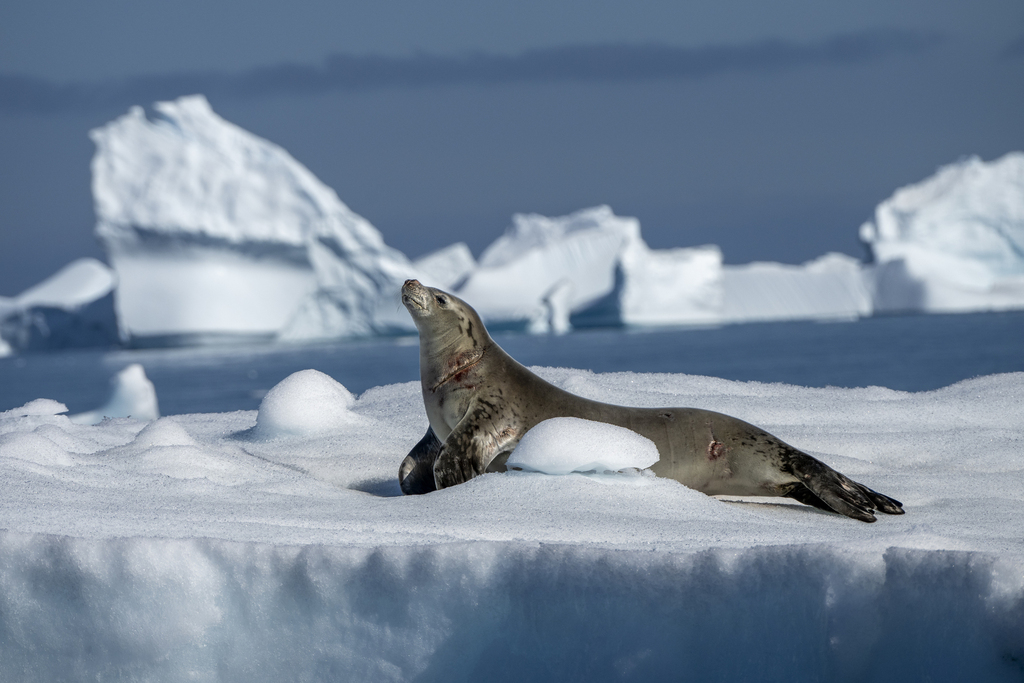
Crabeater Seal
Photo © Charlotte Kirchner
Photo © Charlotte Kirchner — CC BY 4.0 — Source: iNaturalist photo #465730923Identification
The crabeater seal is a medium- to large-sized seal, with adults typically measuring over 2 metres in length and weighing around 200 kilograms. Females are slightly larger than males, averaging 6 centimetres longer and about 8 kilograms heavier. Their bodies are comparatively slender compared to other seal species, with pointed snouts and long skulls. Most crabeater seals are covered in brown or silver fur, with darker coloration around the flippers. The colour varies seasonally: recently moulted seals appear darker, while those about to moult are silvery-white. Younger animals display distinctive net-like, chocolate-brown markings on the shoulders, sides and flanks, often bearing scars from leopard seal attacks. After moulting, their fur becomes a darker brown, fading to blonde on the belly and lightening further throughout the year until summer, when they appear almost completely blonde.
The crabeater seal's most distinctive feature is its unique dentition. The postcanine teeth are finely divided with multiple cusps, and together with the tight fit of the upper and lower jaw and a bony protuberance near the back of the mouth, they create a near-perfect sieve for filtering their small crustacean prey. Adult seals often bear visible scarring around the flippers from leopard seal predation, while males may show additional scars on the throat and jaw from breeding-season fights with rivals.
Range & Habitat
Crabeater seals have a continuous circumpolar distribution surrounding Antarctica and are found primarily on the free-floating pack ice that extends seasonally from the Antarctic coast. They spend the entire year within the pack ice zone as it advances and retreats with the seasons, remaining primarily within the continental shelf area in waters less than 600 metres deep. Occasional sightings and strandings occur on the extreme southern coasts of Argentina, South Africa, Australia and New Zealand, but these are rare. The population is genetically well-mixed with no evidence of subspecies separations.
Pack ice serves as a critical platform for these seals, providing resting places, mating grounds, and social aggregation sites, as well as access to their primary prey. The species colonized Antarctica during the late Miocene or early Pliocene, between 15 and 25 million years ago, when the region was considerably warmer than today.
Behaviour & Diet
Crabeater seals are highly specialized krill predators, feeding almost exclusively on Antarctic krill from the Southern Ocean. Despite their common name, they do not eat crabs—the misleading name derives from a historical translation error. Their evolutionary success is entirely dependent on their uniquely adapted sieve-like tooth structure, which allows them to filter vast quantities of these small crustaceans from the water. This specialization has made them the most abundant seal species in the world.
On ice, crabeater seals can raise their heads and arch their backs, and they are capable of moving quickly when not subject to overheating. These seals exhibit notable scarring patterns that reflect the challenges of their environment: attack scars from leopard seals around the flippers are common, and breeding males bear additional scarring from fierce competition with rivals during the mating season. Despite their abundance as predators, crabeater seal pups form an important component of the diet of leopard seals, their larger Antarctic cousins.
Best Time & Places to See It
Crabeater seals are found year-round within the Antarctic pack ice zone, though their precise location shifts seasonally as the ice advances and retreats. They are by far the most abundant seal species in the world, with population estimates ranging from at least 7 million to possibly as many as 75 million individuals, making encounters relatively likely for those visiting Antarctic waters and pack ice regions. The continental shelf areas in waters less than 600 metres deep offer the best viewing opportunities.
While crabeater seals have a continuous circumpolar distribution around Antarctica, they occasionally appear on the southern coasts of Argentina, South Africa, Australia and New Zealand, though such sightings are rare and unpredictable.
Photography Tips
Photographers should focus on capturing the seals' distinctive pale coloration and slender profile, which differ markedly from other seal species. The seasonal colour variation provides different photographic opportunities: the darker appearance of recently moulted seals contrasts dramatically with the silvery-white animals approaching their moult, and the progressive lightening through summer offers varied aesthetic possibilities. Seek out younger animals to photograph the striking net-like, chocolate-brown markings on the shoulders and flanks.
The scarring patterns visible on many individuals—particularly the leopard seal attack scars around the flippers and breeding-season combat scars on males—tell compelling stories and make worthwhile compositional elements. Capture seals with their heads raised and backs arched on the ice, a characteristic posture that showcases their slender build. The pointed snout and long skull are also identifying features worth emphasizing in close-up shots.
Deception Island
Gabriel de Castilla Base, Antarctica
+26 birds+10 mammals
Steaming geothermal vents pierce a landscape of blackened volcanic sand and ice, where the earth's raw power still trembles beneath your feet. This horseshoe-shaped caldera, flooded…
VIEW ISLAND & ARCHIPELAGOCuverville Island
Cuverville Island, Antarctica
+19 birds+10 mammals
Granite peaks and sculpted ice define this windswept archipelago off the Antarctic Peninsula, where steep rocky shores plunge into waters thick with drifting brash ice. Cuverville…
VIEW ISLAND & ARCHIPELAGONeko Harbour
Neko Harbour, Antarctica
+18 birds+10 mammals
Towering peaks of fractured ice rise abruptly from gunmetal waters, their faces scarred by millennia of glacial advance and retreat. This pocket of the Antarctic Peninsula…
VIEW PROTECTED LANDSCAPEParadise Bay
Brown Station, Antarctica
+18 birds+9 mammals
Where the Antarctic Peninsula's rugged coastline meets the Southern Ocean, Brown Station stands sentinel over Paradise Bay—a protected landscape of ice-carved inlets, towering glacial faces, and…
VIEW PROTECTED LANDSCAPEBrown Bluff
Brown Bluff, Antarctica
+23 birds+9 mammals
Where rust-colored volcanic peaks pierce the Antarctic Peninsula's icy realm, a geologist's dreamscape unfolds beneath towering cliffs of iron oxide and ancient lava. Brown Bluff rises…
VIEW PROTECTED LANDSCAPEPort Lockroy
Port Lockroy, Antarctica
+19 birds+9 mammals
Towering peaks of black rock pierce through Antarctic pack ice on the Gerlache Strait, where one of the continent's most accessible harbors cradles a living microcosm…
VIEW PROTECTED LANDSCAPEHalf Moon Island
Cámara Base, Antarctica
+25 birds+8 mammals
Jagged volcanic peaks rise from the cobalt waters of the South Shetland Islands, their slopes carpeted in moss and lichen where hardy vegetation clings to windswept…
VIEW ISLAND & ARCHIPELAGOPetermann Island
Petermann Island, Antarctica
+16 birds+9 mammals
Icebound cliffs rise dramatically from the Bellingshausen Sea, their weathered faces sculpted by millennia of Antarctic wind and tide. This slender wedge of rock and ice,…
VIEW ISLAND & ARCHIPELAGOPaulet Island
Paulet Island, Antarctica
+20 birds+6 mammals
Windswept ice and weathered rock converge at this remote Antarctic outcrop, where jagged peaks pierce through perpetual pack ice and glacial moraines descend toward cobalt waters.…
VIEW ISLAND & ARCHIPELAGODanco Island
Danco Island, Antarctica
+17 birds+10 mammals
Dramatic black rock pierces the Antarctic Peninsula's icy waters, crowned with permanent snow and ringed by calving glaciers that thunder into the sea. This volcanic outcrop…
VIEW ISLAND & ARCHIPELAGOWilhelmina Bay
Wilhelmina Bay, Antarctica
+20 birds+10 mammals
Sheer cliffs of black volcanic rock plunge into waters so pristine they reflect the Antarctic sky like polished obsidian. This remote western Antarctic inlet, ringed by…
VIEW PROTECTED LANDSCAPELemaire Channel
Orne Harbour, Antarctica
+25 birds+13 mammals
Where granite peaks plunge into steel-grey waters, the Lemaire Channel carves one of Antarctica's most dramatic passages. This narrow strait, squeezed between the Antarctic Peninsula and…
VIEW PROTECTED LANDSCAPENo community photos yet. Log in to add the first one.
No community observations of this species yet.