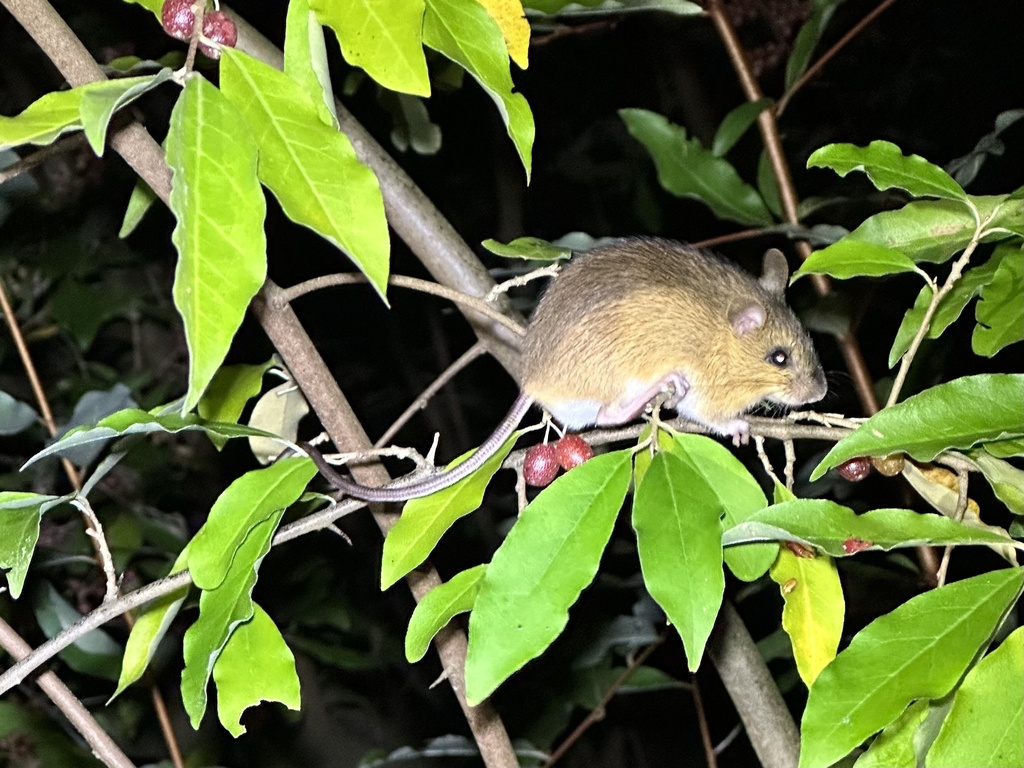
Eastern Woodland Jumping Mouse
Photo © brendanboyd
Photo © brendanboyd — CC BY 4.0 — Source: iNaturalist photo #573270999Identification
The woodland jumping mouse is a medium-sized rodent with distinctive adaptations for leaping. Its most striking feature is its extremely long tail, which comprises approximately 60% of its total body length and is dark brown above with a creamy white underside and white tip. The tail is sparsely haired, thin, and scaly. The mouse has small, high-crowned skulls with orange or yellow grooved incisors, three molariform teeth, and notably absent premolars. Its coloration tends to be darker in southern populations. Long hind legs and feet provide the powerful musculature necessary for its remarkable jumping ability—up to 1 meter (3 feet 3 inches) in a single bound.
The species exhibits anatomical specializations for cold climates. Its hypsodont (high-crowned) molars are both rooted, and its long vertebrae and leg bones are specifically adapted for the explosive locomotion that defines this genus within the jumping mouse family Zapodidae.
Range & Habitat
The woodland jumping mouse occurs throughout northeastern North America, with five recognized subspecies distributed across New Brunswick, Ontario, Quebec, North Carolina, eastern Wisconsin, and Michigan. The nominate subspecies and the North Carolina population are collectively termed the eastern woodland jumping mouse.
Populations reach their highest densities in cool, moist boreal woodlands dominated by spruce-fir and hemlock-hardwood forests. The mice favor locations where streams flow from woodlands into meadows rich with touch-me-not plants (Impatiens), and areas where forest and meadow intermix. Suitable habitat must provide abundant water sources and dense ground cover.
Behaviour & Diet
Woodland jumping mice are largely solitary but surprisingly tolerant of one another in captivity, displaying little aggression. They are predominantly silent animals, though young mice squeak and make suckling sounds shortly after birth, and adults produce soft clucking sounds while sleeping and before hibernation. Communication between mates and between mothers and young likely involves tactile contact and chemical signals that convey individual identity and reproductive status.
Diet varies by geography and season. Studies of New York populations revealed that fungi (particularly Endogone species, located by olfaction) comprise about one-third of their diet, with seeds contributing 25%, lepidopterous larvae and fruits around 10%, and beetles approximately 7.5%. Touch-me-not seeds feature prominently in their diet. Summer represents peak activity, coinciding with mating and intensive feeding to restore body weight after hibernation. Most mice enter hibernation by late November, during which body temperature drops dramatically from 37°C to around 2°C (99°F to 36°F). Remarkably, even during hibernation they wake approximately every two weeks to urinate or consume stored food. Sadly, only about one-third of hibernating mice survive to spring, with the remainder succumbing to hypothermia or predation. Surviving mice typically re-emerge around April.
Best Time & Places to See It
Summer is the optimal season for observing woodland jumping mice, when activity peaks and they are actively foraging and mating. Target cool, moist boreal forest habitats where spruce-fir or hemlock-hardwood stands border meadows, particularly near flowing streams and areas with dense touch-me-not vegetation. The interface between forest and open meadow, where water and thick ground cover are available, offers the best chances for encounters.
However, observing these mice in the wild remains challenging due to their elusive nocturnal nature and difficult terrain. Early morning or evening hours in suitable habitat during summer months offer the highest probability of sightings.
Photography Tips
Capturing images of woodland jumping mice demands patience and specialized equipment. Their exceptional jumping ability and nocturnal habits mean that observation typically requires night-vision or thermal imaging capabilities. Position yourself near meadow-forest transitions during summer evenings, particularly near water sources and dense vegetation where mice are most active.
Use remote camera traps set at burrow entrances or along established pathways in suitable habitat. Their distinctive long tail and powerful hind legs are key identifying features worth emphasizing in photographs. The contrast between the dark upper tail and creamy underside is particularly photogenic when well-lit. Given the difficulty of field observation, captive or semi-captive photography may be necessary to capture satisfactory images of this elusive woodland resident.
Algonquin Provincial Park
Cape Breton Highlands National Park
Fundy National Park of Canada
Grands-Jardins National Park
Great Smoky Mountains National Park
Nothing matches these filters.
No community photos yet. Log in to add the first one.
No community observations of this species yet.