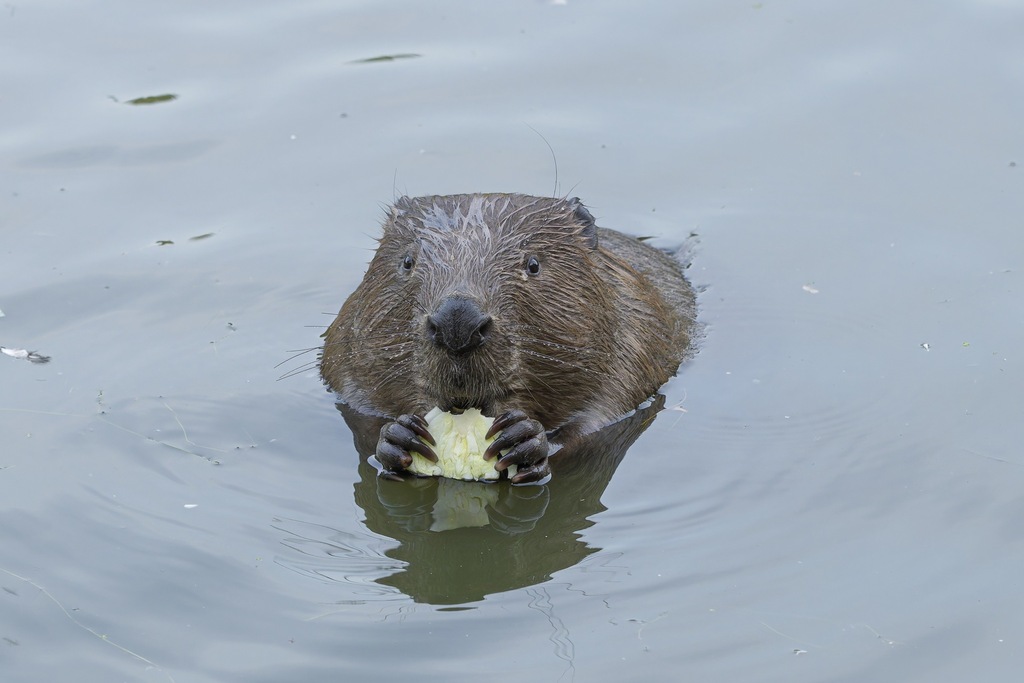
Eurasian Beaver
Photo © holycrab
Photo © holycrab — CC BY 4.0 — Source: iNaturalist photo #518691412Identification
The Eurasian beaver is one of the largest living rodent species and the largest rodent native to Eurasia. Adults measure 80–100 cm in head-to-body length with a 25–50 cm tail, weighing 11–30 kg on average, making them the world's second heaviest rodent after the capybara. Fur colour varies regionally: 66% of individuals are beige or pale brown, 20% reddish brown, 8% brown, and 4% blackish. In Belarus, light chestnut-rust tones dominate, while Russian populations display predominantly blackish-brown or mixed colouration. The Eurasian beaver differs genetically from the North American beaver (48 chromosomes versus 40), with guard hairs featuring longer hollow medullae at their tips.
Range & Habitat
Once hunted to near-extinction with only approximately 1,200 individuals remaining in eight relict populations in the early 20th century, the Eurasian beaver has undergone a remarkable recovery. The species now inhabits Western, Southern, Central and Eastern Europe, Scandinavia, Russia through China and Mongolia, with approximately half the global population in Russia. It lives across nearly all continental European countries from Spain and France westward to Russia and Moldova eastward, and from Scandinavia to the Balkans, with notable recent range expansion into Portugal. The species is absent only from southern Balkan regions and European microstates. About 1.5 million individuals existed by 2020.
Behaviour & Diet
Eurasian beavers are monogamous animals that select mates genetically different from themselves, contributing to their remarkable ability to recover from extremely small founding populations—as few as three individuals. This genetic flexibility, combined with their mating behaviour, enabled their survival through the bottleneck of near-extinction and underpinned successful reintroduction programmes across their former range.
Best Time & Places to See It
Reintroduction and protection programmes have been highly successful across continental Europe. Prime regions include the river systems of Spain (Ebro, Zadorra, Arga, Huerva, and Jalón rivers), Scandinavia, and throughout Central and Eastern Europe. Russia and the former Soviet Union host approximately 83% of the species' population, offering the highest probability of encounters. Recent sightings in Portugal indicate ongoing range expansion.
Photography Tips
Beavers are most active during dawn and dusk hours. Approach slowly and quietly along riverbanks and wetland edges where these rodents are most likely to be foraging or engaged in dam-building activities. The variation in coat colour across populations and regions provides excellent photographic opportunities to document regional differences. Early morning light is ideal for capturing the distinctive fur texture and colour variations that characterise this recovering species.
Aggtelek National Park
Alpilles Regional Nature Park
Avesnois Regional Nature Park
Baronnies Provençales Regional Nature Park
Bavarian Forest National Park
Białowieża National Park
Biebrza National Park
Bieszczady National Park
Camargue Regional Nature Park
Nothing matches these filters.
No community photos yet. Log in to add the first one.
No community observations of this species yet.