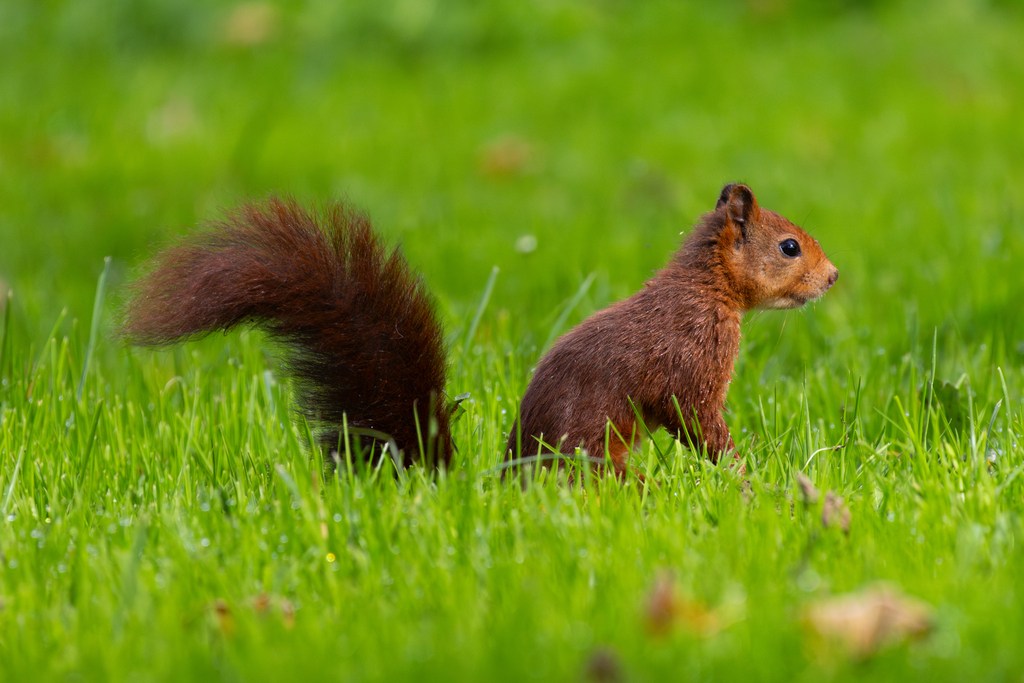
Eurasian Red Squirrel
Photo © Diego González Dopico
Photo © Diego González Dopico — CC BY 4.0 — Source: iNaturalist photo #442125320Identification
The Eurasian red squirrel is a small tree squirrel with a typical head-and-body length of 19 to 23 cm and a tail of 15 to 20 cm, weighing between 250 and 340 g. Males and females are identical in size. The species is instantly recognizable by its distinctive ear-tufts, which are particularly prominent in winter when the animal sheds its thinner summer coat for a thicker, darker winter coat between August and November. The underside is always white-cream in colour.
Coat colour is highly variable and represents one of the species' most striking features. Red coats are most common in Great Britain, but across Europe and Asia, coat colours range through reddish-brown, brown, bright chestnut, grey, black, and bluish. Different colour morphs often coexist within the same population, with melanism common in continental, boreal, and montane populations but rare in the British Isles. The long, bushy tail aids balance and steering during leaps between trees and helps regulate body temperature during sleep.
Range & Habitat
The red squirrel is common throughout Eurasia, inhabiting both coniferous forests and temperate broadleaf woodlands. Populations are densest in large areas of coniferous forest, with secondary densities in mixed forests, deciduous forests, and parklands. In northern Europe and Siberia, they prefer boreal coniferous woods of Scots pine, Norway spruce, and Siberian pine. In western and southern Europe, they favour broad-leaved woods where a mixture of tree and shrub species provides reliable year-round food sources. They also adapt well to suburban areas and conifer plantations.
Unfortunately, red squirrel populations have declined significantly in Great Britain, Ireland, and Italy in recent years, primarily due to competition with introduced eastern grey squirrels from North America. However, the population in Scotland is stabilising thanks to active conservation efforts.
Behaviour & Diet
The red squirrel is diurnal and primarily herbivorous, becoming active at sunrise and continuing throughout the day. As a fully arboreal species, it is superbly adapted for life in the trees, with a skeleton specially modified for climbing and leaping. Its relatively light bones contrast with disproportionately long and heavy hind legs, enabling powerful jumping from tree to tree. The long tail plays a crucial role in these acrobatic movements, providing balance and steering during leaps and rapid branch traversals.
Beyond its athletic prowess, the tail also serves important social functions, being used to signal and communicate with other squirrels during social interactions.
Best Time & Places to See It
Red squirrels are active throughout daylight hours, making daytime visits to suitable habitat most rewarding. Coniferous and mixed woodlands offer the best viewing opportunities, particularly in areas where populations remain healthy. Scotland's stabilising population makes it an increasingly reliable destination for observing this species, while continental European boreal forests and Siberian coniferous woods support healthy populations. Suburban parks and gardens with mature trees may also yield sightings, though success varies by region.
Photography Tips
The red squirrel's prominent ear-tufts and variable coat colours make it a visually compelling subject, particularly in winter when the ear-tufts are most pronounced. Early morning light is ideal for capturing the subtle colour variations across different subspecies and geographic populations. The squirrel's arboreal nature means photographing it among branches and foliage; patience and positioning yourself near productive feeding areas will improve your chances of clean shots. The long, bushy tail is a defining feature worth emphasising in composition, as it captures the animal's graceful movements through the canopy.
Abruzzo, Lazio and Molise National Park
Aggtelek National Park
Alpilles Regional Nature Park
Appennino Tosco-Emiliano National Park
Åsnens National Park
Avesnois Regional Nature Park
Baikal National Park
Baronnies Provençales Regional Nature Park
Bavarian Forest National Park
Nothing matches these filters.
No community photos yet. Log in to add the first one.
No community observations of this species yet.