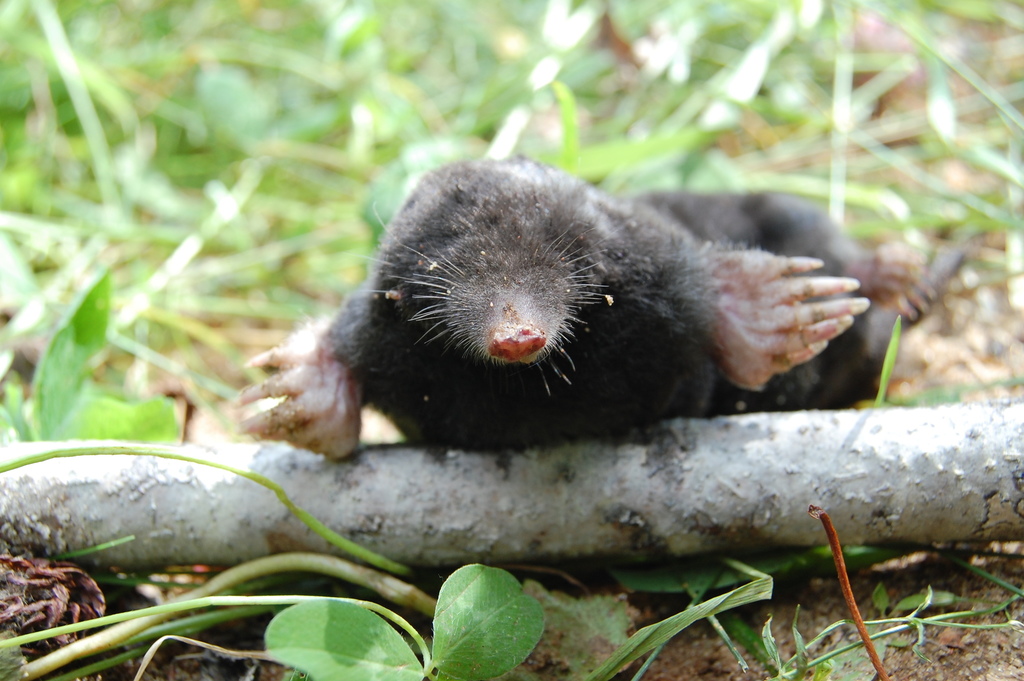
European Mole
Photo © Natalya Ivanova
Photo © Natalya Ivanova — CC BY 4.0 — Source: iNaturalist photo #48241320Identification
The European mole is a small, cylindrical mammal measuring 11 to 16 cm in length and weighing 70 to 130 grams, with females typically smaller than males. Its most distinctive features are its streamlined body adapted for tunnelling, tiny eyes (just 1 mm in diameter) hidden beneath fur, and ears that appear only as small ridges in the skin. Despite popular belief, European moles do possess vision and can detect light and movement. Their fur is usually dark grey, though individuals with white, light grey, tan, taupe, and black fur have all been recorded—a variation tolerated because their subterranean lifestyle means coat colour offers no survival advantage.
Range & Habitat
The European mole has a wide distribution across Europe and western Asia, ranging from the United Kingdom and southern Scandinavia in the north to northern Greece in the south, and extending east to western Siberia. An estimated 35 to 40 million moles inhabit the UK alone. While primarily subterranean, European moles are not exclusively underground dwellers. Young moles dispersing in spring and early summer must leave their natal burrows to establish new territories, forcing them above ground. In summer, moles tend to burrow more superficially, possibly due to hardened soil. They favour areas adjacent to drainage lines and streams but avoid flooded or permanently dry soils. Critically, earthworm abundance is the primary factor determining local mole populations; soil type, vegetation, and altitude have minimal influence on habitat selection.
Behaviour & Diet
European moles are remarkable engineers, constantly extending their tunnel systems which serve as both home and hunting grounds. Their saliva contains toxins that paralyse earthworms, their preferred prey. Despite the common belief that moles consume their body weight daily, studies show they actually eat approximately half their body weight in food each day. While captive moles accept diverse diets including liver, mice, mealworms, shrews, and maggots, wild moles show a clear preference for earthworms. In areas with fewer earthworms, insects—both larval and adult forms—comprise the main diet, supplemented by centipedes and small mammals including rodents and other moles.
Best Time & Places to See It
European moles are most visible during spring and early summer when young moles disperse from their mothers' burrows in search of new territories. This is when you're most likely to observe them above ground. Look for characteristic molehills, the displaced earth pushed to the surface as moles extend their tunnel systems. These mounds are your best indicator of mole presence in suitable habitat. In urban and rural greenspace, moles favour areas with good earthworm populations near streams and drainage lines. In suitable habitats, an area of 10 hectares is required to support a persistent mole population.
Photography Tips
Photographing European moles presents unique challenges due to their cryptic, subterranean nature. Focus on capturing evidence of their presence rather than the animals themselves: photograph molehills in characteristic landscapes, or capture the texture of disturbed soil patterns that reveal tunnel systems. Early morning light can beautifully illuminate fresh molehills. If you encounter a mole above ground during dispersal season, use a fast shutter speed and stable positioning, as these small mammals move quickly. Macro photography of their distinctive features—the powerful forelimbs, tiny eyes, and smooth fur—can be achieved with careful handling in appropriate circumstances. Remember that moles have photopic vision and will withdraw from bright flashlight beams, so use natural light whenever possible.
Aggtelek National Park
Alpilles Regional Nature Park
Avesnois Regional Nature Park
Bannau Brycheiniog National Park
Bavarian Forest National Park
Belluno Dolomites National Park
Białowieża National Park
Biebrza National Park
Bieszczady National Park
Nothing matches these filters.
No community photos yet. Log in to add the first one.
No community observations of this species yet.