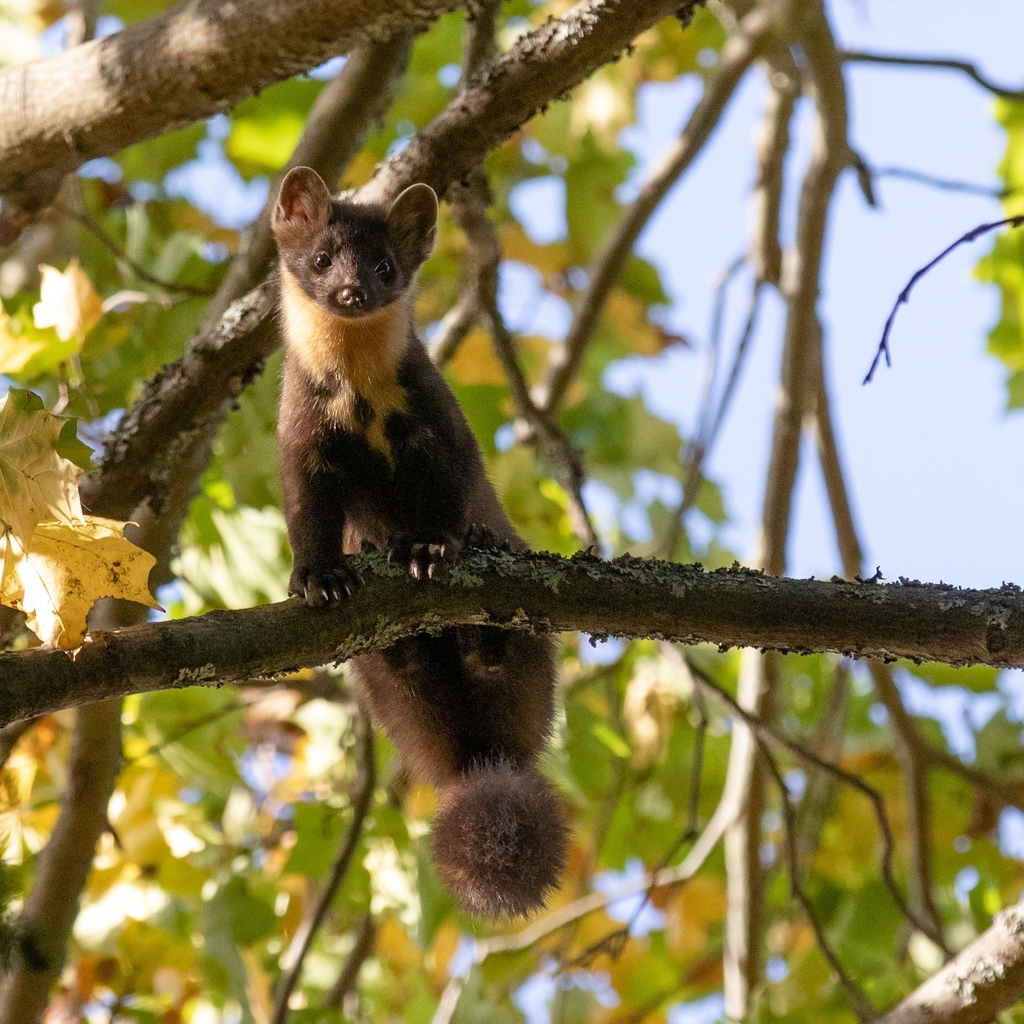
European Pine Marten
Photo © Vova Jd
Photo © Vova Jd — CC BY-SA 4.0 — Source: iNaturalist photo #431724850Identification
The European pine marten is a slender mustelid with light to dark brown fur that changes seasonally—short and coarse in summer, becoming longer and silkier in winter. A distinctive cream- to yellow-coloured bib marking adorns its throat. Adults measure up to 53 cm in body length with a bushy tail of about 25 cm, weighing around 1.5–1.7 kg, with males slightly larger than females. The species possesses excellent senses of sight, smell, and hearing.
Range & Habitat
Native to most of Europe, Asia Minor, the Caucasus, and parts of Iran, Iraq, and Syria, the European pine marten has experienced dramatic range expansion in Britain and Ireland over recent decades. In Scotland, it has spread from the northwestern Highlands into Sutherland, Caithness, and southeastern regions including Moray, Aberdeenshire, and Perthshire, with populations on islands such as Skye and Mull. England has seen remarkable recovery, with confirmed sightings in Shropshire, Yorkshire, Northumberland, the New Forest, and even London. Wales hosts a recovering population, particularly in mid-Wales, while in Ireland populations are concentrated in the west and south, especially the Burren and Killarney National Park, though the Midlands population is expanding significantly.
Behaviour & Diet
The European pine marten is the only mustelid with semiretractable claws, making it uniquely adapted for arboreal life—climbing and running through tree branches with agility despite also being relatively quick on the ground. Primarily nocturnal and crepuscular, it hunts small mammals, birds, insects, frogs, and carrion, supplementing its diet with berries, fruits, bird eggs, nuts, and honey. The species is territorial, marking its home range with distinctive black, twisted scat. In Ireland, pine martens have proven instrumental in controlling invasive grey squirrel populations, allowing native red squirrels to recover in areas where their ranges overlap.
Best Time & Places to See It
Evening and night hours offer the best viewing opportunities. In Scotland, the core range in the Highlands and expanding populations in Perthshire, Tayside, and the islands of Skye and Mull are most reliable. In England, the New Forest, Forest of Dean, Grizedale Forest in Cumbria, and woodlands of Shropshire offer increasing chances. Welsh visitors should explore mid-Wales forests, while Irish naturalists should focus on the Burren and Killarney National Park, with growing opportunities in the Midlands.
Photography Tips
Night vision and camera traps are essential given the species' nocturnal habits. Remote-triggered cameras placed near den sites or along regular pathways yield the best results. The marten's arboreal nature means positioning cameras on trees at various heights increases success. Look for activity around dusk and throughout the night. Patient, long-term camera placement in known marten territories, combined with understanding their territorial marking behaviour, offers the best chance of capturing images of this elusive mustelid.
Alpilles Regional Nature Park
Avesnois Regional Nature Park
Bannau Brycheiniog National Park
Baronnies Provençales Regional Nature Park
Bavarian Forest National Park
Beinn Eighe National Nature Reserve
Białowieża National Park
Biebrza National Park
Boucles de la Seine Normande Regional Nature Park
Nothing matches these filters.
No community photos yet. Log in to add the first one.
No community observations of this species yet.