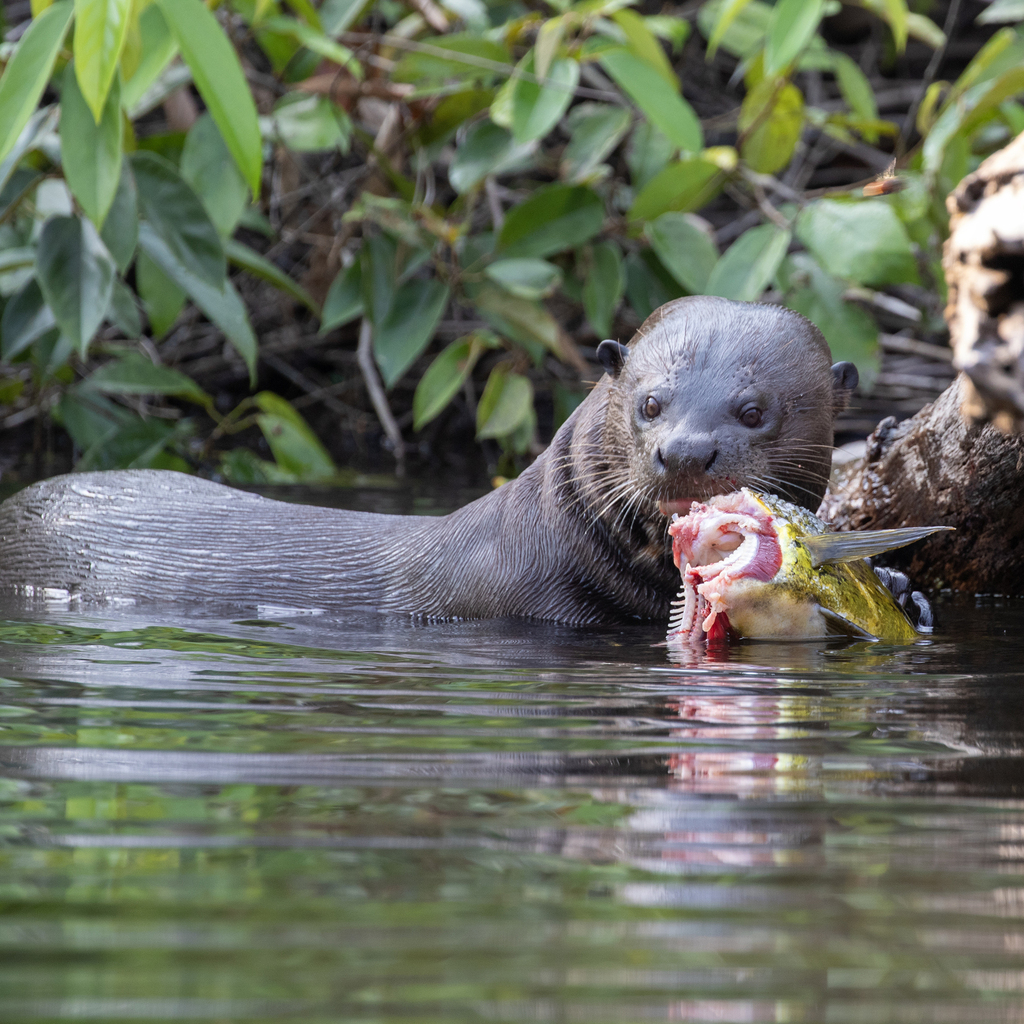
Giant Otter
Photo © Dan Vickers
Photo © Dan Vickers — CC BY 4.0 — Source: iNaturalist photo #460766069Identification
The giant otter is the longest member of the weasel family, reaching up to 1.8 m (5 ft 11 in). Unlike most mustelids, this is a highly social species with distinctive adaptations for aquatic life: exceptionally dense fur, a characteristic wing-like tail, and webbed feet. Its streamlined body and powerful tail make it unmistakable in the water. The giant otter is the noisiest otter species, producing distinct vocalizations that communicate alarm, aggression, and reassurance—a useful identification feature even when the animal itself is not visible.
Range & Habitat
The giant otter ranges across north-central South America, living mostly in and along the Amazon River and in the Pantanal. The Guianas represent one of the last strongholds for this species, while modest but well-protected populations exist in the Peruvian Amazonian basin. The species prefers freshwater rivers and streams that are usually seasonally flooded, though it also inhabits freshwater lakes and springs. It constructs extensive campsites near feeding areas, clearing large amounts of vegetation. Once distributed across a vast range, the species' distribution is now greatly reduced and discontinuous, making it one of the most endangered mammals in the Neotropics.
Behaviour & Diet
Atypical of mustelids, the giant otter is highly social, with family groups typically comprising three to eight members centered on a dominant breeding pair. These groups are extremely cohesive and cooperative. The species is diurnal, active exclusively during daylight hours. Although generally peaceful, giant otters are territorial, and aggression between groups has been documented. Their diet consists almost exclusively of fish, particularly characins and catfish, though they may also consume crabs, turtles, snakes, and small caimans. Humans are their only serious natural predators, though they must compete with Neotropical otters and various crocodilian species for food resources.
Best Time & Places to See It
The Guianas offer some of the most reliable opportunities to encounter giant otters in their natural habitat. The Peruvian Amazonian basin also provides good chances with significant legal protection in place. Look for them during daylight hours along river systems and seasonally flooded streams within the Amazon and Pantanal regions. Their loud, distinctive vocalizations often betray their presence before visual sighting. Early morning is typically productive for observation, when family groups are most active along their established campsites near feeding areas.
Photography Tips
The giant otter's social nature and diurnal activity make it rewarding for photography when located. Position yourself along rivers and streams during early morning light when groups are most active. The distinctive wing-like tail and dense fur provide excellent detail opportunities. Patience is essential—wait quietly near known feeding areas and campsites. Capturing the animals' characteristic vocalizations in behavior, such as alertness displays or group interactions, tells compelling stories. Wide-angle shots showcasing family groups in their aquatic habitat convey the species' social and behavioral uniqueness. Note that this is an endangered species; prioritize observation ethics and maintain appropriate distance to avoid disturbing these vulnerable populations.
Bahuaja Sonene National Park
Encontro das Águas State Park
French Guiana Amazonian Park
Guirá State Park
Jaú National Park
Manu National Park
Natural la Paya National Park
Pantanal Matogrossense National Park
Rio Negro Pantanal State Park
Nothing matches these filters.
No community photos yet. Log in to add the first one.
No community observations of this species yet.