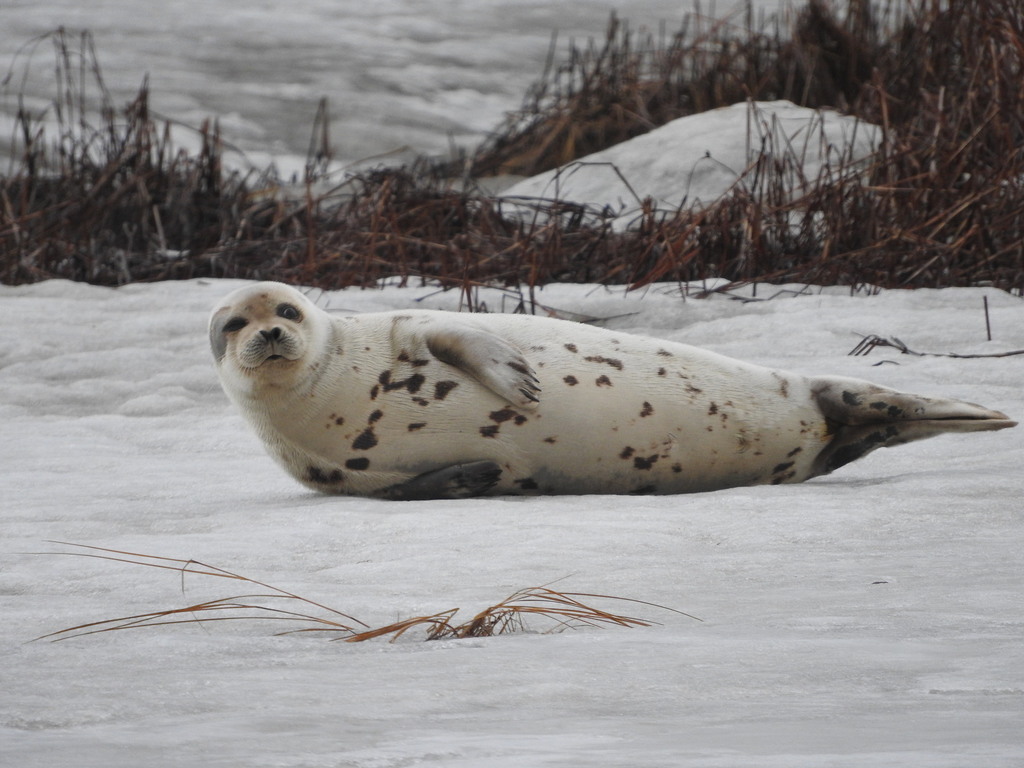
The harp seal (Pagophilus groenlandicus), also known as the saddleback seal or Greenland seal, is a species of earless seal, or true seal, native to the northernmost Atlantic Ocean and Arctic Ocean. Originally in the genus Phoca with a number of other species, it was reclassified into the monotypic genus Pagophilus in 1844. In Greek, its scientific name translates to "Greenlandic ice-lover", and its taxonomic synonym, Phoca groenlandica translates to "Greenlandic seal". == Description == The mature harp seal has pure black eyes. It has a silver-grey fur covering its body, with black harp- or wishbone-shaped markings dorsally, accounting for its common name. Adult harp seals grow to be 1.7 to 2.0 m (5 ft 7 in to 6 ft 7 in) long and weigh from 115 to 140 kg (254 to 309 lb). The harp seal pup has a white coat for the first 2–3 weeks until the first moult, when it is replaced by a black-dotted silver to grey coat. Pups acquire their characteristic pattern once they near sexual maturity. In males, the transition to the harp-pattern tends to be abrupt, while in females it may be gradual and span years. Some females may never lose all their…
South Spitsbergen National Park
Norway
+41 birds+15 mammals
Glaciers and tundra meet in Norway's high Arctic, where South Spitsbergen National Park sprawls across the southernmost reaches of the Svalbard archipelago. Here, massive valley glaciers…
VIEW NATIONAL PARKNorthwest Spitsbergen National Park
Norway
+58 birds+17 mammals
Where the High Arctic converges with the Norwegian mainland, Northwest Spitsbergen National Park sprawls across one of Earth's most extreme and pristine wildernesses. Crowned by jagged…
VIEW NATIONAL PARKNorthern Isfjorden National Park
Norway
+40 birds+12 mammals
Where the Arctic fjord system cuts deep into Svalbard's northwestern coast, Northern Isfjorden National Park protects a landscape of stark geological drama—towering cliff faces, tidewater glaciers,…
VIEW NATIONAL PARKGros Morne National Park
Canada
+180 birds+19 mammals
Where glacier-carved fjords pierce the interior of Newfoundland, Gros Morne National Park unfolds across nearly four thousand square kilometres of some of Canada's most dramatic coastal…
VIEW NATIONAL PARKForillon National Park
Gaspé, Canada
+258 birds+16 mammals
Where the Gaspésie Peninsula juts into the Gulf of Saint Lawrence, granite cliffs and coastal headlands frame one of eastern Canada's most dramatic marine-terrestrial boundaries. Forillon…
VIEW NATIONAL PARKSassen-Bünsow Land National Park
Soere, Norway
+30 birds+10 mammals
Where Arctic tundra sprawls across glaciated plateaus in the remote Svalbard archipelago, a realm of raw geological drama unfolds. Sassen-Bünsow Land National Park encompasses a landscape…
VIEW NATIONAL PARKDisko Bay
Kitsissuarsuit, Greenland
+46 birds+9 mammals
Where Arctic fjords carve deep into Greenland's western coast, Disko Bay creates a protected landscape of extraordinary ecological complexity. The waters here merge temperate Atlantic currents…
VIEW PROTECTED LANDSCAPENuuk Fjord System
Nuuk, Greenland
+54 birds+3 mammals
Where granite peaks plunge directly into the Arctic Ocean, a labyrinth of deep fjords carves through Greenland's southwestern coast, their waters eternally shadowed by towering rock…
VIEW PROTECTED LANDSCAPENo community photos yet. Log in to add the first one.
No community observations of this species yet.